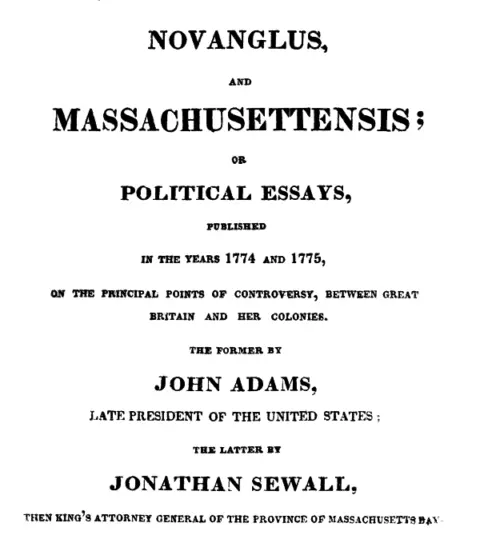
Novanglus, and Massachusettensis or, Political Essays, Published in the Years 1774 and 1775, on the Principal Points of Controversy, between Great Britain and Her Colonies
A stronger proof cannot be wished, of the scandalous license of the tory presses, than the swarms of pamphlets and speculations, in New York and Boston, since last October. "Madness, folly, delusion, delirium, infatuation, phrensy, high treason and rebellion," are charged in every page, upon three millions of as good and loyal, as sensible and virtuous people, as any in the empire: nay upon that congress, which was as full and free a representative, as ever was constituted by any people, chosen universally without solicitation, or the least tincture of corruption: that congress which consisted of governors, counsellors, some of them by mandamus too, judges of supreme courts, speakers of assemblies, planters and merchants of the first fortune and character, and lawyers of the highest class, many of them educated at the temple, called to the bar in England, and of abilities and integrity equal to any there.
Massachusettensis, conscious that the people of this continent have the utmost abhorrence of treason and rebellion, labours to avail himself of the magic in these words. But his artifice is vain. The people are not to be intimidated by hard words, from a necessary defence of their liberties: Their attachment to their constitution so dearly purchased by their own and their ancestors blood and treasure, their aversion to the late innovations, their horror of arbitrary power and the Romish religion, are much deeper rooted than their dread of rude sounds and unmannerly language. They do not want the advice of an honest lawyer, if such an one could be found, nor will they be deceived by a dishonest one. They know what offence it is, to assemble, armed and forcibly obstruct the course of justice. They have been many years considering and inquiring, they have been instructed by Massachusettensis and his friends, in the nature of treason, and the consequences of their own principles and actions. They know upon what hinge the whole dispute turns. That the fundamentals of the government over them, are disputed, that the minister pretends and had the influence to obtain the voice of the last parliament in his favour, that parliament is the only supreme, sovereign, absolute and uncontroulable legislative over all the Colonies, that therefore the minister and all his advocates will call resistance, to acts of parliament, by the names of treason and rebellion. But at the same time they know, that in their own opinions, and in the opinions of all the Colonies, parliament has no authority over them, excepting to regulate their trade, and this not by any principle of common law, but merely by the consent of the Colonies, founded on the obvious necessity of a case, which was never in contemplation of that law, nor provided for by it; that therefore they have as good a right to charge that minister, Massachusettensis and the whole army to which he has fled for protection, with treason and rebellion. For if the parliament has not a legal authority to overturn their constitution, and subject them to such acts as are lately passed, every man, who accepts of any commission and takes any steps to carry those acts into execution, is guilty of overt acts of treason and rebellion against his majesty, his royal crown and dignity, as much as if he should take arms against his troops, or attempt his sacred life. They know that the resistance against the stampt act, which was made through all America, was in the opinion of Massachusettensis, and George Grenville, high treason, and that Brigadier Ruggles, and good Mr. Ogden, pretended at the congress at New York, to be of the same mind, and have been held in utter contempt and derision by the whole continent, for the same reason, ever since; because in their own opinion, that resistance was a noble stand against tyranny, and the only opposition to it, which could have been effectual. That if the American resistance to the act for destroying your charter, and to the resolves for arresting persons here and sending them to England for trial is treason, the lords and commons, and the whole nation, were traitors at the revolution.