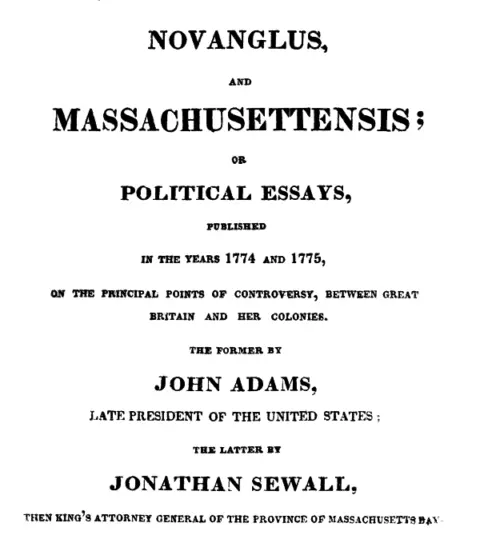
Novanglus, and Massachusettensis or, Political Essays, Published in the Years 1774 and 1775, on the Principal Points of Controversy, between Great Britain and Her Colonies
Your friend and humble servant,
JOHN ADAMS.
Mr. WIRT, Attorney General of the United States.
TO THE SAME.
Quincy, January 23, 1819.
SIR,
I thank you for your kind letter of the 12th of this month. As I esteem the character of Mr. Henry, an honour to our country, and your volume a masterly delineation of it, I gave orders to purchase it as soon as I heard of it, but was told it was not to be had in Boston. I have seen it only by great favour on a short loan. A copy from the author would be worth many by purchase. It may be sent to me by the mail.
From a personal acquaintance, perhaps I might say a friendship, with Mr. Henry, of more than forty years, and from all that I have heard or read of him, I have always considered him as a gentleman of deep reflection, keen sagacity, clear foresight, daring enterprise, inflexible intrepidity, and untainted integrity; with an ardent zeal for the liberties, the honour, and felicity of his country, and his species. All this, you justly as I believe, represent him to have been. There are, however, remarks to be made upon your work, which, if I had the eyes and hands, I would, in the spirit of friendship, attempt. But my hands, and eyes, and life, are but for a moment.
When congress had finished their business, as they thought, in the autumn of 1774, I had, with Mr. Henry, before we took leave of each other, some familiar conversation, in which I expressed a full conviction, that our resolves, declarations of rights, enumeration of wrongs, petitions, remonstrances, and addresses, associations, and non-importation agreements, however they might be expected [Errata: respected] in America, and however necessary to cement the union of the colonies, would be but waste water in England. Mr. Henry said, they might make some impression among the people of England, but agreed with me that they would be totally lost upon the government. I had but just received a short and hasty letter, written to me by major Joseph Hawley, of Northampton, containing "a few broken hints," as he called them, of what he thought was proper to be done, and concluding with these words, "after all we must fight." This letter I read to Mr. Henry, who listened with great attention; and as soon as I had pronounced the words, "after all we must fight," he raised his head, and with an energy and vehemence that I can never forget, broke out with "BY G--D, I AM OF THAT MAN'S MIND." I put the letter into his hand, and when he had read it, he returned it to me, with an equally solemn asseveration, that he agreed entirely in opinion with the writer. I considered this as a sacred oath, upon a very great occasion, and could have sworn it as religiously as he did, and by no means inconsistent with what you say, in some part of your book, that he never took the sacred name in vain.