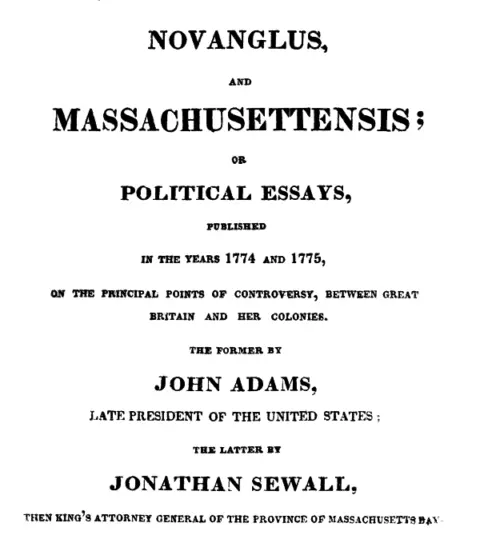
Novanglus, and Massachusettensis or, Political Essays, Published in the Years 1774 and 1775, on the Principal Points of Controversy, between Great Britain and Her Colonies
If any gentleman supposes this controversy to be nothing to the present purpose, he is grossly mistaken. It spread an universal alarm against the authority of parliament. It excited a general and just apprehension, that bishops and diocesses and churches, and priests, and tythes, were to be imposed on us by parliament. It was known, that neither king, nor ministry, nor archbishops, could appoint bishops, in America, without an act of parliament, and if parliament could tax us, they could establish the church of England, with all its creeds, articles, tests, ceremonies, and tythes, and prohibit all other churches, as conventicles, and schism shops.
Nor must Mr. Cushing be forgotten. His good sense and sound judgment, the urbanity of his manners, his universal good character, his numerous friends and connections, and his continual intercourse with all sorts of people, added to his constant attachment to the liberties of his country, gave him a great and salutary influence from the beginning in 1760.
Let me recommend these hints to the consideration of Mr. Wirt, whose life of Mr. Henry I have read with great delight. I think that after mature investigation, he will be convinced, that Mr. Henry did not "give the first impulse to the ball of independence," and that Otis, Thatcher, Samuel Adams, Mayhew, Hancock, Cushing, and thousands of others, were labouring for several years at the wheel, before the name of Henry was heard beyond the limits of Virginia.
If you print this, I will endeavour to send you something concerning Samuel Adams, who was destined to a longer career, and to act a more conspicuous, and perhaps a more important part than any other man. But his life would require a volume. If you decline printing this letter, I pray you to return it as soon as possible to,
Sir, Your humble servant,
JOHN ADAMS.
TO MR. WIRT.
Quincy, January 5, 1818.
SIR,
Your sketches of the life of Mr. Henry have given me a rich entertainment. I will not compare them to the Sybil, conducting Æneas to see the ghosts of departed sages and heroes in the region below, but to an angel, convoying me to the abodes of the blessed on high, to converse with the spirits of just men made perfect. The names of Henry, Lee, Bland, Pendleton, Washington, Rutledge, Dickinson, Wythe, and many others, will ever thrill through my veins with an agreeable sensation. I am not about to make any critical remarks upon your works, at present. But, sir,
Erant heroes ante Agamemnona multi.
Or, not to garble Horace,
Vixere fortes ante Agamemnona
Multi: sed omnes illacrimabiles
Urgentur, ignotique longa
Nocte, carent quia vate sacro.