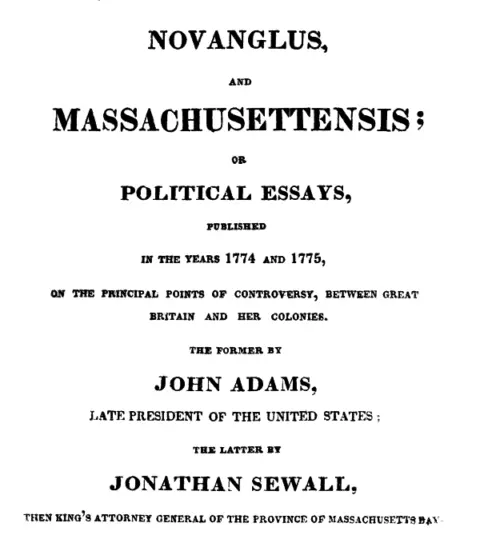
Novanglus, and Massachusettensis or, Political Essays, Published in the Years 1774 and 1775, on the Principal Points of Controversy, between Great Britain and Her Colonies
His indignation against him henceforward, to 1765, when he died, knew no bounds but truth. I speak from personal knowledge. For, from 1758 to 1765, I attended every superior and inferior court in Boston, and recollect not one, in which he did not invite me home to spend evenings with him, when he made me converse with him as well as I could, on all subjects of religion, morals, law, politics, history, philosophy, belles lettres, theology, mythology, cosmogony, metaphysics,--Lock, Clark, Leibnits, Bolingbroke, Berckley,--the pre-established harmony of the universe, the nature of matter and of spirit, and the eternal establishment of coincidences between their operations, fate, foreknowledge, absolute; and we reasoned on such unfathomable subjects as high as Milton's gentry in pandemonium; and we understood them as well as they did, and no better. To such mighty mysteries he added the news of the day, and the tittle tattle of the town. But his favourite subject was politics, and the impending threatening system of parliamentary taxation and universal government over the colonies. On this subject he was so anxious and agitated that I have no doubt it occasioned his premature death. From the time when he argued the question of writs of assistance, to his death he considered the king, ministry, parliament and nation of G. B. as determined to new model the colonies from the foundation; to annul all their charters, to constitute them all royal governments; to raise a revenue in America by parliamentary taxation; to apply that revenue to pay the salaries of governours, judges and all other crown officers; and, after all this, to raise as large a revenue as they pleased, to be applied to national purposes at the exchequer in England; and further to establish bishops and the whole system of the church of England, tythes and all, throughout all British America. This system, he said, if it was suffered to prevail, would extinguish the flame of liberty all over the world; that America would be employed as an engine to batter down all the miserable remains of liberty in Great Britain and Ireland, where only any semblance of it was left in the world. To this system he considered Hutchinson, the Olivers and all their connections, dependants, adherents, shoelickers, &c. entirely devoted. He asserted that they were all engaged with all the crown officers in America and the understrappers of the ministry in England, in a deep and treasonable conspiracy to betray the liberties of their country, for their own private, personal and family aggrandizement. His philippicks against the unprincipled ambition and avarice of all of them, but especially of Hutchinson, were unbridled; not only in private, confidential conversations, but in all companies and on all occasions. He gave Hutchinson the sobriquet of "Summa Potestatis," and rarely mentioned him but by the name of "Summa." His liberties of speech were no secrets to his enemies. I have sometimes wondered that they did not throw him over the bar, as they did soon afterwards major Hawley. For they hated him worse than they did James Otis, or Samuel Adams, and they feared him more, because they had no revenge for a father's disappointment of a seat on the superior bench to impute to him, as they did to Otis; and Thatcher's character through life had been so modest, decent, unassuming; his morals so pure, and his religion so venerated, that they dared not attack him. In his office were educated to the bar, two eminent characters, the late judge Lowell, and Josiah Quincy, aptly called the Boston Cicero. Mr. Thatcher's frame was slender, his constitution delicate; whether his physicians overstrained his vessels with mercury, when he had the small pox by inoculation at the castle, or whether he was overplied by public anxieties and exertions, the small pox left him in a decline from which he never recovered. Not long before his death he sent for me to commit to my care some of his business at the bar. I asked him whether he had seen the Virginia resolves: "Oh yes--they are men! they are noble spirits! It kills me to think of the lethargy and stupidity that prevails here. I long to be out. I will go out. I will go out. I will go into court, and make a speech which shall be read after my death, as my dying testimony against this infernal tyranny which they are bringing upon us." Seeing the violent agitation into which it threw him, I changed the subject as soon as possible, and retired. He had been confined for some time. Had he been abroad among the people, he would not have complained so pathetically of the "lethargy and stupidity that prevailed," for town and country were all alive; and in August became active enough, and some of the people proceeded to unwarrantable excesses, which were more lamented by the patriots than by their enemies. Mr. Thatcher soon died, deeply lamented by all the friends of their country.