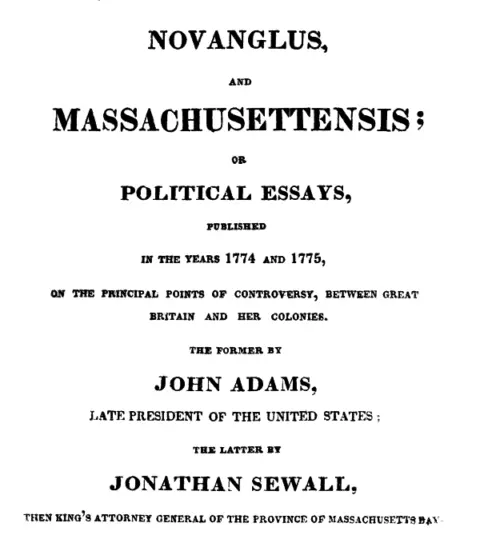
Novanglus, and Massachusettensis or, Political Essays, Published in the Years 1774 and 1775, on the Principal Points of Controversy, between Great Britain and Her Colonies
MASSACHUSETTENSIS.
LETTERS
FROM THE
HON. JOHN ADAMS,
TO THE
HON. WM. TUDOR, AND OTHERS,
ON THE
EVENTS OF THE AMERICAN REVOLUTION.
TO THE EDITOR OF THE WEEKLY REGISTER.
Quincy, January 14, 1818.
MR. NILES,
In a former letter I hazarded an opinion, that the true history of the American revolution could not be recovered. I had many reasons for that apprehension; one of which I will attempt to explain.
Of the determination of the British cabinet to assert and maintain the sovereign authority of parliament over the colonies, in all cases of taxation and internal policy, the first demonstration which arrived in America was an order in council to the officers of the customs in Massachusetts Bay, to carry into execution the acts of trade, and to apply to the supreme judicature of the province for writs of assistance, to authorise them to break and enter all houses, cellars, stores, shops, ships, bales, casks, &c. to search and seize all goods, wares, and merchandizes, on which the taxes imposed by those acts had not been paid.
Mr. Cockle, of Salem, a deputy under Mr. Paxton, of Boston, the collector of the customs, petitioned the superior court in Salem, in November, 1760, for such a writ. The court doubted its constitutionality, and consequently its legality; but as the king's order ought to be considered, they ordered the question to be argued before them, by counsel, at the next February term in Boston.
The community was greatly alarmed. The merchants of Salem and of Boston, applied to Mr. Otis to defend them and their country, against that formidable instrument of arbitrary power. They tendered him rich fees; he engaged in their cause, but would accept no fees.
JAMES OTIS, of Boston, sprung from families among the earliest of the planters of the colonies, and the most respectable in rank, while the word rank, and the idea annexed to it, were tolerated in America. He was a gentleman of general science, and extensive literature. He had been an indefatigable student during the whole course of his education in college, and at the bar. He was well versed in Greek and Roman history, philosophy, oratory, poetry, and mythology, His classical studies had been unusually ardent, and his acquisitions uncommonly great. He had composed a treatise on Latin prosody, which he lent to me, and I urged him to print. He consented. It is extant, and may speak for itself. It has been lately reviewed in the Anthology by one of our best scholars, at a mature age, and in a respectable station. He had also composed, with equal skill and great labour, a treatise on Greek prosody. This he also lent me, and, by his indulgence, I had it in my possession six months. When I returned it, I begged him to print it. He said there were no Greek types in the country, or, if there were, there was no printer who knew how to use them. He was a passionate admirer of the Greek poets, especially of Homer; and he said it was in vain to attempt to read the poets in any language, without being master of their prosody. This classic scholar was also a great master of the laws of nature and nations. He had read Puffendorph, Grotius, Barbeyrac, Burlamaqui, Vattel, Heineccius; and, in the civil law, Domal, Justinian, and, upon occasions, consulted the corpus juris at large. It was a maxim which he inculcated on his pupils, as his patron in profession, Mr. Gridley, had done before him, "that a lawyer ought never to be without a volume of natural or public law, or moral philosophy, on his table, or in his pocket." In the history, the common law, and statute laws of England, he had no superior, at least in Boston.