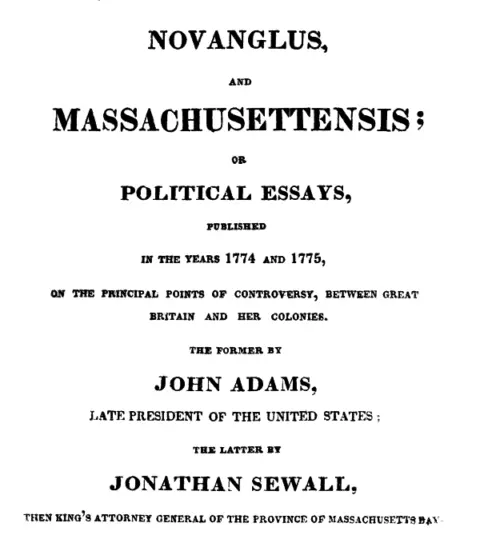
Novanglus, and Massachusettensis or, Political Essays, Published in the Years 1774 and 1775, on the Principal Points of Controversy, between Great Britain and Her Colonies
The crimes are these; the persons named by him conspired together to enslave their country, in consequence of a plan, the outlines of which have been drawn by sir Edmund Andross and others, and handed down by tradition to the present times. He tells us that governor Shirley, in 1754, communicated the profound secret, the great design of taxing the colonies by act of parliament, to the sagacious gentleman, eminent philosopher, and distinguished patriot, Dr. Franklin. The profound secret is this; after the commencement of hostilities between the English and French colonies in the last war, a convention of committees from several provinces were called by the king, to agree upon some general plan of defence. The principal difficulty they met with was in devising means whereby each colony might be obliged to contribute its proportionable part. General Shirley proposed that application should be made to parliament to impower the committees of the several colonies to tax the whole according to their several proportions. This plan was adopted by the convention, and approved of by the assembly in New York, who passed a resolve in these words: "That the scheme proposed by governor Shirley for the defence of the British colonies in North America, is well concerted, and that this colony joins therein." This however did not succeed, and he proposed another, viz. for the parliament to assess each one's proportion, and in case of failure to raise it on their part, that it should be done by parliament. This is the profound secret. His assiduity, in endeavouring to have some effectual plan of general defence established, is, by the false colouring of this writer, represented as an attempt to aggrandise himself, family and friends; and that gentleman, under whose administration the several parties in the province were as much united, and the whole province rendered as happy as it ever was, for so long a time together, is called a "crafty, busy, ambitious, intriguing, enterprizing man." This attempt of Governor Shirley for a parliamentary taxation, is however a circumstance strongly militating with this writer's hypothesis, for the approbation shewn to the Governor's proposal by the convention, which consisted of persons from the several colonies, not inferior in point of discernment, integrity, knowledge or patriotism to the members of our late grand congress, and the vote of the New York assembly furnishes pretty strong evidence that the authority of parliament, even in point of taxation, was not doubted in that day. Even Dr. Franklin, in the letter alluded to, does not deny the right. His objections go to the inexpediency of the measure. He supposes it would create uneasiness in the minds of the colonists should they be thus taxed, unless they were previously allowed to send representatives to parliament. If Dr. Franklin really supposes that the parliament has no constitutional right to raise a revenue in America, I must confess myself at a loss to reconcile his conduct in accepting the office of post-master, and his assiduity in increasing the revenue in that department, to the patriotism predicated of him by Novanglus, especially as this unfortunately happens to be an internal tax. This writer then tells us, that the plan was interrupted by the war, and afterwards by Governor Pownal's administration. That Messieurs Hutchinson and Oliver, stung with envy at Governor Pownal's favourites, propagated slanders respecting him to render him uneasy in his seat. My answer is this, that he that publishes such falsehoods as these in a public newspaper, with an air of seriousness, insults the understanding of the public, more than he injures the individuals he defames. In the next place we are told, that Governor Bernard was the proper man for this purpose, and he was employed by the junto to suggest to the ministry the project of taxing the colonies by act of parliament. Sometimes Governor Bernard is the arch enemy of America, the source of all our troubles, now only a tool in the hands of others. I wish Novanglus's memory had served him better, his tale might have been consistent with itself, however variant from truth. After making these assertions with equal gravity and assurance, he tells us, he does not advance this without evidence. I had been looking out for evidence a long time, and was all attention when it was promised, but my disappointment was equal to the expectation he had raised, when I found the evidence amounted to nothing more than Governor Bernard's letters and principles of law and polity, wherein he asserts the supremacy of parliament over the colonies both as to legislation and taxation. Where this writer got his logic, I do not know. Reduced to a syllogism, his argument stands thus; Governor Bernard, in 1764, wrote and transmitted to England certain letters and principles of law and polity, wherein he asserts the right of parliament to tax the colonies; Messieurs Hutchinson and Oliver were in unison with him in all his measures; therefore Messieurs Hutchinson and Oliver employed Governor Bernard to suggest to the ministry the project of taxing the colonies by act of parliament. The letters and principles are the whole of the evidence, and this is all the appearance of argument contained in his publication. Let us examine the premises. That Governor Bernard asserted the right of parliament to tax the colonies in 1764, is true. So did Mr. Otis, in a pamphlet he published the self-same year, from which I have already taken an extract. In a pamphlet published in 1765, Mr. Otis tells us, "it is certain that the parliament of Great Britain hath a just, clear, equitable and constitutional right, power and authority to bind the colonies by all acts wherein they are named. Every lawyer, nay every Tyro, knows this; no less certain is it that the parliament of Great Britain has a just and equitable right, power and authority to impose taxes on the colonies internal and external, on lands as well as on trade." But does it follow from Governor Bernard's transmitting his principles of polity to four persons in England, or from Mr. Otis's publishing to the whole world similar principles, that either the one or the other suggested to the ministry the project of taxing the colonies by act of parliament? Hardly, supposing the transmission and publication had been prior to the resolution of parliament to that purpose; but very unfortunately for our reasoner, they were both subsequent to it, and were the effect and not the cause.