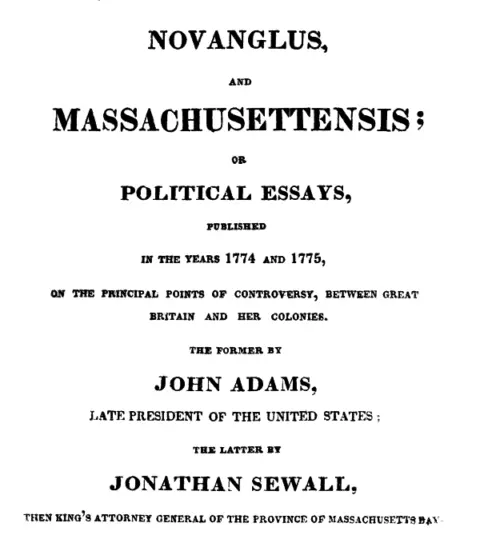
Novanglus, and Massachusettensis or, Political Essays, Published in the Years 1774 and 1775, on the Principal Points of Controversy, between Great Britain and Her Colonies
Their motives were truly patriotic. Let us now attend to the ways and means by which the whigs prevented these exertions producing such effects. Previous to this, a new, and until lately, unheard of, mode of opposition had been devised, said to be the invention of the fertile brain of one of our party agents, called a committee of correspondence. This is the foulest, subtlest, and most venomous serpent that ever issued from the eggs of sedition. These committees generally consist of the highest whigs, or at least there is some high whig upon them, that is the ruling spirit of the whole. They are commonly appointed at thin town meetings, or if the meetings happen to be full, the moderate men seldom speak or act at all, when this sort of business comes on. They have been by much too modest. Thus the meeting is often prefaced with, "at a full town meeting," and the several resolves headed with nem. con. with strict truth, when in fact, but a small proportion of the town have had a hand in the matter. It is said that the committee for the town of Boston was appointed for a special purpose, and that their commission long since expired. However that may be, these committees when once established, think themselves amenable to none, they assume a dictatorial style, and have an opportunity under the apparent sanction of their several towns, of clandestinely wreaking private revenge on individuals, by traducing their characters, and holding them up as enemies to their country, wherever they go, as also of misrepresenting facts and propagating sedition through the country. Thus, a man of principle and property, in travelling through the country, would be insulted by persons, whose faces he had never before seen; he would often feel the smart without suspecting the hand that administered the blow. These committees, as they are not known in law, and can derive no authority from thence, lest they should not get their share of power, sometimes engross it all; they frequently erect themselves into a tribunal, where the same persons are at once legislators, accusers, witnesses, judges, and jurors, and the mob the executioners. The accused has no day in court, and the execution of the sentence is the first notice he receives. This is the channel through which liberty matters have been chiefly conducted the summer and fall past. This accounts for the same distempers breaking out in different parts of the province, at one and the same time, which might be attributed to something supernatural, by those that were unacquainted with the secret conductors of the infection. It is chiefly owing to these committees, that so many respectable persons have been abused, and forced to sign recantations and resignations; that so many persons, to avoid such reiterated insults, as are more to be deprecated by a man of sentiment than death itself, have been obliged to quit their houses, families, and business, and fly to the army for protection; that husband has been separated from wife, father from son, brother from brother, the sweet intercourse of conjugal and natural affection interrupted, and the unfortunate refugee forced to abandon all the comforts of domestic life. My countrymen, I beg you to pause and reflect on this conduct. Have not these people, that are thus insulted, as good a right to think and act for themselves in matters of the last importance, as the whigs? Are they not as closely connected with the interest of their country as the whigs? Do not their former lives and conversations appear to have been regulated by principle, as much as those of the whigs? You must answer, yes. Why, then, do you suffer them to be cruelly treated for differing in sentiment from you? Is it consistent with that liberty you profess? Let us wave the consideration of right and liberty, and see if this conduct can be reconciled to good policy. Do you expect to make converts by it? Persecution has the same effect in politics, that it has in religion; it confirms the sectary. Do you wish to silence them, that the inhabitants of the province may appear unanimous? The maltreatment they receive, for differing from you, is undeniable evidence that we are not unanimous. It may not be amiss to consider, that this is a changeable world, and time's rolling wheel may ere long bring them uppermost; in that case I am sure you would not wish to have them fraught with resentment. It is astonishing, my friends, that those who are in pursuit of liberty, should ever suffer arbitrary power, in such an hideous form and squalid hue, to get a footing among them. I appeal to your good sense; I know you have it, and hope to penetrate to it, before I have finished my publications, notwithstanding the thick atmosphere that now envelopes it. But to return from my digression, the committee of correspondence represented the destruction of the tea in their own way; they represented those that addressed Gov. Hutchinson, as persons of no note or property, as mean, base wretches, and seekers that had been sacrificing their country in adulation of him. Whole nations have worshipped the rising, but if this be an instance, it is the only one of people's worshipping the setting sun. By this means the humane and benevolent, in various parts of the continent, were induced to advise us not to comply with the terms for opening our port, and engage to relieve us with their charities, from the distress that must otherwise fall upon the poor. Their charitable intentions ascend to heaven, like incense from the altar, in sweet memorial before the throne of God; but their donations came near proving fatal to the province. It encouraged the whigs to persevere in injustice, and has been the means of seducing many an honest man into the commission of a crime, that he did not suspect himself capable of being guilty of. What I have told you, is not the mere suggestions of a speculatist; there are some mistakes as to numbers, and there may be some as to time and place, partly owing to miscopying, and partly to my not always having had the books and papers necessary to greater accuracy, at hand; but the relation of facts is in substance true, I had almost said, as holy writ. I do not ask you to take the truths of them from an anonymous writer. The evidence of most of them is within your reach; examine for yourselves. I promise that the benefit you will reap therefrom will abundantly pay you, for the trouble of the research; you will find I have faithfully unriddled the whole mystery of our political iniquity. I do not address myself to whigs or tories, but to the whole people. I know you well. You are loyal at heart, friends to good order, and do violence to yourselves in harboring, one moment, disrespectful sentiments towards Great Britain, the land of our forefathers' nativity, and sacred repository of their bones; but you have been most insidiously induced to believe that Great Britain is rapacious, cruel, and vindictive, and envies us the inheritance purchased by the sweat and blood of our ancestors. Could that thick mist, that hovers over the land and involves in it more than Egyptian darkness, be but once dispelled, that you might see our Sovereign, the provident father of all his people, and Great Britain a nursing mother to these colonies, as they really are, long live our gracious king, and happiness to Britain, would resound from one end of the province to the other.