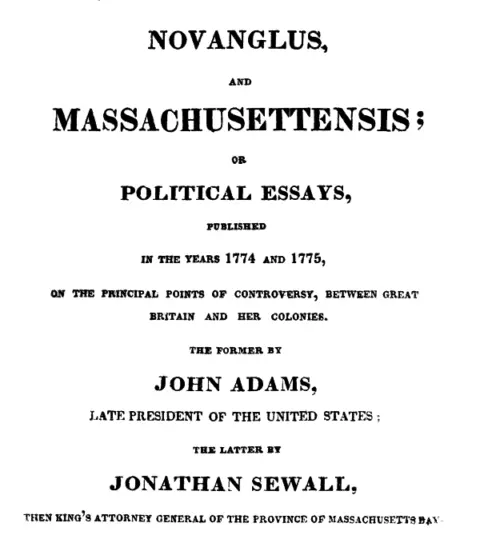
Novanglus, and Massachusettensis or, Political Essays, Published in the Years 1774 and 1775, on the Principal Points of Controversy, between Great Britain and Her Colonies
At the conclusion of the late war, Great Britain found that though she had humbled her enemies, and greatly enlarged her own empire, that the national debt amounted to almost one hundred and fifty millions, and that the annual expence of keeping her extended dominions in a state of defence, which good policy dictates no less in a time of peace than war, was increased in proportion to the new acquisitions. Heavy taxes and duties were already laid, not only upon the luxuries and conveniences, but even the necessaries of life in Great Britain and Ireland. She knew that the colonies were as much benefitted by the conquests in the late war, as any part of the empire, and indeed more so, as their continental foes were subdued, and they might now extend their settlements not only to Canada, but even to the western ocean.--The greatest opening was given to agriculture, the natural livelihood of the country, that ever was known in the history of the world, and their trade was protected by the British navy. The revenue to the crown, from America, amounted to but little more than the charges of collecting it. She thought it as reasonable that the colonies should bear a part of the national burden, as that they should share in the national benefit. For this purpose the stamp-act was passed. The colonies soon found that the duties imposed by the stamp-act would be grievous, as they were laid upon custom-house papers, law proceedings, conveyancing, and indeed extended to almost all their internal trade and dealings. It was generally believed through the colonies, that this was a tax not only exceeding our proportion, but beyond our utmost ability to pay. This idea, united the colonies generally in opposing it. At first we did not dream of denying the authority of parliament to tax us, much less to legislate for us. We had always considered ourselves, as a part of the British empire, and the parliament, as the supreme legislature of the whole. Acts of parliament for regulating our internal polity were familiar. We had paid postage agreeable to act of parliament, for establishing a post-office, duties imposed for regulating trade, and even for raising a revenue to the crown without questioning the right, though we closely adverted to the rate or quantum. We knew that in all those acts of government, the good of the whole had been consulted, and whenever through want of information any thing grievous had been ordained, we were sure of obtaining redress by a proper representation of it. We were happy in our subordination; but in an evil hour, under the influence of some malignant planet, the design was formed of opposing the stamp-act, by a denial of the right of parliament to make it. The love of empire is so predominant in the human breast, that we rarely find an individual content with relinquishing a power that he is able to retain; never a body of men. Some few months after it was known that the stamp-act was passed, some resolves of the house of burgesses in Virginia, denying the right of parliament to tax the colonies, made their appearance. We read them with wonder; they savoured of independence; they flattered the human passions; the reasoning was specious; we wished it conclusive. The transition, to believing it so, was easy; and we, and almost all America, followed their example, in resolving that the parliament had no such right. It now became unpopular to suggest the contrary; his life would be in danger that asserted it. The newspapers were open to but one side of the question, and the inflammatory pieces that issued weekly from the press, worked up the populace to a fit temper to commit the outrages that ensued. A non-importation was agreed upon, which alarmed the merchants and manufacturers in England. It was novel, and the people in England then supposed, that the love of liberty was so powerful in an American merchant, as to stifle his love of gain, and that the agreement would be religiously adhered to. It has been said, that several thousands were expended in England, to foment the disturbances there. However that may be, opposition to the ministry was then gaining ground, from circumstances, foreign to this. The ministry was changed, and the stamp-act repealed. The repealing statute passed, with difficulty however, through the house of peers, near forty noble lords protested against giving way to such an opposition, and foretold what has since literally come to pass in consequence of it. When the statute was made, imposing duties upon glass, paper, India teas, &c. imported into the colonies, it was said, that this was another instance of taxation, for some of the dutied commodities were necessaries, we had them not within ourselves, were prohibited from importing them from any place except Great Britain, were therefore obliged to import them from Great Britain, and consequently, were obliged to pay the duties. Accordingly newspaper publications, pamphlets, resolves, non-importation agreements, and the whole system of American opposition was again put in motion. We obtained a partial repeal of this statute, which took off the duties from all the articles except teas. This was the lucky moment when to have closed the dispute. We might have made a safe and honorable retreat. We had gained much, perhaps more than we expected. If the parliament had passed an act declaratory of their right to tax us, our assemblies had resolved, ten times, that they had no such right. We could not complain of the three-penny duty on tea as burdensome, for a shilling which had been laid upon it, for the purpose of regulating trade, and therefore was allowed to be constitutional, was taken off; so that we were in fact gainers nine-pence in a pound by the new regulation. If the appropriation of the revenue, arising from this statute was disrelished, it was only our striking off one article of luxury from our manner of living, an article too, which if we may believe the resolves of most of the towns in this province, or rely on its collected wisdom in a resolve of the house of representatives, was to the last degree ruinous to health. It was futile to urge its being a precedent, as a reason for keeping up the ball of contention; for, allowing the supreme legislature ever to want a precedent, they had many for laying duties on commodities imported into the colonies. And beside we had great reason to believe that the remaining part of the statute would be repealed, as soon as the parliament should suppose it could be done with honor to themselves, as the incidental revenue arising from the former regulation, was four fold to the revenue arising from the latter. A claim of the right, could work no injury, so long as there was no grievous exercise of it, especially as we had protested against it, through the whole, and could not be said to have departed from our claims in the least. We might now upon good terms have dropped the dispute, and been happy in the affections of our mother country; but that is yet to come. Party is inseperable from a free state. The several distributions of power, as they are limited by, so they create perpetual dissentions between each other, about their respective boundaries; but the greatest source is the competition of individuals for preferment in the state. Popularity is the ladder by which the partizans usually climb. Accordingly, the struggle is, who shall have the greatest share of it. Each party professes disinterested patriotism, though some cynical writers have ventured to assert, that self-love is the ruling passion of the whole. There were two parties in this province of pretty long standing, known by the name of whig and tory, which at this time were not a little imbittered against each other. Men of abilities and acknowledged probity were on both sides. If the tories were suspected of pursuing their private interest through the medium of court favor, there was equal reason to suspect the whigs of pursuing their private interest by the means of popularity. Indeed some of them owed all their importance to it, and must in a little time have sunk into obscurity, had these turbulent commotions then subsided.