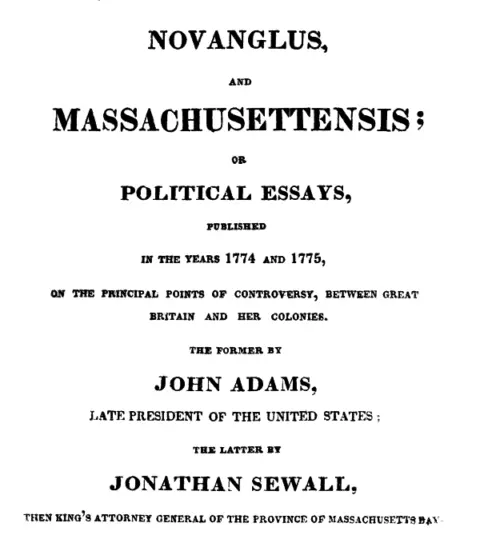
Novanglus, and Massachusettensis or, Political Essays, Published in the Years 1774 and 1775, on the Principal Points of Controversy, between Great Britain and Her Colonies
I assure you, my friends, I would not that this conduct should be told beyond the borders of this province; I wish it were consigned to perpetual oblivion; but alas, it is too notorious to be concealed; our news-papers have already published it to the world; we can neither prevent nor conceal it. The shaft is already sped, and the utmost exertion is necessary to prevent the blow. We already feel the effects of anarchy; mutual confidence, affection, and tranquility, those sweetners of human life, are succeeded by distrust, hatred, and wild uproar; the useful arts of agriculture and commerce are neglected for caballing, mobbing this or the other man, because he acts, speaks, or is suspected of thinking different from the prevailing sentiment of the times, in purchasing arms, and forming a militia; O height of madness! with a professed design of opposing Great Britain. I suspect many of us have been induced to join in these measures, or but faintly to oppose them, from an apprehension that Great Britain would not, or could not exert herself sufficiently to subdue America. Let us consider this matter. However closely we may hug ourselves in the opinion, that the parliament has no right to tax or legislate for us, the people of England hold the contrary opinion as firmly. They tell us we are a part of the British empire; that every state, from the nature of government, must have a supreme, uncontrolable power, co-extensive with the empire itself; and that that power is vested in parliament. It is as unpopular to deny this doctrine in Great Britain, as it is to assert it in the colonies; so there is but little probability of serving ourselves at this day by our ingenious distinctions between a right of legislation for one purpose, and not for another. We have bid them defiance; and the longest sword must carry it, unless we change our measures. Mankind are the same, in all parts of the world. The same fondness for dominion that presides in the breast of an American, actuates the breast of an European. If the colonies are not a part of the British empire already, and subject to the supreme authority of the state, Great Britain will make them so. Had we been prudent enough to confine our opposition within certain limits, we might have stood some chance of succeeding once more; but alas, we have passed the Rubicon. It is now universally said and believed, in England, that if this opportunity of reclaiming the colonies, and reducing them to a sense of their duty is lost, they, in truth, will be dismembered from the empire, and become as distinct a state from Great Britain, as Hanover; that is, although they may continue their allegiance to the person of the king, they will own none to the imperial crown of Great Britain, nor yield obedience to any of her laws, but such as they shall think proper to adopt. Can you indulge the thought one moment, that Great Britain will consent to this? For what has she protected and defended the colonies against the maritime powers of Europe, from their first British settlement to this day? For what did she purchase New-York of the Dutch? For what was she so lavish of her best blood and treasure in the conquest of Canada, and other territories in America? Was it to raise up a rival state, or to enlarge her own empire? Or if the consideration of empire was out of the question, what security can she have of our trade, when once she has lost our obedience? I mention these things, my friends, that you may know how people reason upon the subject in England, and to convince you that you are much deceived, if you imagine that Great Britain will accede to the claims of the colonies, she will as soon conquer New-England as Ireland or Canada, if either of them revolted; and by arms, if the milder influences of government prove ineffectual. Perhaps you are as fatally mistaken in another respect. I mean, as to the power of Great Britain to conquer. But can any of you, that think soberly upon the matter, be so deluded as to believe that Great Britain, who so lately carried her arms with success to every part of the globe, triumphed over the united powers of France and Spain, and whose fleets give law to the ocean, is unable to conquer us? Should the colonies unite in a war against Great Britain (which by the way is not a supposable case) the colonies south of Pennsylvania would be unable to furnish any men; they have not more than is necessary to govern their numerous slaves, and to defend themselves against the Indians. I will suppose that the northern colonies can furnish as many, and indeed more men than can be used to advantage; but have you arms fit for a campaign? If you have arms, have you military stores, or can you procure them? When this war is proclaimed, all supplies from foreign parts will be cut off. Have you money to maintain the war? Or had you all those things, some others are still wanting, which are absolutely necessary to encounter regular troops, that is discipline, and that subordination, whereby each can command all below him, from a general officer to the lowest subaltern; these you neither have nor can have in such a war. It is well known that the provincials in the late war were never brought to a proper discipline, though they had the example of the regular troops to encourage, and the martial law to enforce it. We all know, notwithstanding the province law for regulating the militia, it was under little more command than what the officers could obtain from treating and humouring the common soldiers; what, then, can be expected from such an army as you will bring into the field, if you bring any, each one a politician, puffed up with his own opinion, and feeling himself second to none? Can any of you command ten thousand such men? Can you punish the disobedient? Can all your wisdom direct their strength, courage or activity to any given point? Would not the least disappointment or unfavourable aspect cause a general dereliction of the service? Your new-fangled militia have already given us a specimen of their future conduct. In some of their companies, they have already chosen two, in others, three sets of officers, and are as dissatisfied with the last choice as the first. I do not doubt the natural bravery of my countrymen; all men would act the same part in the same situation. Such is the army with which you are to oppose the most powerful nation upon the globe. An experienced officer would rather take his chance with five thousand British troops, than with fifty thousand such militia. I have hitherto confined my observations to the war within the interior parts of the colonies, let us now turn our eyes to our extensive sea coast, and that we find wholly at the mercy of Great Britain; our trade, fishery, navigation, and maritime towns taken from us the very day that war is proclaimed. Inconceivably shocking the scene; if we turn our views to the wilderness, our back settlements a prey to our ancient enemy, the Canadians, whose wounds received from us in the late war, will bleed afresh at the prospect of revenge, and to the numerous tribes of savages, whose tender mercies are cruelties. Thus with the British navy in the front, Canadians and savages in the rear, a regular army in the midst, we must be certain that whenever the sword of civil war is unsheathed, devastation will pass through our land like a whirlwind; our houses be burnt to ashes; our fair possessions laid waste, and he that falls by the sword, will be happy in escaping a more ignominious death.