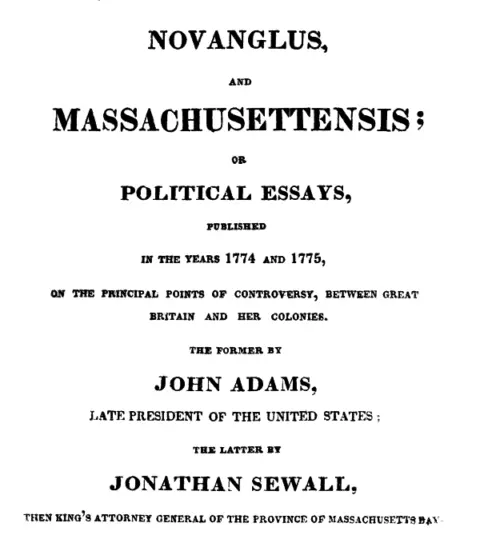
Novanglus, and Massachusettensis or, Political Essays, Published in the Years 1774 and 1775, on the Principal Points of Controversy, between Great Britain and Her Colonies
In the celebration of their late festival, they discovered that they are not insensible of the feelings of a man for his native country. The most generous minds are the most exquisitely capable of this sentiment. Let me entreat them to recollect the history of their brave and intrepid countrymen, who struggled at least 1100 years for liberty. Let them compare the case of Wales with the case of America, and then lay their hands upon their hearts and say, whether we can in justice be bound by all acts of parliament, without being incorporated with the kingdom.
NOVANGLUS.
ADDRESSED
To the Inhabitants of the Colony of Massachusetts Bay,
March 27, 1775.
MY FRIENDS,
Massachusettensis in some of his writings has advanced, that our allegiance is due to the political capacity of the king, and therefore involves in it obedience to the British parliament. Gov. Hutchinson, in his memorable speech, laid down the same position. I have already shewn, from the case of Wales, that this position is groundless, and that allegiance was due from the Welch to the king, jure feodali, before the conquest of Lewellyn, and after that to the crown, until it was annexed to the realm, without being subject to acts of parliament any more than to acts of the king, without parliament. I shall hereafter shew from the case of Ireland, that subjection to the crown implies no obedience to parliament. But before I come to this, I must take notice of a pamphlet, entitled "A candid examination of the mutual claims of Great Britain and the colonies, with a plan of accommodation on constitutional principles." This author, p. 8, says, "to him (i. e. the king) in his representative capacity, and as supreme executor of the laws, made by a joint power of him and others, the oaths of allegiance are taken," and afterwards: "hence these professions, (i. e. of allegiance) are not made to him either in his legislative, or executive capacities; but yet it seems they are made to the king. And into this distinction, which is no where to be found either in the constitution of the government, in reason or common sense, the ignorant and thoughtless have been deluded ever since the passing of the stamp act, and they have rested satisfied with it without the least examination." And in p. 9, he says, "I do not mean to offend the inventers of this refined distinction, when I ask them, is this acknowledgement made to the king, in his politic capacity as king of Great Britain, &c.? if so, it includes a promise of obedience to the British laws." There is no danger of this gentleman's giving offence to the inventers of this distinction, for they have been many centuries in their graves. This distinction is to be found every where. In the case of Wales, Ireland, and elsewhere, as I shall shew most abundantly before I have done, it is to be found in two of the greatest cases, and most deliberate and solemn judgments that were ever passed. One of them is Calvin's case, 7 Rep. which, as lord Coke tells us, was as elaborately, substantially, and judiciously argued, as he ever heard, or read of any. After it had been argued in the court of king's bench, by learned council, it was adjourned to the exchequer chamber, and there argued again, first by council on both sides, and then by the lord chancellor, and all the twelve judges of England, and among these were the greatest men, that Westminster-Hall ever could boast. Ellismore, Bacon, Hide, Hobart, Crook, and Coke, were all among them: and the chancellor and judges were unanimous in resolving. What, says the book? 7. Rep. 10. "Now seeing the king hath but one person, and several capacities, and one politic capacity for the realm of England, and another for the realm of Scotland, it is necessary to be considered to which capacity ligeance is due. And it was resolved that it was due to the natural person of the king (which is ever accompanied with the politic capacity, and the politic capacity as it were appropriated to the natural capacity) and it is not due to the politic capacity only, that is, to the crown or kingdom, distinct from his natural capacity." And further on 7. Rep. 11. "But it was clearly resolved by all the judges, that presently by the descent his majesty was completely and absolutely king," &c. and that coronation was but a royal ornament. 6. "In the reign of Edward 2d. the Spencers, to cover the treason hatched in their hearts, invented this damnable and damned opinion, that homage and oath of allegiance was more by reason of the king's crown, (that is of his politic capacity) than by reason of the person of the king, upon which opinion they inferred execrable and detestable consequences." And afterwards, 12. "Where books and acts of parliament speak of the ligeance of England, &c. speaking briefly in a vulgar manner, are to be understood of the ligeance due by the people of England to the king; for no man will affirm, that England itself, taking it for the continent thereof, doth owe any ligeance or faith, or that any faith or ligeance should be due to it: but it manifestly appeareth, that the ligeance or faith of the subject is proprium quarto modo to the king, omni, soli, et semper. And oftentimes in the reports of our book cases, and in acts of parliament also, the crown or kingdom is taken for the king himself," &c. "Tenure in capite is a tenure of the crown, and is a seigniorie in grosse, that is of the person of the king." And afterwards 6, "for special purposes the law makes him a body politic, immortal and invisible, whereunto our allegiance cannot appertain." I beg leave to observe here, that these words in the foregoing adjudication, that "the natural person of the king is ever accompanied with the politic capacity, and the politic capacity as it were appropriated to the natural capacity," neither imply nor infer allegiance or subjection to the politic capacity; because in the case of king James 1st. his natural person was "accompanied" with three politic capacities at least, as king of England, Scotland, and Ireland: yet the allegiance of an Englishman to him did not imply or infer subjection to his politic capacity, as king of Scotland.