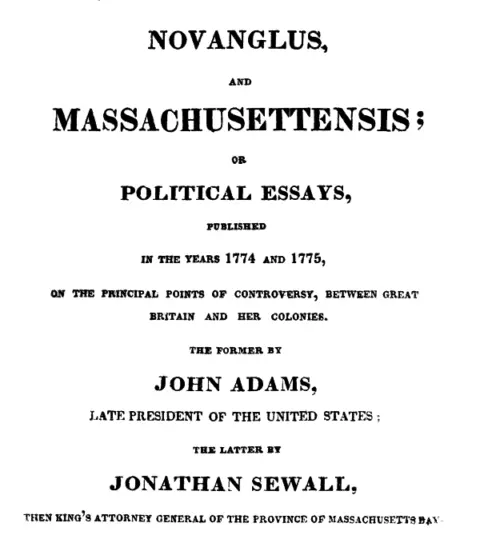
Novanglus, and Massachusettensis or, Political Essays, Published in the Years 1774 and 1775, on the Principal Points of Controversy, between Great Britain and Her Colonies
That there are any who pant after "independence," (meaning by this word a new plan of government over all America, unconnected with the crown of England, or meaning by it an exemption from the power of parliament to regulate trade) is as great a slander upon the province as ever was committed to writing. The patriots of this province desire nothing new; they wish only to keep their old privileges. They were for 150 years allowed to tax themselves, and govern their internal concerns, as they thought best. Parliament governed their trade as they thought fit. This plan, they wish may continue forever. But it is honestly confessed, rather than become subject to the absolute authority of parliament, in all cases of taxation and internal polity, they will be driven to throw off that of regulating trade.
"To deny the supreme authority of the state, is a high misdemeanor; to oppose it by force, an overt act of treason." True: and therefore Massachusettensis, who denies the king represented by his governor, his majesty's council, by charter, and house of representatives, to be the supreme authority of this province, has been guilty of a high misdemeanour: and those ministers, governors, and their instruments, who have brought a military force here, and employed it against that supreme authority, are guilty of ----, and ought to be punished with ----. I will be more mannerly than Massachusettensis.
"The realm of England is an appropriate term for the ancient realm of England, in contradistinction to Wales and other territories, that have been annexed to it."
There are so many particulars in the case of Wales analogous to the case of America, that I must beg leave to enlarge upon it.
Wales was a little portion of the island of Great Britain, which the Saxons were never able to conquer. The Britons had reserved this tract of land to themselves, and subsisted wholly by pasturage, among their mountains. Their princes, however, during the Norman period, and until the reign of king Edward the first, did homage to the crown of England, as their feudal sovereign, in the same manner as the prince of one independent state in Europe frequently did to the sovereign of another. This little principality of shepherds and cowherds, had however maintained their independence, through long and bloody wars against the omnipotence of England, for 800 years. It is needless to enumerate the causes of the war between Lewellyn and Edward the first. It is sufficient to say that the Welch prince refused to go to England to do homage, and Edward obtained a new aid of a fifteenth from his parliament, to march with a strong force into Wales. Edward was joined by David and Roderic, two brothers of Lewellyn, who made a strong party among the Welch themselves, to assist and second the attempts to enslave their native country. The English monarch, however, with all these advantages, was afraid to put the valor of his enemies to a trial, and trusted to the slow effects of famine to subdue them. Their pasturage, with such an enemy in their country, could not subsist them, and Lewellyn, Nov. 19, 1277, at last submitted, and bound himself to pay a reparation of damages, to do homage to the crown of England, and almost to surrender his independence as a prince, by permitting all the other Barons of Wales, excepting four, to swear fealty to the same crown. But fresh complaints soon arose. The English grew insolent on their bloodless victory, and oppressed the inhabitants; many insults were offered, which at last raised the indignation of the Welch, so that they determined again to take arms, rather than bear any longer the oppression of the haughty victors. The war raged sometime, until Edward summoned all his military tenants, and advanced with an army too powerful for the Welch to resist. Lewellyn was at last surprized, by Edward's general Mortimer, and fighting at a great disadvantage, was slain, with two thousand of his men. David, who succeeded in the principality, maintained the war for some time, but at last was betrayed to the enemy, sent in chains to Shrewsbury, brought to a formal trial before the peers of England, and although a sovereign prince, ordered by Edward to be hanged, drawn and quartered, as a traitor, for defending by arms the liberties of his native country! All the Welch nobility submitted to the conqueror. The laws of England, sheriffs, and other ministers of justice, were established in that principality, which had maintained its liberties and independency, 800 years.