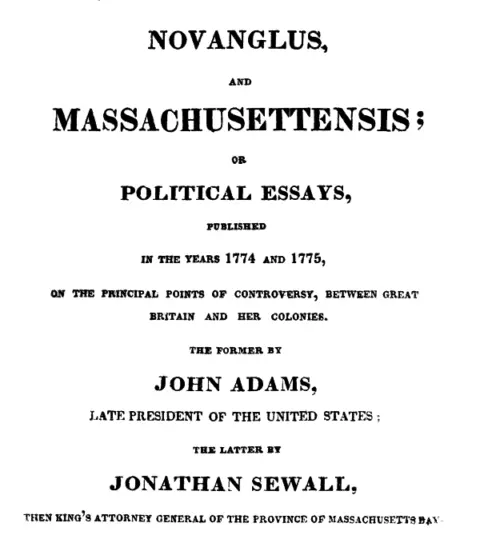
Novanglus, and Massachusettensis or, Political Essays, Published in the Years 1774 and 1775, on the Principal Points of Controversy, between Great Britain and Her Colonies
My indignation at this letter, has sometimes been softened by compassion. It carries on the face of it evident marks of madness. It was written in such a transport of passions, ambition and revenge chiefly, that his reason was manifestly overpowered. The vessel was tost in such a hurricane, that she could not feel her helm. Indeed, he seems to have had a confused consciousness of this himself. Pardon me this excursion, says he, it really proceeds from the state of mind into which our perplexed affairs often throws me."
"It is our highest interest to continue a part of the British empire; and equally our duty to remain subject to the authority of parliament," says Massachusettensis.
We are a part of the British dominions, that is of the king of Great Britain, and it is our interest and duty to continue so. It is equally our interest and duty to continue subject to the authority of parliament, in the regulation of our trade, as long as she shall leave us to govern our internal policy, and to give and grant our own money, and no longer.
This letter concludes with an agreeable flight of fancy. The time may not be so far off, however, as this writer imagines, when the colonies may have the balance of numbers and wealth in her favour. But when that shall happen, if we should attempt to rule her by an American parliament, without an adequate representation in it, she will infallibly resist us by her arms.
NOVANGLUS.
ADDRESSED
To the Inhabitants of the Colony of Massachusetts Bay,
March 13, 1775.
MY FRIENDS,
It has been often observed by me, and it cannot be too often repeated, that colonization is casus omissus at common law. There is no such title known in that law. By common law, I mean that system of customs, written and unwritten, which was known and in force in England, in the time of king Richard 1st. This continued to be the case, down to the reign of Elizabeth, and king James 1st. In all that time, the laws of England were confined to the realm, and within the four seas. There was no provision made in this law for governing colonies beyond the Atlantic, or beyond the four seas, by authority of parliament, no nor for the king to grant charters to subjects to settle in foreign countries. It was the king's prerogative to prohibit the emigration of any of his subjects, by issuing his writ ne exeat regno. And therefore it was in the king's power to permit his subjects to leave the kingdom. 1 Hawk. P.C. c. 22. § 4. "It is a high crime to disobey the king's lawful commands, or prohibitions, as not returning from beyond sea, upon the king's letters to that purpose; for which the offender's lands shall be seized until he return; and when he does return, he shall be fined, &c. or going beyond sea, against the king's will, expressly signified, either by the writ ne exeat regno, or under the great or privy seal, or signet, or by proclamation." When a subject left the kingdom, by the king's permission, and if the nation did not remonstrate against it, by the nation's permission too, at least connivance, he carried with him, as a man, all the rights of nature. His allegiance bound him to the king, and entitled him to protection. But how? not in France; the king of England was not bound to protect him in France, nor in America; not in the dominions of Lewis, nor of Passachus, or Massachusetts. He had a right to protection, and the liberties of England upon his return there, not otherwise. How then do we, New Englandmen, derive our laws? I say, not from parliament, not from common law, but from the law of nature, and the compact made with the king in our charters. Our ancestors were entitled to the common law of England, when they emigrated, that is, to just so much of it as they pleased to adopt, and no more. They were not bound or obliged to submit to it, unless they chose it. By a positive principle of the common law, they were bound, let them be in what part of the world they would, to do nothing against the allegiance of the king. But no kind of provision was ever made by common law, for punishing or trying any man, even for treason, committed out of the realm. He must be tried in some county of the realm, by that law, the county where the overt-act was done, or he could not be tried at all. Nor was any provision ever made, until the reign of Henry VIII. for trying treasons committed abroad, and the acts of that reign were made on purpose to catch cardinal Pole.