THE CLASSIC COLLECTION✦The StrollersCLASSIC FREE BOOKS
The Strollers
Frederic Stewart Isham
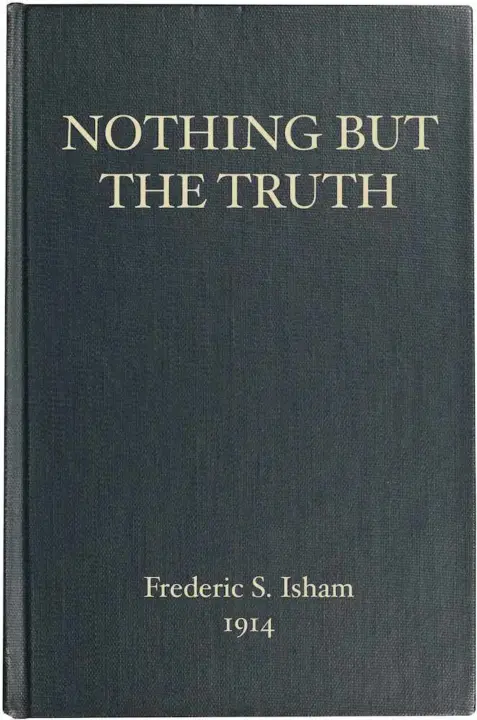
THE CLASSIC COLLECTION · 1914
"Nothing But the Truth" by Frederic S. Isham is a novel written in the early 20th century. The story revolves around Bob Bennett, a young man facing financial hardship after his father's business failure. As he navigates social life amidst this turmoil, the narrative explores themes of honesty, societal expectations, and the complexities of love and friendship. The opening of the novel introduces readers to a conversation between Bob and his friends at the University Club, where they challenge him to undertake a daring experiment: to only speak the truth for three weeks. This sets off a chain of events that complicates Bob's interactions as he tries to balance his obligations to his father and the expectations of his social circle. As he contemplates the task ahead, the weight of truthfulness becomes apparent, particularly when he encounters Miss Gwendoline Gerald, a figure of his affection. The narrative hints at Bob's struggles between loyalty, honesty, and societal pressures, setting the stage for a comedic and poignant exploration of the challenges that arise when one dares to live authentically in a world often driven by pretense.
Introduction adapted from the source catalogue; source summaries may be automatically generated.
Free to read · English · 73,905 words · No account needed
MAKE TIME FOR A GOOD BOOK
On by default. Untick to stop anonymous reading totals. Each page counts after 10 seconds in view. How this works.
Anonymous counting is on unless you have switched it off.
“You bet I did,” returned Dickie. “I put in a good day,” viciously, “while you were fishing.”
“Yes,” corroborated the commodore, “Dickie found a dozen people who think you’re dottie on the crumpet, all right.”
Bob folded his arms, still regarding Dickie. “You know what I’ve a mind
to do to you?”
“Hold on!” said Dan hastily. “This matter’s got to be handled tactfully. We can’t, any one of us, give way to our personal feelings, however much we may want to. Let’s be businesslike. Eh, Clarence? Businesslike.”
“Sure,” said Clarence faintly.
But Dickie, standing behind the commodore and Clarence, said something about tact being a waste of time in some cases. He said it in such a sneering nasty way that Bob breathed deep.
“I’ve simply got to spank that little rooster,” he muttered.
But again the commodore smoothed things over. “Shut up, Dickie,” he said angrily. “You’ll spoil all. I’m sure Bob wants to help us out, if he can. He knows it’s really up to him, to do so. Bob’s a good sport.” It was an awful effort for the commodore to appear nice and amiable, but he managed to, for the moment. “You will help us out, won’t you?” he added, placing velvety fingers on Bob’s arm.
But Bob with a vigorous swing shook off those fingers. He didn’t intend being taken into custody. Dan and the others might as well understand that, first as last. The commodore’s voice grew more appealing.
“Don’t you see you’re being crazy will account for everything?”
“Oh, will it?” In a still small voice.
“Miss Gwendoline asked me if you’d showed signs before coming down here?” piped up Dickie. And again Bob breathed deep. Then his thoughts floated away. Dickie was too insignificant to bother with.
“Hallucinations!” observed the commodore briskly. “Fits you to a T!”
Bob didn’t answer. He was trying to think if she—Miss Gwendoline—hadn’t said something about hallucinations?
“You simply imagined all those things you confided to Mrs. Dan. You didn’t mean to tell what wasn’t so, but you couldn’t help yourself. You really believed it all, at the time. You are irresponsible.”
“Maybe you’ll tell me next there isn’t any Gee-gee,” said Bob. “Also, that Miss Gid-up is but an empty coinage of the brain?”
“No, we’ll do better than that. The existence of a Gee-gee accounts, in part, for your condition. First stage, Gee-gee on the brain; then, brain-storm! Gee-gee is part of your obsession!”
Your reading position is saved on this browser. Take it to another device with a library code. Reading pages adapt to text, rather than matching a printed edition.
Frederic Stewart Isham
Frederic Stewart Isham
Frederic Stewart Isham
BEHIND THE BOOK
This eBook is for the use of anyone anywhere in the United States and most other parts of the world at no cost and with almost no restrictions whatsoever. You may copy it, give it away or re-use it under the terms of the Project Gutenberg License included with this eBook or online at www.gutenberg.org. If you are not located in the United States, you will have to check the laws of the country where you are located before using this eBook. Read the source licence.
The original source file, including credits and licence, is retained by this library. Request an original-format copy at no charge. Please include the book title and Project Gutenberg identifier #43916.
KEEP YOUR CURIOSITY GOING
Coulson Kernahan

Maurice Baring
Frances Wright
Cécile Tormay

Frederic Jesup Stimson

W. H. P. (William Henry Pope) Jarvis