THE CLASSIC COLLECTION✦The StrollersCLASSIC FREE BOOKS
The Strollers
Frederic Stewart Isham
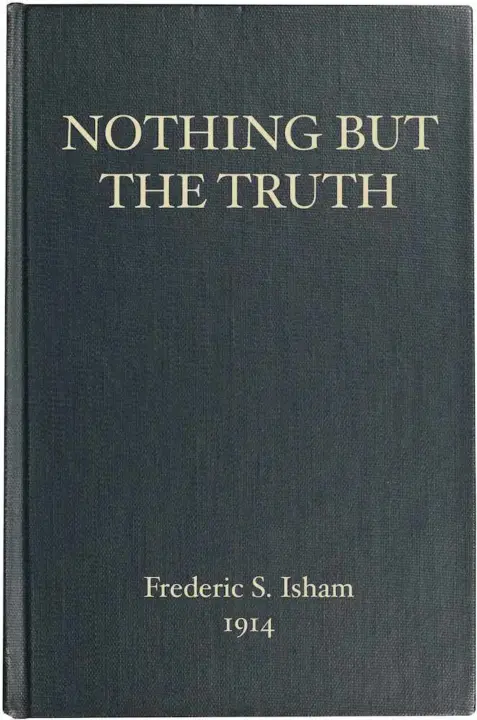
THE CLASSIC COLLECTION · 1914
"Nothing But the Truth" by Frederic S. Isham is a novel written in the early 20th century. The story revolves around Bob Bennett, a young man facing financial hardship after his father's business failure. As he navigates social life amidst this turmoil, the narrative explores themes of honesty, societal expectations, and the complexities of love and friendship. The opening of the novel introduces readers to a conversation between Bob and his friends at the University Club, where they challenge him to undertake a daring experiment: to only speak the truth for three weeks. This sets off a chain of events that complicates Bob's interactions as he tries to balance his obligations to his father and the expectations of his social circle. As he contemplates the task ahead, the weight of truthfulness becomes apparent, particularly when he encounters Miss Gwendoline Gerald, a figure of his affection. The narrative hints at Bob's struggles between loyalty, honesty, and societal pressures, setting the stage for a comedic and poignant exploration of the challenges that arise when one dares to live authentically in a world often driven by pretense.
Introduction adapted from the source catalogue; source summaries may be automatically generated.
Free to read · English · 73,905 words · No account needed
MAKE TIME FOR A GOOD BOOK
On by default. Untick to stop anonymous reading totals. Each page counts after 10 seconds in view. How this works.
Anonymous counting is on unless you have switched it off.
“It isn’t the green garden talking, is it, Bob?” asked Clarence Van Duzen whose sole occupation was being a director in a few corporations—or, more strictly speaking, not being one. It took almost all Clarence’s time to “direct” his wife, or try to.
Bob looked at Clarence reproachfully. “No,” he said. “I’m still master of all my thoughts.” Gloomily. “I couldn’t forget if I tried.”
“That’s all right, then,” said Dickie.
Then Clarence “took” some one else who staked Bob. And Dickie did likewise. And there was some more talk. And then Bob staked himself.
“Little short of cash at the bank just now,” he observed. “But if you’ll take my note—”
“Take your word if you want,” said the commodore.
“No; here’s my note.” He gave it—a large amount—payable in thirty days. It was awful, but he did it. He hardly thought what he was doing. Having the utmost confidence he would win, he didn’t stop to realize what a large contract he was taking on. But Dan, Dickie, Clarence and the others did.
“Of course, you can’t go away and hide,” said Dickie to Bob with sudden
suspicion.
“No; you can’t do that,” from Clarence. “Or get yourself arrested and locked up for three weeks! That wouldn’t be fair, old chap.”
“Bob understands he’s got to go on in the even tenor of his way,” said
the commodore.
Bob nodded. “Just as if nothing had happened!” he observed. “I’ll not seek, or I’ll not shirk. I’m on honor, you understand.”
“That’s good enough for me!” said Dickie. “Bob’s honest.”
“And me!” from Clarence.
“And me!” from half a dozen other good souls, including the non-aqueous
commodore.
“Gentlemen, I thank you,” said Bob, affected by this outburst of confidence. “I thank you for this display of—this display—”
“Cut it!”
“Cork it up! And speaking of corks—”
“When does it begin?” interrupted Bob.
“When you walk out of here,”
“At the front door?”
“When your foot touches the sidewalk, son.” The commodore who was about forty in years sometimes assumed the paternal.
“Never mind the ‘son.’” Bob shuddered. “One father at a time, please!” And then hastily, not to seem ungracious: “I’ve got such a jolly good, real dad, you understand—”
The commodore dropped the paternal. “Well, lads, here’s a bumper to
Bob,” he said.
“We see his finish.”
“No doubt of that.”
“To Bob! Good old Bob! Ho! ho!”
“Ha! ha!” said Bob funereally.
Then he got up.
“Going?”
“Might as well.”
The commodore drew out a watch.
Your reading position is saved on this browser. Take it to another device with a library code. Reading pages adapt to text, rather than matching a printed edition.
Frederic Stewart Isham
Frederic Stewart Isham
Frederic Stewart Isham
BEHIND THE BOOK
This eBook is for the use of anyone anywhere in the United States and most other parts of the world at no cost and with almost no restrictions whatsoever. You may copy it, give it away or re-use it under the terms of the Project Gutenberg License included with this eBook or online at www.gutenberg.org. If you are not located in the United States, you will have to check the laws of the country where you are located before using this eBook. Read the source licence.
The original source file, including credits and licence, is retained by this library. Request an original-format copy at no charge. Please include the book title and Project Gutenberg identifier #43916.
KEEP YOUR CURIOSITY GOING
Coulson Kernahan

Maurice Baring
Frances Wright
Cécile Tormay

Frederic Jesup Stimson

W. H. P. (William Henry Pope) Jarvis