THE CLASSIC COLLECTION✦The StrollersCLASSIC FREE BOOKS
The Strollers
Frederic Stewart Isham
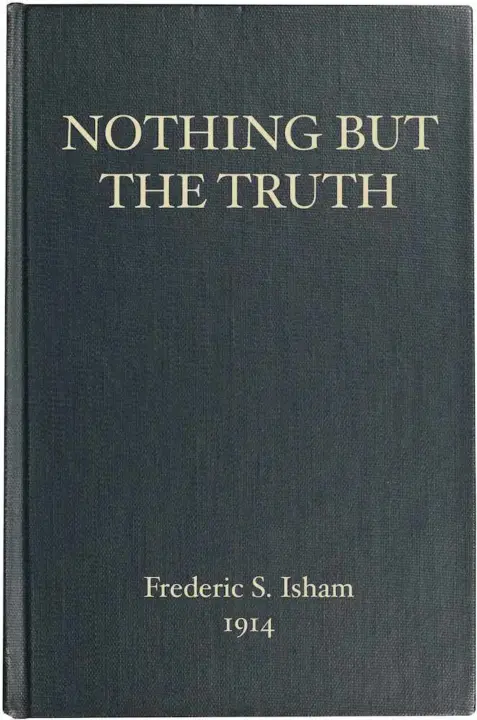
THE CLASSIC COLLECTION · 1914
"Nothing But the Truth" by Frederic S. Isham is a novel written in the early 20th century. The story revolves around Bob Bennett, a young man facing financial hardship after his father's business failure. As he navigates social life amidst this turmoil, the narrative explores themes of honesty, societal expectations, and the complexities of love and friendship. The opening of the novel introduces readers to a conversation between Bob and his friends at the University Club, where they challenge him to undertake a daring experiment: to only speak the truth for three weeks. This sets off a chain of events that complicates Bob's interactions as he tries to balance his obligations to his father and the expectations of his social circle. As he contemplates the task ahead, the weight of truthfulness becomes apparent, particularly when he encounters Miss Gwendoline Gerald, a figure of his affection. The narrative hints at Bob's struggles between loyalty, honesty, and societal pressures, setting the stage for a comedic and poignant exploration of the challenges that arise when one dares to live authentically in a world often driven by pretense.
Introduction adapted from the source catalogue; source summaries may be automatically generated.
Free to read · English · 73,905 words · No account needed
MAKE TIME FOR A GOOD BOOK
On by default. Untick to stop anonymous reading totals. Each page counts after 10 seconds in view. How this works.
Anonymous counting is on unless you have switched it off.
Ah, what was that? An open elevator?—people going in?—She, too,—those with her—Yes—click! a closed door! The radiant vision had vanished, was going upward; Bob breathed again. Think of being even paradoxically glad at witnessing her disappear! Bob ceased now to think; stood as in a trance.
“Why do people go to concerts?” said the commodore in aggrieved tones. “Some queen, that!”
“And got the rocks—or stocks!” from Dickie. “Owns about three of those railroads that are going a-begging nowadays.”
“Wake up, Bobbie!” some one now addressed that abstracted individual.
Bob shook himself.
“Old friend of yours, Miss Gwendoline Gerald, I believe?” said the
commodore significantly.
“Yes; I’ve known Miss Gerald for some time,” said Bob coldly.
“‘Known for some time’—” mimicked the commodore. “Phlegmatic dog! Well, what shall we do now?”
“Hang around until the concert’s over?” suggested Dickie.
“Hang around nothing!” said the commodore. “It’s one of those classical high-jinks.” Disgustedly. “Lasts so late the sufferers haven’t time for anything after it’s over. Just enough energy left to stagger to their cars and fall over in a comatose condition.”
“Suppose we could go to the bar?”
“Naughty! Naughty!” A sprightly voice interrupted.
The commodore wheeled. “Mrs. Ralston!” he exclaimed gladly.
It was the gorgeous lady of the gorgeous car.
“Just finished my shopping and thought I’d have a look in here,” she
said vivaciously.
“Concert, I suppose?” from the commodore, jubilantly.
“Yes. Dubussy. Don’t you adore Dubussy?” with schoolgirlish enthusiasm. Though almost sixty, she had the manners of a “just-come-out.”
“Nothing like it,” lied the commodore.
“Ah, then you, too, are a modern?” gushed the lady.
“I’m so advanced,” said the commodore, “I can’t keep up with myself.”
They laughed. “Ah, silly man!” said the lady’s eyes. Bob gazed at her and the commodore enviously. Oh, to be able once more to prevaricate like that! The commodore had never heard Dubussy in his life. Ragtime and merry hornpipes were his limits. And Mrs. Ralston was going to the concert, it is true, but to hear the music? Ah, no! Her box was a fashionable rendezvous, and from it she could study modernity in hats. Therein, at least, she was a modern of the moderns. She was so advanced, the styles had fairly to trot, or turkey-trot, to keep up with her.
“Well,” she said, with that approving glance women usually bestowed upon Bob, “I suppose I mustn’t detain you busy people after that remark I overheard.”
Your reading position is saved on this browser. Take it to another device with a library code. Reading pages adapt to text, rather than matching a printed edition.
Frederic Stewart Isham
Frederic Stewart Isham
Frederic Stewart Isham
BEHIND THE BOOK
This eBook is for the use of anyone anywhere in the United States and most other parts of the world at no cost and with almost no restrictions whatsoever. You may copy it, give it away or re-use it under the terms of the Project Gutenberg License included with this eBook or online at www.gutenberg.org. If you are not located in the United States, you will have to check the laws of the country where you are located before using this eBook. Read the source licence.
The original source file, including credits and licence, is retained by this library. Request an original-format copy at no charge. Please include the book title and Project Gutenberg identifier #43916.
KEEP YOUR CURIOSITY GOING
Coulson Kernahan

Maurice Baring
Frances Wright
Cécile Tormay

Frederic Jesup Stimson

W. H. P. (William Henry Pope) Jarvis