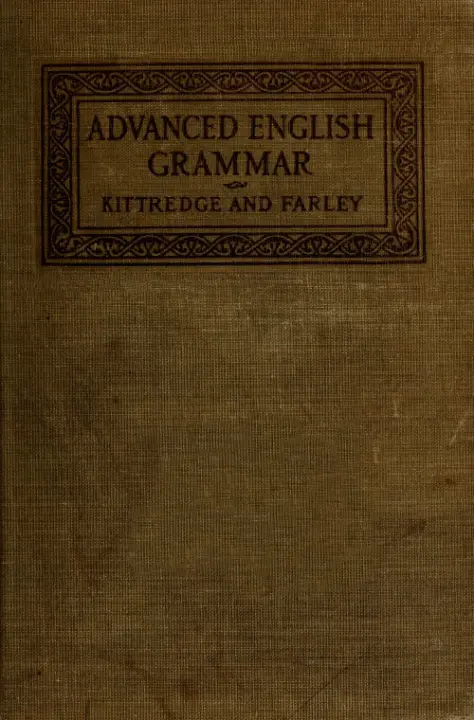
An Advanced English Grammar with Exercises
George Lyman Kittredge & Frank Edgar Farley
THE CLASSIC COLLECTION · 1907
"Notes on Witchcraft" by George Lyman Kittredge is a historical account written in the early 20th century. This work focuses on the witchcraft phenomenon in New England, particularly the Salem Witch Trials, providing an analysis of the sociocultural context of witchcraft beliefs and how they manifested during this period. Kittredge aims to explore the belief in witchcraft as a universal human concern rather than an anomaly of Puritan thought, emphasizing that the events at Salem should be interpreted within the broader historical framework of witchcraft. The opening of the book discusses the historical tendency to view New England colonists as uniquely separated from European thought patterns, particularly concerning beliefs in witchcraft. Kittredge sets the stage by asserting that witchcraft was a globally recognized superstition, not exclusive to Puritan belief, and that the events of 1692 should be viewed as part of a larger pattern of witch trials throughout history. He critiques the idea that the Salem witch trials were driven by uncommon fanaticism, arguing instead that they were emblematic of the broader societal beliefs and tensions of the time, shaped by the shared fears and influences that permeated 17th-century thought globally.
Introduction adapted from the source catalogue; source summaries may be automatically generated.
Free to read · English · 27,603 words · No account needed
MAKE TIME FOR A GOOD BOOK
On by default. Untick to stop anonymous reading totals. Each page counts after 10 seconds in view. How this works.
Anonymous counting is on unless you have switched it off.
[177] Legge, Scottish Review, XVIII, 273-274. Ady (A Candle in the Dark, 1656, p. 105) says: “A little before the Conquest of Scotland (as is reported upon good intelligence) the Presbytery of Scotland did, by their own pretended authority, take upon them to Summon, Convent, Censure, and Condemn people to cruel death for Witches and (as is credibly reported) they caused four thousand to be executed by Fire and Halter, and had as many in prison to be tried by them, when God sent his conquering Sword to suppress them.” The “conquest” to which Ady refers is Cromwell’s in 1650. It is well known that from 1640 to Cromwell’s invasion, witch prosecution ran riot in Scotland, but that during his supremacy there were very few executions in that country (see Legge, pp. 266-267). Cf. p. 8, note 6, above.
[178] Die praktischen Folgen des Aberglaubens, p. 34.
[179] Soldan, Geschichte der Hexenprozesse, ed. Heppe, I,
492.
[180] Dæmonolatreia, Lugduni, 1595.
[181] See p. 42, above.
[182] Soldan, Geschichte der Hexenprozesse, ed. Heppe, II,
38 ff.
[183] See the extraordinary enumeration in Roskoff, Geschichte des Teufels, Leipzig, 1869, II, 293 ff.; cf. S. Riezler, Geschichte der Hexenprozesse in Bayern, pp. 141 ff., 283 ff.
[184] Potts, The Wonderfull Discoverie of Witches, 1613
(Chetham Society reprint).
[185] Matthew Hopkins, Discovery of Witches, 1647, p. 3.
[186] John Stearne, A Confirmation and Discovery of
Witchcraft, 1648, p. 14.
[187] Wright, Narratives of Sorcery and Magic, Chap. xxv.
[188] Memorials, 1732, p. 163.
[189] Page 450.
[190] A Relation of the Diabolical Practices of above Twenty Wizards and Witches, 1697; Sadducismus Debellatus, 1698; A History of the Witches of Renfrewshire, 1877. A seventh committed suicide in prison.
[191] An Account of the Tryals, Examination and Condemnation, of Elinor Shaw, and Mary Phillips [etc.], London [1705]; The Northamptonshire Witches. Being a true and faithful Account of the Births [etc.] of Elinor Shaw, and Mary Phillips, (The two notorious Witches) That were executed at Northampton on Saturday, March the 17th, 1705.... Communicated in a Letter last Post, from Mr. Ralph Davis, of Northampton ... London, 1705. The first tract is dated March 8, 1705; the second, March 18th, 1705. Both are signed “Ralph Davis.” I have used the reprints by Taylor & Son, Northampton, 1866. On this case, see [F. Marshall,] A Brief History of Witchcraft, with Especial Reference to Northamptonshire, Northampton, 1866, pp. 13-15, 16; Notes and Queries, 7th Series, IX, 117; Northamptonshire Notes and Queries II, 19; Eugene Teesdale, in Bygone Northamptonshire, edited by William Andrews, 1891, pp. 114-115; Gough, British Topography, 1780, II, 46.
Your reading position is saved on this browser. Take it to another device with a library code. Reading pages adapt to text, rather than matching a printed edition.
George Lyman Kittredge & Frank Edgar Farley
BEHIND THE BOOK
This eBook is for the use of anyone anywhere in the United States and most other parts of the world at no cost and with almost no restrictions whatsoever. You may copy it, give it away or re-use it under the terms of the Project Gutenberg License included with this eBook or online at www.gutenberg.org. If you are not located in the United States, you will have to check the laws of the country where you are located before using this eBook. Read the source licence.
The original source file, including credits and licence, is retained by this library. Request an original-format copy at no charge. Please include the book title and Project Gutenberg identifier #70895.
KEEP YOUR CURIOSITY GOING
Cécile Tormay

Moritz Busch
John L. Ransom
Frances Wright
Cécile Tormay

Mabel Potter Daggett