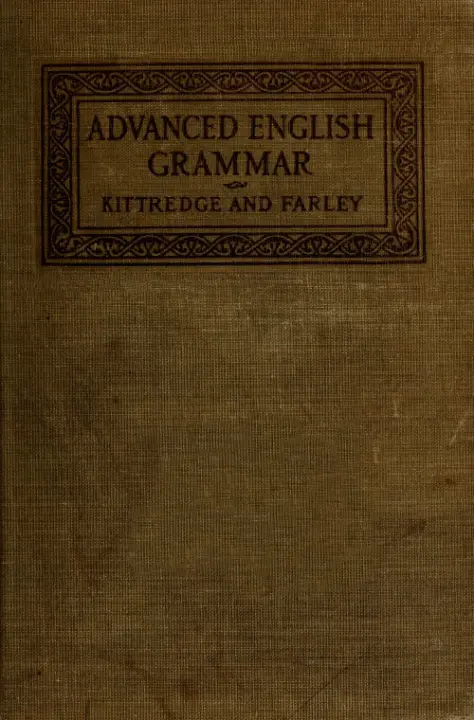
An Advanced English Grammar with Exercises
George Lyman Kittredge & Frank Edgar Farley
THE CLASSIC COLLECTION · 1907
"Notes on Witchcraft" by George Lyman Kittredge is a historical account written in the early 20th century. This work focuses on the witchcraft phenomenon in New England, particularly the Salem Witch Trials, providing an analysis of the sociocultural context of witchcraft beliefs and how they manifested during this period. Kittredge aims to explore the belief in witchcraft as a universal human concern rather than an anomaly of Puritan thought, emphasizing that the events at Salem should be interpreted within the broader historical framework of witchcraft. The opening of the book discusses the historical tendency to view New England colonists as uniquely separated from European thought patterns, particularly concerning beliefs in witchcraft. Kittredge sets the stage by asserting that witchcraft was a globally recognized superstition, not exclusive to Puritan belief, and that the events of 1692 should be viewed as part of a larger pattern of witch trials throughout history. He critiques the idea that the Salem witch trials were driven by uncommon fanaticism, arguing instead that they were emblematic of the broader societal beliefs and tensions of the time, shaped by the shared fears and influences that permeated 17th-century thought globally.
Introduction adapted from the source catalogue; source summaries may be automatically generated.
Free to read · English · 27,603 words · No account needed
MAKE TIME FOR A GOOD BOOK
On by default. Untick to stop anonymous reading totals. Each page counts after 10 seconds in view. How this works.
Anonymous counting is on unless you have switched it off.
[81] Saducismus Triumphatus, Part II, ed. 1682, p. 4. (ed. 1726, pp. 225-226). Glanvill is here replying to Webster, whose book, it will be remembered, appeared in 1677.
[82] Increase Mather’s copy is in the Harvard College
Library.
[83] Lowell, New England Two Centuries Ago, Writings,
Riverside edition, II, 73.
[84] Leviathan, i, 2 (English Works, ed. Molesworth, III, 9). Compare Hobbes’s Dialogue between a Philosopher and a Student of the Common Law of England (English Works, VI, 96):--“L. I know not. Besides these crimes, there is conjuration, witchcraft, sorcery and enchantment; which are capital by the statute I James, c. 12.--P. But I desire not to discourse of that subject. For though without doubt there is some great wickedness signified by those crimes; yet I have ever found myself too dull to conceive the nature of them, or how the devil hath power to do so many things which witches have been accused of.” Wier is far more humane, as well as more reasonable. If one holds, he writes, that witches are to be severely punished for their evil intent, let it be remembered that there is a great difference between sane and insane will. “Quod si quis contentiose uoluntatem seuerius puniendam defendat, is primum distinguat inter uoluntatem hominis sani perfectam, quae in actum uere dirigi coeperit: et inter uitiatae mentis sensum, uel (si uoles) corruptam amentis uoluntatem: cui suo opere, quasi alterius esset, colludit diabolus, nec alius insulse uolentem subsequitur effectus.” De Præstigiis Dæmonum, vi, 21, ed. 1568, pp. 641-642.
[85] Table-Talk, 1689, p. 59 (the first edition). Selden
died in 1654.
[86] Soldan, Geschichte der Hexenprozesse, ed. Heppe, II,
243.
[87] A Candle in the Dark: or, A Treatise concerning the Nature of Witches & Witchcraft, 1656, p. 41.
[88] Sir Robert Filmer’s brief tract, An Advertisement to the Jury-men of England, touching Witches, was occasioned, according to the Preface, by “the late Execution of Witches at the Summer Assizes in Kent.” It was first published in 1652, and may be found annexed to the Free-holders Grand Inquest, 1679. The case which elicited Sir Robert’s little book is reported in A Prodigious & Tragicall History of the Arraignment, Tryall, Confession, and Condemnation of six Witches at Maidstone, in Kent, at the Assizes there held in July, Fryday 30, this present year, 1652 (London, 1652, reprinted 1837).
[89] A. D. White, A History of the Warfare of Science with
Theology, 1896, I, 362.
[90] Wood, Athenæ Oxonienses, ed. Bliss, III, 1114.
[91] Dr. Hutchinson’s admirable work, An Historical Essay concerning Witchcraft, which still remains one of the most valuable treatises on this subject that we have, was published in 1718. It appeared in a second edition in 1720, in which year he was appointed Bishop of Down and Connor.
Your reading position is saved on this browser. Take it to another device with a library code. Reading pages adapt to text, rather than matching a printed edition.
George Lyman Kittredge & Frank Edgar Farley
BEHIND THE BOOK
This eBook is for the use of anyone anywhere in the United States and most other parts of the world at no cost and with almost no restrictions whatsoever. You may copy it, give it away or re-use it under the terms of the Project Gutenberg License included with this eBook or online at www.gutenberg.org. If you are not located in the United States, you will have to check the laws of the country where you are located before using this eBook. Read the source licence.
The original source file, including credits and licence, is retained by this library. Request an original-format copy at no charge. Please include the book title and Project Gutenberg identifier #70895.
KEEP YOUR CURIOSITY GOING
Cécile Tormay

Moritz Busch
John L. Ransom
Frances Wright
Cécile Tormay

Mabel Potter Daggett