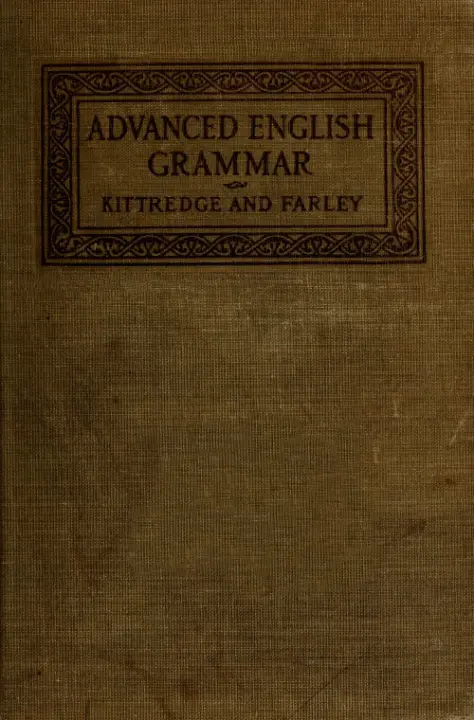
An Advanced English Grammar with Exercises
George Lyman Kittredge & Frank Edgar Farley
THE CLASSIC COLLECTION · 1907
"Notes on Witchcraft" by George Lyman Kittredge is a historical account written in the early 20th century. This work focuses on the witchcraft phenomenon in New England, particularly the Salem Witch Trials, providing an analysis of the sociocultural context of witchcraft beliefs and how they manifested during this period. Kittredge aims to explore the belief in witchcraft as a universal human concern rather than an anomaly of Puritan thought, emphasizing that the events at Salem should be interpreted within the broader historical framework of witchcraft. The opening of the book discusses the historical tendency to view New England colonists as uniquely separated from European thought patterns, particularly concerning beliefs in witchcraft. Kittredge sets the stage by asserting that witchcraft was a globally recognized superstition, not exclusive to Puritan belief, and that the events of 1692 should be viewed as part of a larger pattern of witch trials throughout history. He critiques the idea that the Salem witch trials were driven by uncommon fanaticism, arguing instead that they were emblematic of the broader societal beliefs and tensions of the time, shaped by the shared fears and influences that permeated 17th-century thought globally.
Introduction adapted from the source catalogue; source summaries may be automatically generated.
Free to read · English · 27,603 words · No account needed
MAKE TIME FOR A GOOD BOOK
On by default. Untick to stop anonymous reading totals. Each page counts after 10 seconds in view. How this works.
Anonymous counting is on unless you have switched it off.
These specimens of Webster’s temper of mind might perhaps suffice to show with what slight justification he has been regarded as a scientific rationalist. We must not dismiss him, however, until we have scrutinized his views on the subject of witchcraft itself. He passes for a strong denier of the whole business of sorcery. We shall find that this is a great mistake. So far from denying the existence of witches, Webster is indignant at the imputation that his theories and those of other like-minded scholars should be interpreted in any such sense. “If I deny that a Witch cannot flye in the air, nor be transformed or transubstantiated into a Cat, a Dog, or an Hare, or that the Witch maketh any visible Covenant with the Devil, or that he sucketh on their bodies, or that the Devil hath carnal Copulation with them; I do not thereby deny either the Being of Witches, nor other properties that they may have, for which they may be so called: no more than if I deny that a dog hath rugibility (which is only proper to a Lion) doth it follow that I deny the being of a Dog, or that he hath latrability?”[69] This sentence contains, in effect, the sum and substance of Webster’s negative propositions on the subject.[70] Let us see what he holds as affirmatives.
Though rejecting the theory of an external covenant between the devil and a witch, Webster acknowledges “an internal, mental, and spiritual League or Covenant betwixt the Devil and all wicked persons.” Further, “this spiritual League in some respects and in some persons may be, and is an explicit League, that is, the persons that enter into it, are or may be conscious of it, and know it to be so.”[71] Now there are certain persons, commonly called witches, who are full of “hatred, malice, revenge and envy,” of which the devil is the “author and causer,”[72] and these, by Satan’s instigation, “do secretly and by tradition learn strange poysons, philters and receipts whereby they do much hurt and mischief. Which most strange wayes of poysoning, tormenting, and breeding of unwonted things in the stomach and bellies of people, have not been unknown unto many learned men and Philosophers.”[73] Among these effects of “an art more than Diabolical,” which has “been often practiced by most horrible, malevolent, and wicked persons,” is the production of the plague. There is no doubt of the fact. There are “undeniable examples.” An unguent may be prepared which is of such power that when it is smeared upon the handles of doors, “those that do but lightly touch them are forthwith infected.” In 1536 there was a conspiracy of some forty persons in Italy, who caused the death of many in this way.[74] To such arts Webster ascribes the dreadful outbreak of jail-fever at the Oxford assizes in 1579. This was not, and could not be, the ordinary “prison infection.” It was brought about by the contrivances of one Roland Jenks, “a Popish recusant,” who was condemned for seditious words against the queen. Jenks, it seems, had procured strange poisons of a local apothecary, and had made a kind of candle out of them. As soon as he was condemned, he lighted his candle, from which there arose such a “damp,” or steam, that the pestilence broke out as we have seen.[75] It is manifest, Webster holds, “that these kind of people that are commonly called Witches, are indeed (as both the Greek and Latin names doe signifie) Poysoners, and in respect of their Hellish designs are Diabolical, but the effects they procure flow from natural Causes.”[76] This last proposition is, indeed, perhaps the chief point of Webster’s book. Witches exist, and they do horrible things, but they accomplish their ends, not by the actual intervention of the devil and his imps, but by virtue of an acquaintance with little-known laws of nature. Another example, which cannot be quoted in detail, will make Webster’s position perfectly clear. A man was afflicted with a dreadful disease. The cause was discovered to be the presence of an oaken pin in the corner of a courtyard. The pin was destroyed and the man drank birchen ale. He made a complete recovery. It is plain, according to Webster, that the pulling up and burning of the oaken pin “was with the help of the Birchen Ale the cure; but it can no wayes be judged necessary that the Devil should fix the Oak pin there, but that the Witch might do it himself. Neither can it be thought to be any power given by the Devil to the Oaken pin, that it had not by nature, for in all probability it will constantly by a natural power produce the same effect; only thus far the Devil had a hand in the action, to draw some wicked person to fix the pin there ..., thereby to hurt and torture him.”[77]
Your reading position is saved on this browser. Take it to another device with a library code. Reading pages adapt to text, rather than matching a printed edition.
George Lyman Kittredge & Frank Edgar Farley
BEHIND THE BOOK
This eBook is for the use of anyone anywhere in the United States and most other parts of the world at no cost and with almost no restrictions whatsoever. You may copy it, give it away or re-use it under the terms of the Project Gutenberg License included with this eBook or online at www.gutenberg.org. If you are not located in the United States, you will have to check the laws of the country where you are located before using this eBook. Read the source licence.
The original source file, including credits and licence, is retained by this library. Request an original-format copy at no charge. Please include the book title and Project Gutenberg identifier #70895.
KEEP YOUR CURIOSITY GOING
Cécile Tormay

Moritz Busch
John L. Ransom
Frances Wright
Cécile Tormay

Mabel Potter Daggett