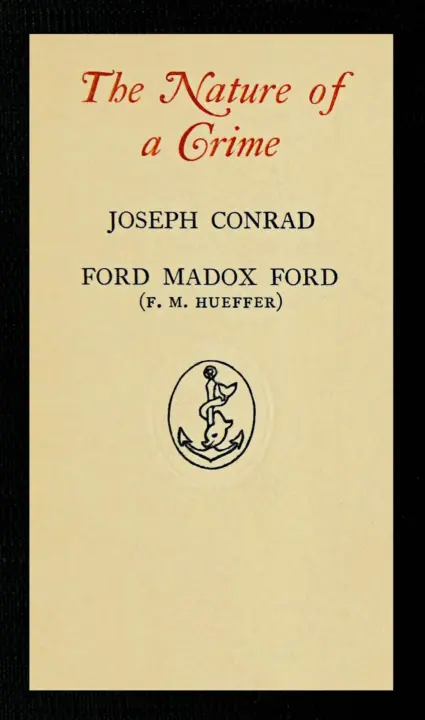
The nature of a crime
Joseph Conrad & Ford Madox Ford
THE CLASSIC COLLECTION · 1921
"Notes on Life & Letters" by Joseph Conrad is a collection of essays and reflections composed during the late 19th and early 20th centuries. The work encapsulates Conrad's insights into literature, critiques of various authors, and contemplations on life, reflecting on the intersection of literary creation and human experience. The essays range from appreciative observations about his literary predecessors, such as Henry James and Alphonse Daudet, to personal reflections on broader social and political themes. The opening portion of the collection begins with Conrad's author's note, where he humbly presents the essays as a personal tidying of his thoughts on literature and life. He describes the arrangement of these works as a mix of literary and political reflections over a span of two decades, conveying his view that art and intellectual expressions are intimately tied to the essence of human existence. Throughout this initial segment, Conrad emphasizes a sincere and contemplative approach to literary criticism, presenting both gratitude and introspection regarding the transient nature of literary endeavors and the artist's struggle for permanence amidst the inevitable decline of all things. The tone is both reflective and engaging, inviting readers to ponder the significance of literature in understanding human life.
Introduction adapted from the source catalogue; source summaries may be automatically generated.
Free to read · English · 78,409 words · No account needed
MAKE TIME FOR A GOOD BOOK
On by default. Untick to stop anonymous reading totals. Each page counts after 10 seconds in view. How this works.
Anonymous counting is on unless you have switched it off.
For my own part, from a short and cursory acquaintance with my kind, I am inclined to think that the last utterance will formulate, strange as it may appear, some hope now to us utterly inconceivable. For mankind is delightful in its pride, its assurance, and its indomitable tenacity. It will sleep on the battlefield among its own dead, in the manner of an army having won a barren victory. It will not know when it is beaten. And perhaps it is right in that quality. The victories are not, perhaps, so barren as it may appear from a purely strategical, utilitarian point of view. Mr. Henry James seems to hold that belief. Nobody has rendered better, perhaps, the tenacity of temper, or known how to drape the robe of spiritual honour about the drooping form of a victor in a barren strife. And the honour is always well won; for the struggles Mr. Henry James chronicles with such subtle and direct insight are, though only personal contests, desperate in their silence, none the less heroic (in the modern sense) for the absence of shouted watchwords, clash of arms and sound of trumpets. Those are adventures in which only choice souls are ever involved. And Mr. Henry James records them with a fearless and insistent fidelity to the peripeties of the contest, and the feelings of the combatants.
The fiercest excitements of a romance de cape et d'epee, the romance of yard-arm and boarding pike so dear to youth, whose knowledge of action (as of other things) is imperfect and limited, are matched, for the quickening of our maturer years, by the tasks set, by the difficulties presented, to the sense of truth, of necessity--before all, of conduct--of Mr. Henry James's men and women. His mankind is delightful. It is delightful in its tenacity; it refuses to own itself beaten; it will sleep on the battlefield. These warlike images come by themselves under the pen; since from the duality of man's nature and the competition of individuals, the life-history of the earth must in the last instance be a history of a really very relentless warfare. Neither his fellows, nor his gods, nor his passions will leave a man alone. In virtue of these allies and enemies, he holds his precarious dominion, he possesses his fleeting significance; and it is this relation in all its manifestations, great and little, superficial or profound, and this relation alone, that is commented upon, interpreted, demonstrated by the art of the novelist in the only possible way in which the task can be performed: by the independent creation of circumstance and character, achieved against all the difficulties of expression, in an imaginative effort finding its inspiration from the reality of forms and sensations. That a sacrifice must be made, that something has to be given up, is the truth engraved in the innermost recesses of the fair temple built for our edification by the masters of fiction. There is no other secret behind the curtain. All adventure, all love, every success is resumed in the supreme energy of an act of renunciation. It is the uttermost limit of our power; it is the most potent and effective force at our disposal on which rest the labours of a solitary man in his study, the rock on which have been built commonwealths whose might casts a dwarfing shadow upon two oceans. Like a natural force which is obscured as much as illuminated by the multiplicity of phenomena, the power of renunciation is obscured by the mass of weaknesses, vacillations, secondary motives and false steps and compromises which make up the sum of our activity. But no man or woman worthy of the name can pretend to anything more, to anything greater. And Mr. Henry James's men and women are worthy of the name, within the limits his art, so clear, so sure of itself, has drawn round their activities. He would be the last to claim for them Titanic proportions. The earth itself has grown smaller in the course of ages. But in every sphere of human perplexities and emotions, there are more greatnesses than one--not counting here the greatness of the artist himself. Wherever he stands, at the beginning or the end of things, a man has to sacrifice his gods to his passions, or his passions to his gods. That is the problem, great enough, in all truth, if approached in the spirit of sincerity and knowledge.
Your reading position is saved on this browser. Take it to another device with a library code. Reading pages adapt to text, rather than matching a printed edition.
Joseph Conrad & Ford Madox Ford
Joseph Conrad
Joseph Conrad
Joseph Conrad
BEHIND THE BOOK
This eBook is for the use of anyone anywhere in the United States and most other parts of the world at no cost and with almost no restrictions whatsoever. You may copy it, give it away or re-use it under the terms of the Project Gutenberg License included with this eBook or online at www.gutenberg.org. If you are not located in the United States, you will have to check the laws of the country where you are located before using this eBook. Read the source licence.
The original source file, including credits and licence, is retained by this library. Request an original-format copy at no charge. Please include the book title and Project Gutenberg identifier #1143.
KEEP YOUR CURIOSITY GOING

David Patterson (Spirit) Hatch

David Patterson (Spirit) Hatch

David Patterson (Spirit) Hatch
Cécile Tormay

Moritz Busch
John L. Ransom