THE CLASSIC COLLECTION✦A Library PrimerCLASSIC FREE BOOKS
A Library Primer
John Cotton Dana
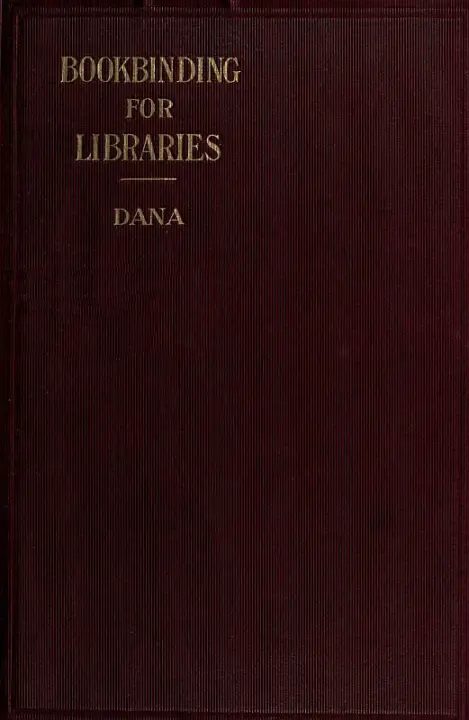
THE CLASSIC COLLECTION · 1906
"Notes on Bookbinding for Libraries" by John Cotton Dana is an instructional manual on the art and practice of bookbinding, written in the early 20th century. This work aims to educate librarians on the processes of binding and rebinding library materials while highlighting the importance of quality and durability in book care. It likely serves as a resource for those looking to better understand both the technical aspects of binding and the practical considerations involved in maintaining a quality library collection. The opening of the book introduces Dana's intentions for the publication, emphasizing that it is meant to provide suggestions rather than definitive answers on bookbinding practices. Dana acknowledges a general lack of knowledge among librarians in America regarding proper binding techniques and expresses a desire for his notes to stimulate interest and improve practices. He briefly recounts his own enlightening experience at a British bindery, reinforcing the need for librarians to engage with the topic actively. Overall, the beginning sets the tone for a comprehensive examination of binding, geared towards improving the longevity and usability of library books.
Introduction adapted from the source catalogue; source summaries may be automatically generated.
Free to read · English · 35,828 words · No account needed
MAKE TIME FOR A GOOD BOOK
On by default. Untick to stop anonymous reading totals. Each page counts after 10 seconds in view. How this works.
Anonymous counting is on unless you have switched it off.
=Start.= When, after cutting, one or more sections of the book come forward, making the fore edge irregular, they are said to have started.
=Steamboating.= Cutting books out of boards, a number being cut at the
same time.
=Straight edge.= A flat ruler.
=Super.= A thin, loosely woven cotton cloth, glued onto the backs of books to help to hold the signatures together and, by extending over to the inside of the cover, to hold book and cover together. In publishers' binding this is usually all that holds a book in its case. It is thin and loosely woven that it may be easily glued down and starched that it may be easily handled. Its place is taken in good binding by fine muslin or jaconet.
=T. E. G.= Top-edge gilt.
=Tacky.= Sticky; spoken often of glue after it has set, but before it
is quite dry.
=Tail.= See Head and tail.
=Tape.= Cotton tape on which many books are best sewn. It should be
stout but flexible.
=Thread.= The thread with which books are sewn is usually made of linen, unbleached. It comes in several sizes. If of good quality, say Hayes's Standard linen, it costs about $1.25 per pound for No. 18 2-cord.
Silk thread is sometimes used in extra binding and on very thick books.
In machine sewing cotton thread is used and wears well.
=Thirty-twomo.= A sheet of paper folded into thirty-two leaves; usually
written 32mo.
=Three-quarters bound.= See Half-bound.
=Tight back.= See Back, tight and loose.
=Title.= The space between the bands upon which the title is lettered.
=Titled.= See Pieced.
=Tools.= Brass stamps used for impressing gold leaf on leather. Applied particularly to the hand stamps and tools used in finishing.
=Top cover.= The upper or front cover of a book in binding.
=Top edges.= The head or top of a book, in contradistinction to
fore-edge or tail.
=Top gilt.= Used in speaking of a book of which the top edge only is
gilded.
=Top side.= The front side of the cover of a book in binding.
=Tree calf.= A bright brown calf stained by acids in conventional imitation of the trunk and branches of a tree.
=Trimmed.= The edges of a book are said to be trimmed when the edges of the larger or projecting leaves only have been cut.
=Trindle.= A strip of thin wood or iron used to take the round out of a
book when it is cut.
=Tub.= The stand which supports the lying press. Originally an actual
tub to catch the shavings.
=Turkey morocco.= Made of goatskins from Turkey. It is very strong, durable leather; expensive, but worth the money.
Your reading position is saved on this browser. Take it to another device with a library code. Reading pages adapt to text, rather than matching a printed edition.
BEHIND THE BOOK
This eBook is for the use of anyone anywhere in the United States and most other parts of the world at no cost and with almost no restrictions whatsoever. You may copy it, give it away or re-use it under the terms of the Project Gutenberg License included with this eBook or online at www.gutenberg.org. If you are not located in the United States, you will have to check the laws of the country where you are located before using this eBook. Read the source licence.
The original source file, including credits and licence, is retained by this library. Request an original-format copy at no charge. Please include the book title and Project Gutenberg identifier #47456.
KEEP YOUR CURIOSITY GOING

Charles G. (Charles Griffith) Ross
Hannah Webster Foster

Emily Lawless
Edwin Hamlin Carr

Charles De Lano Hine
Andrew Ure