THE CLASSIC COLLECTION✦A Library PrimerCLASSIC FREE BOOKS
A Library Primer
John Cotton Dana
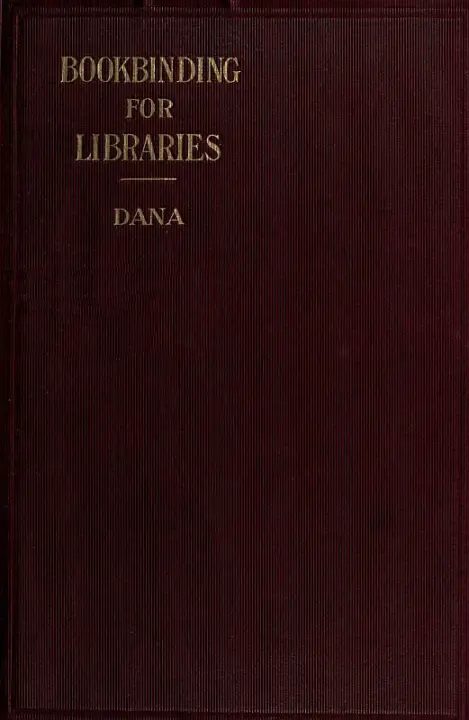
THE CLASSIC COLLECTION · 1906
"Notes on Bookbinding for Libraries" by John Cotton Dana is an instructional manual on the art and practice of bookbinding, written in the early 20th century. This work aims to educate librarians on the processes of binding and rebinding library materials while highlighting the importance of quality and durability in book care. It likely serves as a resource for those looking to better understand both the technical aspects of binding and the practical considerations involved in maintaining a quality library collection. The opening of the book introduces Dana's intentions for the publication, emphasizing that it is meant to provide suggestions rather than definitive answers on bookbinding practices. Dana acknowledges a general lack of knowledge among librarians in America regarding proper binding techniques and expresses a desire for his notes to stimulate interest and improve practices. He briefly recounts his own enlightening experience at a British bindery, reinforcing the need for librarians to engage with the topic actively. Overall, the beginning sets the tone for a comprehensive examination of binding, geared towards improving the longevity and usability of library books.
Introduction adapted from the source catalogue; source summaries may be automatically generated.
Free to read · English · 35,828 words · No account needed
MAKE TIME FOR A GOOD BOOK
On by default. Untick to stop anonymous reading totals. Each page counts after 10 seconds in view. How this works.
Anonymous counting is on unless you have switched it off.
When the book is sewed flexible the bands appear upon the back. When the back is so sewn as to let in the twine, the appearance of raised bands is produced, if at all, by gluing narrow strips of leather across the back before the volume is covered. A hard, closely twisted cord is also sometimes used in fine binding.
=Bastard title.= See Half-title.
=Bead.= A little roll formed by the knots of the headband.
=Beating hammer.= The heavy, short-handled hammer used in beating, weighing generally about 10 lbs. Books are beaten to make the leaves lie close to one another.
=Beating stone.= The bed of stone or iron on which books are beaten.
=Beveled boards.= Very heavy boards for sides, chamfered along the
edges.
=Binder.= A temporary cover for periodicals and pamphlets, usually so arranged that it may be taken off and attached to successive numbers of a publication.
=Bindery.= A book-binding establishment.
=Blank books.= Applied to a large variety of books which are bound with blank leaves, or leaves having ruled lines and little or no printing: account books, memorandum books, ledgers, etc. The binding of such books is a special trade.
=Bleed.= When a book on being trimmed is so cut that some of the print is taken off it is said to bleed.
=Blind-tooled.= When tools are impressed upon the leather, without gold, they are said to be blind or blank, and the book is blind-tooled. This tooling is sometimes called antique.
=Blocking press.= Another and more general term for the stamping or arming press; one of the chief implements used in cloth work. Used for finishing or decorating the sides and back of a cover by a mechanical process.
=Board papers.= Those parts of the end papers which are pasted onto the
boards.
=Board shears.= Heavy shears, usually fitted to a table, and with a
gauge for cutting boards.
=Boards.= Are of several kinds, such as pressing, backing, cutting, burnishing, gilding, etc. The paste-boards used for side covers are termed boards. The boards used for cutting books "out of boards" are called steamboat-boards. Tinned boards are used for finished work, while brass or iron-bound boards are used for pressing cloth-work. See also In boards.
=Bock morocco.= The name given to a leather made of Persian sheepskin usually finished in imitation of morocco. It does not wear well and soon decays.
=Bodkin or stabbing-awl.= A strong point of iron or steel fixed in a wooden handle to form the holes in boards through which to lace bands. Used also for tracing lines for cutting fore-edges.
=Bolt.= Folded edge of sheets in an unopened book.
=Books, sizes of.= See folio, quarto, octavo, sixteenmo, thirty-twomo,
etc.
Your reading position is saved on this browser. Take it to another device with a library code. Reading pages adapt to text, rather than matching a printed edition.
BEHIND THE BOOK
This eBook is for the use of anyone anywhere in the United States and most other parts of the world at no cost and with almost no restrictions whatsoever. You may copy it, give it away or re-use it under the terms of the Project Gutenberg License included with this eBook or online at www.gutenberg.org. If you are not located in the United States, you will have to check the laws of the country where you are located before using this eBook. Read the source licence.
The original source file, including credits and licence, is retained by this library. Request an original-format copy at no charge. Please include the book title and Project Gutenberg identifier #47456.
KEEP YOUR CURIOSITY GOING

Charles G. (Charles Griffith) Ross
Hannah Webster Foster

Emily Lawless
Edwin Hamlin Carr

Charles De Lano Hine
Andrew Ure