THE CLASSIC COLLECTION✦An outlaw’s diary: the CommuneCLASSIC FREE BOOKS
An outlaw’s diary: the Commune
Cécile Tormay
THE CLASSIC COLLECTION · 1909
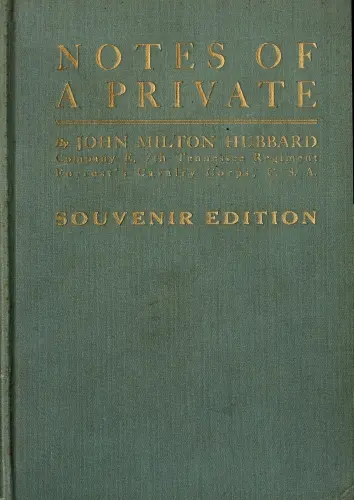
"Notes of a Private" by John Milton Hubbard is a historical account written in the early 20th century. The narrative is rooted in the author's personal experiences as a soldier in the Confederate Army during the American Civil War, specifically while serving in Company E of the Seventh Tennessee Cavalry. The book provides insights into the life and sentiments of the soldiers, as well as various events and battles they participated in, highlighting the complexities of loyalty, valor, and survival amidst the backdrop of war. The opening of the memoir introduces the reader to Hubbard's intentions in documenting his experiences, emphasizing a desire for truthfulness and justice regarding the men and events he observed. He recalls the initial excitement and camaraderie among the young recruits embarking on their military journey and discusses the stark transition from civilian life to war. The reader gets a glimpse of the naïveté of soldiers as they prepare for combat, filled with a mix of humor and earnestness, as they navigate through logistical challenges of soldiering. The narrative sets the foundation for a detailed exploration of wartime experiences, soldier behavior, and evolving perspectives as the Confederate forces engage in various campaigns and encounters throughout the South.
Introduction adapted from the source catalogue; source summaries may be automatically generated.
Free to read · English · 44,859 words · No account needed
MAKE TIME FOR A GOOD BOOK
On by default. Untick to stop anonymous reading totals. Each page counts after 10 seconds in view. How this works.
Anonymous counting is on unless you have switched it off.
Well, as to “Old Fulton.” I should say he had been reared in an atmosphere of gall, wormwood and vinegar. With a desperate temper and no sweetness of soul, upon the slightest provocation he would fly into a towering rage. If asked as to his age, a tart reply, interlarded with oaths, was the result. His stringy hair and long flowing beard were evidences of age. His cadaverous appearance, high cheek bones, piercing gray eyes, alert head set in a long skinny frame, and his fiery passions would have presented an interesting study to the excursionist into the fields of anthropology. This old Kentuckian had joined the Tennesseeans for the purpose, as he said, of soon killing a few Yankees. He never gratified his supreme desire, for within a few months, having, perhaps, tired of camp life, he got his discharge and set his face towards Kentucky. After his departure, we could revert with amusement to “Old Fulton’s” effort to start a camp fire at Island No. 10, with wet wood. When the smoke had blinded the old man, and his patience and wind were exhausted, he leaped upon the pile of fagots and, uttering violent oaths, kicked them in every direction. This exhibition of temper was rather amusing.
About the first of October, 1861, Haywood’s and Neely’s companies were ordered to Camp Beauregard in Graves county to picket and scout for Bowen’s brigade. This was a charming place for holiday soldiering, situated near the village of Feliciana. As the cavalry was encamped outside the infantry lines and there was little fear of attack, the discipline was sufficiently lax to permit us to draw upon the surrounding country for luxuries. These consisted of such things as old hams, chickens and “peach and honey.” The boys did not neglect their opportunities. But life at Camp Beauregard was soon to be a thing of the past. The Federals were known to be making a move from Cairo. We reached Columbus just in time to witness the battle of Belmont across the river. This was the 7th day of November. Grant’s army was driven back to their transports. Here we saw Federal prisoners for the first time, and as many of them were wounded, we seemed to be a little nearer real war. Going into winter quarters we entered upon the monotonous duty of picketing the Milburn road. Dreary nights and weary days. Dull camp routine and nothing to excite interest. But there was to be a change. The news that Fort Donelson had fallen came in the last days of February. The excitement meant that we were leaving Kentucky. With our friends, the Rangers, we were ordered to Island No. 10. Here our hardships increased, as we were poorly supplied with tents and cold rains were falling. The gunboats were replying to our heavy guns, but to little purpose, as the range was poor. They would send an occasional shot clear into the timber, and there was no telling when one might land right in our camp. Our nervousness on this account soon wore off, as we were exposed thus for seventeen days. In the meantime, the river rapidly rose and there was a rushing current through Reelfoot Lake in our rear. This put us on an island. I know that our captain wished to be ordered to the main land. The order came, but there was great fear that it would be countermanded, as Mackall was just superseding McCown, who had given the order. There was hot haste to get beyond the reach of orders. After floundering around for a day in trying to reach a steamer, which it was said would be available in the back water, we concluded that our only resource was to reach a dry spot on the lake shore and collect a few old flatboats and to reach the east side. In making our way to the lake we found much of the back water up to the saddle skirts. We readily secured one old rickety boat, which would carry five men with their horses and accoutrements. As the lake here was five miles wide, and the water still rising, our crossing would surely be slow and perilous. At this juncture, Tom Joyner, George Bradford and I rode five miles along shore, secured a boat, and having led our horses aboard, pulled for the camp. Everything went well with the ten men and ten horses till we were “half seas over.” Then an adverse wind struck our boat, while the other boat, already much in advance seemed to glide over the water. It was exasperating, but we “hove to” by the side of a friendly raft of logs and awaited more propitious breezes or a lucky calm. We were fortunate in reaching land before nightfall and in getting a good supper at a farm house. But next morning the boats must be carried over that stretch of water in order to rescue our fellow soldiers from an impending peril. When we reached the camp only a detail had been left there to inform us that the rest of the command had gone aboard of a steamer in the back water, which was on its way to Randolph. One time happy they! Thrice and four times happy we! We had escaped the perils of the deep waters and the terrors of a Northern prison. Some of us had had a twenty-mile ride on Reelfoot, but strenuous effort had been rewarded.
Your reading position is saved on this browser. Take it to another device with a library code. Reading pages adapt to text, rather than matching a printed edition.
BEHIND THE BOOK
This eBook is for the use of anyone anywhere in the United States and most other parts of the world at no cost and with almost no restrictions whatsoever. You may copy it, give it away or re-use it under the terms of the Project Gutenberg License included with this eBook or online at www.gutenberg.org. If you are not located in the United States, you will have to check the laws of the country where you are located before using this eBook. Read the source licence.
The original source file, including credits and licence, is retained by this library. Request an original-format copy at no charge. Please include the book title and Project Gutenberg identifier #49466.
KEEP YOUR CURIOSITY GOING
Cécile Tormay

Moritz Busch
John L. Ransom
Frances Wright
Cécile Tormay

Mabel Potter Daggett