THE CLASSIC COLLECTION✦An outlaw’s diary: the CommuneCLASSIC FREE BOOKS
An outlaw’s diary: the Commune
Cécile Tormay
THE CLASSIC COLLECTION · 1909
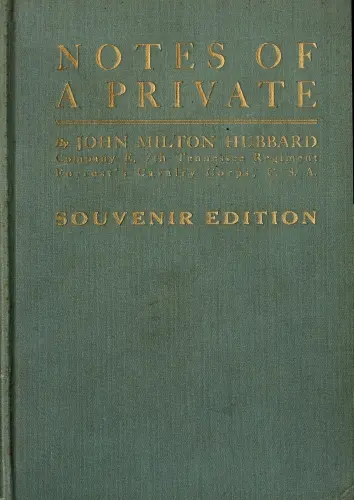
"Notes of a Private" by John Milton Hubbard is a historical account written in the early 20th century. The narrative is rooted in the author's personal experiences as a soldier in the Confederate Army during the American Civil War, specifically while serving in Company E of the Seventh Tennessee Cavalry. The book provides insights into the life and sentiments of the soldiers, as well as various events and battles they participated in, highlighting the complexities of loyalty, valor, and survival amidst the backdrop of war. The opening of the memoir introduces the reader to Hubbard's intentions in documenting his experiences, emphasizing a desire for truthfulness and justice regarding the men and events he observed. He recalls the initial excitement and camaraderie among the young recruits embarking on their military journey and discusses the stark transition from civilian life to war. The reader gets a glimpse of the naïveté of soldiers as they prepare for combat, filled with a mix of humor and earnestness, as they navigate through logistical challenges of soldiering. The narrative sets the foundation for a detailed exploration of wartime experiences, soldier behavior, and evolving perspectives as the Confederate forces engage in various campaigns and encounters throughout the South.
Introduction adapted from the source catalogue; source summaries may be automatically generated.
Free to read · English · 44,859 words · No account needed
MAKE TIME FOR A GOOD BOOK
On by default. Untick to stop anonymous reading totals. Each page counts after 10 seconds in view. How this works.
Anonymous counting is on unless you have switched it off.
When I reported for duty at Verona, Miss., late in January, 1865, Colonel Richardson was in command of Rucker’s Brigade, the ranks of which were filling up surprisingly well, considering the heavy blow we had received in the disastrous repulse of our army in front of Nashville. Most of our men had spent some time at home and came in with new clothes and fresh horses. The rations were good but we had no tents. We constructed rude shelters with whatever timber was at hand, principally fence rails, and over this spread our rubber cloths. Then a good layer of corn stalks was placed for a floor and on this our army blankets. With a roaring log fire in front, we were measurably comfortable. We really had little to do for some time. It was in this camp that it got to the ears of Colonel Richardson that A. S. Coleman, our sutler, who kept a variety of articles in store, was dealing out to the boys a poor article of Confederate whisky. Richardson determined to confiscate the sutler’s whole stock of goods, and sent an officer to seize them. The members of Company E went to the rescue and, it being dark, succeeded, while Coleman was parleying with the officer, in “purloining” all the goods on hand, which they carried out through the back of the tent and kept concealed till the trouble blew over. Coleman was soon doing business at the old stand.
In February, 1865, Forrest was raised to the rank of Lieutenant-General and given the command of about ten thousand cavalry widely dispersed in Alabama, Mississippi and Louisiana. Joe Johnston had superseded Hood and had transferred the remnant of our army further east to place it in the path of Sherman who was marching north from Savannah through South Carolina. So far as our part of the country was concerned, it seemed to me then that the Federals would have had little trouble in sending in a large force and taking possession. With Forrest it was a case of gathering up the fragments, but man never went about anything more earnestly. His work had a telling effect. By a complete reorganization of the cavalry, the troops from each State were thrown into brigades and divisions of their own. This may have added somewhat to the morale of the command, but I do not know that it improved the fighting qualities of the men to any great extent. Certainly there was no better fighting body of men than Rucker’s Old Brigade, composed of Tennesseeans and Mississippians. By the new arrangement, the Tennessee Division was commanded by W. H. Jackson. His two brigade commanders were A. W. Campbell and T. H. Bell. This division now had fat horses, good clothes and good rations. But every man there knew that our quasi holiday would be of short duration. Though the Confederacy seemed tottering to its fall, Jackson’s Division was ready for a campaign. It did not have long to wait. Twelve thousand cavalry were assembled in North Alabama under General James H. Wilson, one of the most capable and enterprising commanders in the Federal army. Accompanied by an immense supply train and a commensurate amount of artillery, this best equipped of all Federal commands set out about the 22nd of March for Selma, Ala., which was a depot for Confederate stores and the location of large factories of arms and ammunition. Being provided with a pontoon train it had little trouble in crossing the swollen streams. It moved rapidly in a southeasterly direction. It was the task of Forrest to move east from Columbus, Miss., fall upon Wilson’s right flank, defeat such detachments as he could cope with, destroy his trains, if possible, and finally beat him to Selma. Forrest’s plans involved the possibility of throwing his whole force against that of Wilson in some favorable position east of Tuskaloosa and to risk the consequences of the greatest cavalry battle ever fought on the continent. How near we subordinates were to witnessing a great event impending and yet how ignorant we were of it! Unforeseen difficulties lay in Forrest’s path while he was apparently making super-human efforts to concentrate his forces for a great battle in which his enemy would number fully two to one. It is painful even to conjecture what the consequences of such a battle might have been. But I anticipate. Prior to the movement towards Selma I had been detailed for duty with the provost guard of Campbell’s Brigade, which was agreeable to me because of the fact that I had not entirely recovered my health, and would have more privileges on the road, though no less responsible service. Our chief duty was to move in the rear and to prevent straggling. It turned out on this expedition to be a position of great danger.
Your reading position is saved on this browser. Take it to another device with a library code. Reading pages adapt to text, rather than matching a printed edition.
BEHIND THE BOOK
This eBook is for the use of anyone anywhere in the United States and most other parts of the world at no cost and with almost no restrictions whatsoever. You may copy it, give it away or re-use it under the terms of the Project Gutenberg License included with this eBook or online at www.gutenberg.org. If you are not located in the United States, you will have to check the laws of the country where you are located before using this eBook. Read the source licence.
The original source file, including credits and licence, is retained by this library. Request an original-format copy at no charge. Please include the book title and Project Gutenberg identifier #49466.
KEEP YOUR CURIOSITY GOING
Cécile Tormay

Moritz Busch
John L. Ransom
Frances Wright
Cécile Tormay

Mabel Potter Daggett