THE CLASSIC COLLECTION✦An outlaw’s diary: the CommuneCLASSIC FREE BOOKS
An outlaw’s diary: the Commune
Cécile Tormay
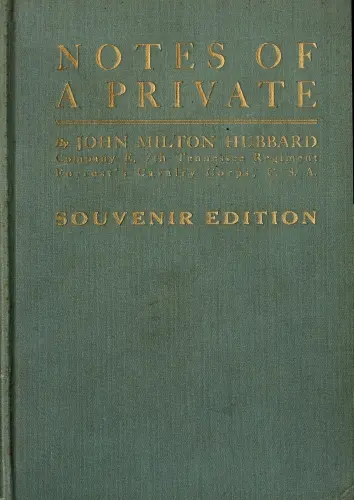
THE CLASSIC COLLECTION · 1909
"Notes of a Private" by John Milton Hubbard is a historical account written in the early 20th century. The narrative is rooted in the author's personal experiences as a soldier in the Confederate Army during the American Civil War, specifically while serving in Company E of the Seventh Tennessee Cavalry. The book provides insights into the life and sentiments of the soldiers, as well as various events and battles they participated in, highlighting the complexities of loyalty, valor, and survival amidst the backdrop of war. The opening of the memoir introduces the reader to Hubbard's intentions in documenting his experiences, emphasizing a desire for truthfulness and justice regarding the men and events he observed. He recalls the initial excitement and camaraderie among the young recruits embarking on their military journey and discusses the stark transition from civilian life to war. The reader gets a glimpse of the naïveté of soldiers as they prepare for combat, filled with a mix of humor and earnestness, as they navigate through logistical challenges of soldiering. The narrative sets the foundation for a detailed exploration of wartime experiences, soldier behavior, and evolving perspectives as the Confederate forces engage in various campaigns and encounters throughout the South.
Introduction adapted from the source catalogue; source summaries may be automatically generated.
Free to read · English · 44,859 words · No account needed
MAKE TIME FOR A GOOD BOOK
On by default. Untick to stop anonymous reading totals. Each page counts after 10 seconds in view. How this works.
Anonymous counting is on unless you have switched it off.
General Smith and General Forrest had approximately and respectively 14,000 and 10,000 men of all arms. Smith kept his army in such compact column movement and so well protected by guards and flankers that Forrest had strenuous work in trying to break into it. The Federals were always ready. This manner of fighting was kept up for about fourteen miles and under a July sun. Men and horses suffered greatly for want of water. Each side lost heavily. The Confederates confidently expected that victory would come to them much as it did in their last great contest. Therefore they fought desperately. The Federals adhering strictly to the tactics laid down by their General declined a general engagement till they could reach a strong natural position. In this respect, Smith acted just as if he knew exactly where he would find an advantageous position in which to deliver battle. And this he found at Harrisburg, a deserted village, which had been absorbed by Tupelo, when the railroad was built. They literally tore up the town by tearing down the houses and using the lumber for breast-works. They brought into requisition every conceivable solid object they could find and, in many places, threw on dirt. They had ample time during the night to make proper dispositions of their troops, so as to be ready for an assault. The Federal line was about a mile and a half in length, and much in the form of a semi-circle. Their twenty-four pieces of artillery were advantageously placed and there was a cavalry brigade on each flank. Their improvised works were garnished with a heavy line of infantry. Certainly the morale of the whole army must have been perfect because of its skillful handling and its success in repulsing the Confederates several times the previous day.
But what of the Southern soldiers, who were to be sent against this formidable array on this memorable morning of the 14th of July, 1864? Having bivouacked in the vicinity they were in line at 7 o’clock. General Forrest, at great risk and with a single individual, that gallant gentleman, Sam Donelson of his staff, having made a careful reconnoissance during the night, was advising with General Lee, who was now in chief command. That these two parties, distinguished in war, capable in command and trusted by their country, felt a heavy weight of responsibility is unquestionable. No element of selfishness was involved in this conference of two men who held in their hands the fate of thousands. They expected to share that day the dangers on the firing line, as was their habit, and therefore might very soon be in the presence of their Maker. Lee generously offered to waive his rank and tender the command for the day to Forrest. This the latter declined, giving as his chief reason the condition of his health. Neither was a man to shirk a responsibility. Lee said that they would move on the enemy’s lines at once. That Forrest did not acquiesce in this determination of Lee, though consenting to lead the right wing in the fight, I am prepared to believe from an incident that occurred the following day and of which I will write further along. Lee urged in support of his position the threatening attitude of the Federals at Mobile, Vicksburg and in North Alabama. Forrest knew that, after deducting horse-holders and other details incident to a battle, the effective fighting force of the Confederates did not exceed seven thousand five hundred men, the casualties of battle and the large number of men rendered unfit for duty by the excessive heat the previous day being considered in the estimate. The Confederates must move to the assault on the right and center through an open space of two hundred yards or more and on their left for fully a mile through an open old field. In the formation, Roddy’s Alabamians, led by Forrest, held the right; Buford’s Kentuckians and Tennesseeans, the center, and Mabry’s Mississippians the left, with the four batteries of artillery properly placed. From the moment the signal gun was heard the fighting was fast and furious, the officers and men struggling to reach the works notwithstanding the withering fire from the protected Federals. Rucker’s Brigade of Chalmers’ division, which had been held in reserve only for a short while, was ordered to the support of Mabry’s Brigade, which, though fighting to the death, was sorely pressed. This movement was on foot, through the open field and facing a broiling sun. This proud little brigade, composed of the Seventh Tennessee, Duff’s Regiment and A. H. Chalmers’ Battalion, rushed to its work with the rebel yell, and was soon intermingled with Mabry’s men near the Federal works. Rucker’s men, as did others, unmindful of their already depleted ranks and seemingly regardless of the issues of life and death, fought as if they expected some supreme moment was near when they would repeat the work of Brice’s Cross Roads. Rucker himself, when within fifty yards of the works, was wounded twice and carried from the field. Captain Statler, of Company E and three of his men were killed here and others wounded. The ground at this point was covered with the dead and wounded while the living were famished because of the intense heat and the lack of water. Human endurance had reached a limit. The Confederates, leaving their dead and wounded on the field, retreated with no attention to order. To save individual life was now all that could be expected of the living.
Your reading position is saved on this browser. Take it to another device with a library code. Reading pages adapt to text, rather than matching a printed edition.
BEHIND THE BOOK
This eBook is for the use of anyone anywhere in the United States and most other parts of the world at no cost and with almost no restrictions whatsoever. You may copy it, give it away or re-use it under the terms of the Project Gutenberg License included with this eBook or online at www.gutenberg.org. If you are not located in the United States, you will have to check the laws of the country where you are located before using this eBook. Read the source licence.
The original source file, including credits and licence, is retained by this library. Request an original-format copy at no charge. Please include the book title and Project Gutenberg identifier #49466.
KEEP YOUR CURIOSITY GOING
Cécile Tormay

Moritz Busch
John L. Ransom
Frances Wright
Cécile Tormay

Mabel Potter Daggett