THE CLASSIC COLLECTION✦An outlaw’s diary: the CommuneCLASSIC FREE BOOKS
An outlaw’s diary: the Commune
Cécile Tormay
THE CLASSIC COLLECTION · 1909
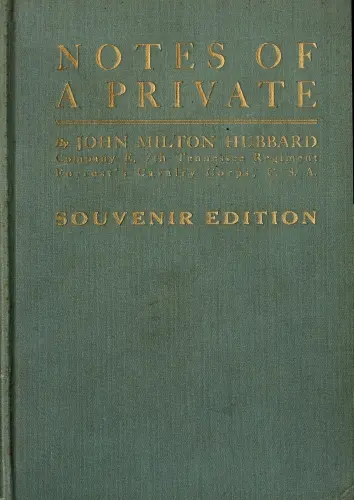
"Notes of a Private" by John Milton Hubbard is a historical account written in the early 20th century. The narrative is rooted in the author's personal experiences as a soldier in the Confederate Army during the American Civil War, specifically while serving in Company E of the Seventh Tennessee Cavalry. The book provides insights into the life and sentiments of the soldiers, as well as various events and battles they participated in, highlighting the complexities of loyalty, valor, and survival amidst the backdrop of war. The opening of the memoir introduces the reader to Hubbard's intentions in documenting his experiences, emphasizing a desire for truthfulness and justice regarding the men and events he observed. He recalls the initial excitement and camaraderie among the young recruits embarking on their military journey and discusses the stark transition from civilian life to war. The reader gets a glimpse of the naïveté of soldiers as they prepare for combat, filled with a mix of humor and earnestness, as they navigate through logistical challenges of soldiering. The narrative sets the foundation for a detailed exploration of wartime experiences, soldier behavior, and evolving perspectives as the Confederate forces engage in various campaigns and encounters throughout the South.
Introduction adapted from the source catalogue; source summaries may be automatically generated.
Free to read · English · 44,859 words · No account needed
MAKE TIME FOR A GOOD BOOK
On by default. Untick to stop anonymous reading totals. Each page counts after 10 seconds in view. How this works.
Anonymous counting is on unless you have switched it off.
The Seventh Tennessee did not participate in this campaign, the history of which is only slightly sketched here in order to give a clear view of the military situation at the time Company E was ordered to rejoin the regiment at Como, Miss. Great attention was now given to organization and equipment. Very many of the recruits had to be armed, and even clothed, before they could become effective soldiers. The work had to be done with dispatch, as we were now having more sunshine, and the roads were drying up. The enemy might soon be on the move. Forrest, having been promoted to the rank of Major-General, assumed command of all the cavalry in North Mississippi and West Tennessee. Within a few days the organizations were perfected, the Seventh Tennessee being assigned to the Fourth Brigade, commanded by Colonel Jeffrey Forrest, the youngest of the Forrest brothers. The entire command was greatly elated by the success of the recent raid, the addition of so many new men, and the prospect of serving under a man who knew nothing but success.
Rumors came in thick and fast that the Federals were preparing to advance both from Memphis and Vicksburg. The Fourth Brigade dropped down to Grenada, in order to watch and frustrate any movement from the south. We had frequently camped at Grenada, and the scenes were familiar. As for myself, I had known the country and many of the people ten years before--yes, indeed, before old college days. We occupied the very ground whence we started on the Holly Springs raid, about one year before. Who could tell but that we should start on one just as remarkable from the same place?
Strong columns of Federals were reported moving from Memphis. From his headquarters at Oxford, the Confederate commander made such dispositions of his four brigades as would most likely defeat the plans of the enemy, so far as they were developed. During the first days of February, it was discovered that about seven thousand well-appointed cavalry were on the road to the rich prairie lands of East Mississippi. Gen. Sooy Smith, their commander, moved with so much dispatch that Forrest, though moving with celerity eastward, found it impossible to head him off till the Federal forces had reached West Point. It was the morning of the 20th of February, 1864. The Federals, going down through Pontotoc and Okolona, had marked their advance by burning houses, barns and fences, and plundering larders and hen roosts. Up to that date, nothing like this had been seen in our part of the country. Our soldiers were aroused by the reports brought in. Of course, there was a firm-set resolution not only to give the ruthless enemy blow for blow, but to avenge the wrongs done to old men, women and children. It looked as if a great battle was impending, and the Confederates were never more ready. We did not know it then, but Forrest was merely trying to hold the enemy in check until reinforcements, under Stephen D. Lee, could arrive from some point below. Jeffrey Forrest’s brigade had already come in contact with Smith’s cavalry between West Point and Aberdeen, and was being pressed back upon West Point. General Forrest, attacking the enemy with a small force on their extreme right wing, discovered, to his chagrin, that they were retreating. There was nothing to do but to press them with energy, so as to inflict as great a loss as possible upon them. Soon it was a lively chase, and the men of Company E were, for the first time, to see Forrest in battle. He was soon right up with the Seventh Regiment, as the men urged their horses through that black prairie mud. Four miles north of West Point the enemy made a stubborn resistance, in the edge of a small woods, but the pursuers, dismounting quickly, drove them away in confusion. Again it was a rattling pace through the mud till the enemy made another stand, five miles further on, where they sought to protect themselves at a rude bridge over a miry little creek, by tearing down fences and making barricades with the rails. Here the Confederates again pressed them in front and on the flanks till they gave way. This running fight, with intervals of resistance, was kept up till nightfall. It was an all-day fight, and we had many sad things to remember. Our dead and wounded were behind us, even if victory was in front of us. Weary and worn, our men and horses were given a few hours of rest. Fortunately, the men found plenty of subsistence and forage in the camp abandoned by the Federals, which helped wonderfully in the work to be done next day.
Your reading position is saved on this browser. Take it to another device with a library code. Reading pages adapt to text, rather than matching a printed edition.
BEHIND THE BOOK
This eBook is for the use of anyone anywhere in the United States and most other parts of the world at no cost and with almost no restrictions whatsoever. You may copy it, give it away or re-use it under the terms of the Project Gutenberg License included with this eBook or online at www.gutenberg.org. If you are not located in the United States, you will have to check the laws of the country where you are located before using this eBook. Read the source licence.
The original source file, including credits and licence, is retained by this library. Request an original-format copy at no charge. Please include the book title and Project Gutenberg identifier #49466.
KEEP YOUR CURIOSITY GOING
Cécile Tormay

Moritz Busch
John L. Ransom
Frances Wright
Cécile Tormay

Mabel Potter Daggett