THE CLASSIC COLLECTION✦An outlaw’s diary: the CommuneCLASSIC FREE BOOKS
An outlaw’s diary: the Commune
Cécile Tormay
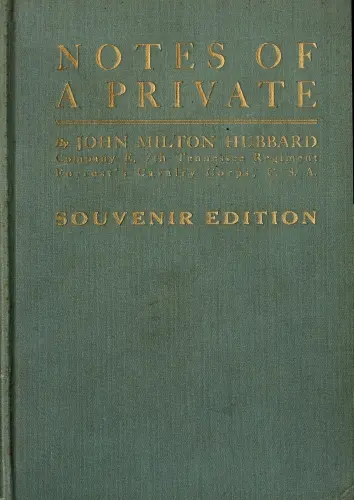
THE CLASSIC COLLECTION · 1909
"Notes of a Private" by John Milton Hubbard is a historical account written in the early 20th century. The narrative is rooted in the author's personal experiences as a soldier in the Confederate Army during the American Civil War, specifically while serving in Company E of the Seventh Tennessee Cavalry. The book provides insights into the life and sentiments of the soldiers, as well as various events and battles they participated in, highlighting the complexities of loyalty, valor, and survival amidst the backdrop of war. The opening of the memoir introduces the reader to Hubbard's intentions in documenting his experiences, emphasizing a desire for truthfulness and justice regarding the men and events he observed. He recalls the initial excitement and camaraderie among the young recruits embarking on their military journey and discusses the stark transition from civilian life to war. The reader gets a glimpse of the naïveté of soldiers as they prepare for combat, filled with a mix of humor and earnestness, as they navigate through logistical challenges of soldiering. The narrative sets the foundation for a detailed exploration of wartime experiences, soldier behavior, and evolving perspectives as the Confederate forces engage in various campaigns and encounters throughout the South.
Introduction adapted from the source catalogue; source summaries may be automatically generated.
Free to read · English · 44,859 words · No account needed
MAKE TIME FOR A GOOD BOOK
On by default. Untick to stop anonymous reading totals. Each page counts after 10 seconds in view. How this works.
Anonymous counting is on unless you have switched it off.
We spent a few weeks at old Pharsalia, on the Yokona river, where we constructed rude winter quarters, or “shanties,” for timber was abundant. We had a great snowstorm, and had to keep fires glowing. We had much pleasure here in receiving and entertaining for a part of a day Mrs. R. P. Neely, of Bolivar, and her daughter, Miss Kate, the latter of whom had been banished from her home by Gen. Brayman, the Federal commander of the post. Mrs. Neely was a splendid type of the true Southern woman, who, like all her children, stood always ready to make sacrifices for the Southern soldiers. She was a woman of most charming personality and gentle refinement, that could have filled almost any station to which ladies are called. Mrs. Elizabeth Lea Neely lived to a great age, and retained to the end the profound respect of all the good people of Bolivar. As for Miss Kate--now Mrs. Collins, of Memphis--she was, or rather is, a woman of the Grace Darling or Mollie Pitcher type, who would go to the rescue of those in peril, or take her place at the guns, if it were to repel the enemies of her country. May her days be long and happy. Charles R. Neely, the elder brother, killed at Brice’s Cross Roads, was already a valuable member of Company E, but here comes young Jimmy, the present capable Superintendent of the Western Hospital, who wanted to be a soldier. His mother protested that he was too young, but as an irregular he did honorable service as the war progressed. We changed our camp by taking post at Mitchell’s Cross Roads, near the mouth of Coldwater, where forage was plentiful and the service light. We had here a goodly number of recruits and returning soldiers from Tennessee. Rations were plentiful, but poor, but “foraging” was good and the citizens hospitable. It was a calm before a storm; indeed, it burst upon us rather suddenly one day that the Federals at Memphis were fitting out an expedition, which, taking advantage of the flooding stage of the waters, would go through the Yazoo Pass into the Coldwater river, thence into the Tallahatchie, and, finally, into the Yazoo river, and thus take Vicksburg in the rear. The projectors of the expedition were convinced of its feasibility, and the Confederates were proportionately alarmed. Fort Pemberton was hastily constructed, near the junction of the Tallahatchie and Yalobusha; heavy guns were mounted and a large force concentrated at that point. The cavalry was ordered to camp in the vicinity, and to scout and picket wherever a horse could go. Within a few days the Federal fleet of gunboats and transports arrived and opened fire on the fort. General Loring, “Old Blizzard,” was on the alert, and the resistance so stubborn that the fleet withdrew and made its way, in a much shattered condition, to Memphis. Glad enough to get out of the black mud around Greenwood, the Seventh Regiment was ordered to the hills. We camped about Grenada and Panola, and watched the roads leading toward Memphis, for the Federals had resumed their old practice of raiding and plundering. Brigadier-General James R. Chalmers, who had made some reputation in Bragg’s army, was placed in command of all the cavalry in North Mississippi. For a month or two we had no clash with the enemy. As soon as the roads would permit, we went over to the Mississippi river, the boys said, “to fight gunboats.” We struck the river in the vicinity of Commerce. We soon saw the smoke of an ascending steamer. Concealed along the shore, we waited with almost breathless anxiety the approach of the steamer. All was in readiness. Our only cannon--a four-pounder--was masked on top of the levee. “Bang!” went a gun. There, now! One of the men in Company E had accidentally shot two others, but the wounds were slight. The silence was more breathless. On came the steamer. When she did get abreast of us, the rattle of small arms was something to remember. The little cannon turned loose her first shot, but the rebound carried her into the mud back of the levee, where she sank up to the hubs. There was a wild scramble among the gunners and others to place the piece in position. There were other shots and other rebounds, but if those fellows did any harm, it was to the timber over in Arkansas. I scarcely think, at this distant day, that they could have “hit a hole in the air,” much less a barndoor at short range. Seeing that the Alice Dean was unarmed, our men rushed down to the water’s edge. A lively fusillade was kept up for some minutes, while Colonel Stocks, in stentorian voice, demanded of the Captain that he bring the boat to shore. This created some amusement, for it was like “whistling to the wind,” as the boat hugged the Arkansas shore and puffed away up stream.
Your reading position is saved on this browser. Take it to another device with a library code. Reading pages adapt to text, rather than matching a printed edition.
BEHIND THE BOOK
This eBook is for the use of anyone anywhere in the United States and most other parts of the world at no cost and with almost no restrictions whatsoever. You may copy it, give it away or re-use it under the terms of the Project Gutenberg License included with this eBook or online at www.gutenberg.org. If you are not located in the United States, you will have to check the laws of the country where you are located before using this eBook. Read the source licence.
The original source file, including credits and licence, is retained by this library. Request an original-format copy at no charge. Please include the book title and Project Gutenberg identifier #49466.
KEEP YOUR CURIOSITY GOING
Cécile Tormay

Moritz Busch
John L. Ransom
Frances Wright
Cécile Tormay

Mabel Potter Daggett