THE CLASSIC COLLECTION✦An outlaw’s diary: the CommuneCLASSIC FREE BOOKS
An outlaw’s diary: the Commune
Cécile Tormay
THE CLASSIC COLLECTION · 1909
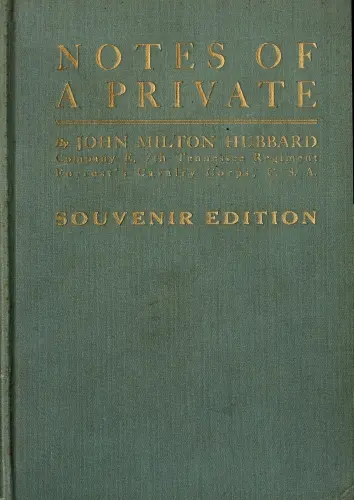
"Notes of a Private" by John Milton Hubbard is a historical account written in the early 20th century. The narrative is rooted in the author's personal experiences as a soldier in the Confederate Army during the American Civil War, specifically while serving in Company E of the Seventh Tennessee Cavalry. The book provides insights into the life and sentiments of the soldiers, as well as various events and battles they participated in, highlighting the complexities of loyalty, valor, and survival amidst the backdrop of war. The opening of the memoir introduces the reader to Hubbard's intentions in documenting his experiences, emphasizing a desire for truthfulness and justice regarding the men and events he observed. He recalls the initial excitement and camaraderie among the young recruits embarking on their military journey and discusses the stark transition from civilian life to war. The reader gets a glimpse of the naïveté of soldiers as they prepare for combat, filled with a mix of humor and earnestness, as they navigate through logistical challenges of soldiering. The narrative sets the foundation for a detailed exploration of wartime experiences, soldier behavior, and evolving perspectives as the Confederate forces engage in various campaigns and encounters throughout the South.
Introduction adapted from the source catalogue; source summaries may be automatically generated.
Free to read · English · 44,859 words · No account needed
MAKE TIME FOR A GOOD BOOK
On by default. Untick to stop anonymous reading totals. Each page counts after 10 seconds in view. How this works.
Anonymous counting is on unless you have switched it off.
On the 3rd day of December, 1862, the Seventh Regiment had placed the Yokona between itself and the enemy. We destroyed the bridges in order to hold them in check. Here we committed about our first depredation on a citizen. We burnt his fence rails. Remember it was cold and wet and we had no axes. The boys spoke of it as an outrage (sic), but felt good as they dried themselves around the burning rails. We consoled ourselves with the reflection that, if the owner were as patriotic as he should have been, he never would utter a word of complaint. Many a time, when the temperature was low, we had occasion to revert with pleasure to the generous fires near Springdale, an old antebellum stagestand.
“Boots and saddles,” for the Federal cavalry had already gotten between the Seventh Regiment and Water Valley. There was but one thing to do. Put on a bold front and run over them or through them. This was so quickly done by our advance that the rear never came in sight of the enemy. The road was now clear and we continued to move south. The next day, just north of Coffeeville, we assisted in forming an ambuscade to entrap the Federal cavalry. This was attended with sufficient success to enable our whole army to take post at Grenada.
We were getting well along into the second year of the war, and our prospects were getting worse on the “Memphis lines.” North Mississippi was in the hands of the Federals, and nothing seemed more probable or possible than that we should be driven further toward the Gulf. Van Dorn had had rather poor success as the commander of an army or the projector of a campaign, but the Confederate authorities knew he was a born cavalryman. He appeared to be the very man to lead a bold movement to the rear of Grant’s army on the Tallahatchie. A corps composed entirely of cavalry was organized to take the road with Holly Springs as an objective point. This place had been abundantly supplied with everything needed by an army of twenty thousand men, encamped south of it, and was garrisoned by about three thousand of all arms. Most of the storehouses around the public square were full of provisions, clothing and medical stores. A large livery stable had been converted into an immense arsenal for the storage of arms and ammunition. There was a long string of cars on the tracks, sufficient, perhaps, to make three good trains, which it was said were loaded with supplies for the army. The sutlers and the small dealers who follow an army, were fully supplied, as if they expected to make a permanent stay in the Sunny South. The cotton speculators were in force, and had hundreds of bales in storage. Van Dorn did not expect to transport any part of these vast supplies south. His purpose was to surprise the garrison at daylight, parole the prisoners and destroy the stores. So after making a march of one day and two nights, much of which was at a trot, and during which we had, after starting from Grenada, swept around by way of Benela, Houston, Pontotoc and New Albany, about 100 miles, we surprised and captured the Federal outpost and entered the town at a gallop. On that clear, frosty morning of December 20th, 1862, the Seventh Regiment was marching in the rear of a column so long and moving so rapidly that we made the last mile or two at about full speed. When we did reach the town, our horses were hot and smoking and men greatly excited. Colonel Murphy, the Federal commander of the post, had already been surprised in his bed and the Confederates were on every corner. Men, women and children were sounding praises to the Confederates. We could hardly realize that we were in possession of the largest booty secured by any army, so far, in the war. Everybody wanted to carry away something, but it was hard to make a selection. Here were great inducements to plunder and such a condition of demoralization existed as might cause the officers to lose control of their men. Whisky, brandy and wines of the best quality and in unbroken packages were among the spoils of war, and everybody so disposed could help himself. And pretty much everybody was disposed. A. S. Coleman, he of the Missouri roasting ear story and sutler of the regiment, had left his wagon at Grenada and had donned his fighting clothes for the raid. He acted as a sort of free lance, who had the assurance to assume special privileges. He visited some of the richest depots early and selected such articles as he knew would please the boys. He soon hove in sight of Company E with a string of hats as long as a plough line wound about him and his horse. What looked like the effigy of a man, clothed in blue trousers of large dimensions and cut in twain at the waist and footless, sat bolt upright on the pommel of Coleman’s saddle. When the contents of the effigy were displayed, we found we had more good liquor than we had room for. All were in fine trim now to attack the commissary stores. As in the case of the fine liquors, the boys did materially reduce the visible supply of good things. People of all classes, without regard even to previous condition of servitude, were told to walk up and help themselves. Children reveled in the pleasures of the occasion, and grown people declared that it was the grandest day the town had ever seen. The work of destruction began in the afternoon. The arsenal was destroyed, all cars with their contents and houses used for the storage of cotton were burned. Town and country were enveloped in smoke and the report of explosives was heard when we were many miles from the scene of destruction. Van Dorn had so completely reaped the fruits of victory that his praise was on every tongue. The men rode out of Holly Springs at nightfall in high glee and perfectly willing to incur other dangers further north. The loss to the Federals has been estimated as high as $3,000,000.
Your reading position is saved on this browser. Take it to another device with a library code. Reading pages adapt to text, rather than matching a printed edition.
BEHIND THE BOOK
This eBook is for the use of anyone anywhere in the United States and most other parts of the world at no cost and with almost no restrictions whatsoever. You may copy it, give it away or re-use it under the terms of the Project Gutenberg License included with this eBook or online at www.gutenberg.org. If you are not located in the United States, you will have to check the laws of the country where you are located before using this eBook. Read the source licence.
The original source file, including credits and licence, is retained by this library. Request an original-format copy at no charge. Please include the book title and Project Gutenberg identifier #49466.
KEEP YOUR CURIOSITY GOING
Cécile Tormay

Moritz Busch
John L. Ransom
Frances Wright
Cécile Tormay

Mabel Potter Daggett