THE CLASSIC COLLECTION✦An outlaw’s diary: the CommuneCLASSIC FREE BOOKS
An outlaw’s diary: the Commune
Cécile Tormay
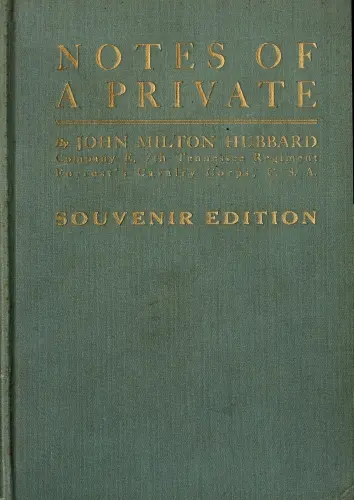
THE CLASSIC COLLECTION · 1909
"Notes of a Private" by John Milton Hubbard is a historical account written in the early 20th century. The narrative is rooted in the author's personal experiences as a soldier in the Confederate Army during the American Civil War, specifically while serving in Company E of the Seventh Tennessee Cavalry. The book provides insights into the life and sentiments of the soldiers, as well as various events and battles they participated in, highlighting the complexities of loyalty, valor, and survival amidst the backdrop of war. The opening of the memoir introduces the reader to Hubbard's intentions in documenting his experiences, emphasizing a desire for truthfulness and justice regarding the men and events he observed. He recalls the initial excitement and camaraderie among the young recruits embarking on their military journey and discusses the stark transition from civilian life to war. The reader gets a glimpse of the naïveté of soldiers as they prepare for combat, filled with a mix of humor and earnestness, as they navigate through logistical challenges of soldiering. The narrative sets the foundation for a detailed exploration of wartime experiences, soldier behavior, and evolving perspectives as the Confederate forces engage in various campaigns and encounters throughout the South.
Introduction adapted from the source catalogue; source summaries may be automatically generated.
Free to read · English · 44,859 words · No account needed
MAKE TIME FOR A GOOD BOOK
On by default. Untick to stop anonymous reading totals. Each page counts after 10 seconds in view. How this works.
Anonymous counting is on unless you have switched it off.
Company E now knew that there was work to be done in the immediate future. The Federals had garrisoned many places on the Memphis and Charleston Railroad, and were making incursions into Mississippi. Steps were taken to unite the armies of Price and Van Dorn for the purpose of making an attack on Corinth where General Rosecrans was posted. As preliminary to this attack, Colonel W. H. Jackson was ordered to take his own and the First Mississippi Cavalry under Pinson and make a reconnoisance in the direction of Corinth. At Davis’ bridge on Big Hatchie river Jackson somewhat unexpectedly came upon Ingersoll’s Eleventh Illinois Cavalry and some regulars just going into camp. The vidette, who had just taken post, was taken in and the rest was easy. Pinson in front charged across the bridge and into the camp of the enemy, who were largely engaged in gathering corn from a field to the right of the road, while the Seventh Tennessee brought up the rear and waked the echoes with the rebel yell. The firing was promiscuous, but there were few casualties. Pinson was the only Confederate wounded. He manifested the spirit and courage of the hero, as we bore him to the Davis residence on a cot secured for the purpose. He had very good reason to think that the ball had penetrated the intestines, but he, nevertheless, spoke cheerfully to anxious enquirers as “boys,” and said that it was only “a small matter” and that he “was all right.” Happily he was.
The spoils were great, considering the few minutes the battle lasted, consisting of one hundred and eighty fine Illinois horses with their accoutrements and arms. We captured only fifty or sixty prisoners, as it was just at nightfall, and most of the enemy took refuge in the timber. I always thought that those fine horses and accoutrements should have been distributed among the boys where most needed and their inferior articles taken up. This might have been done under a board of survey in such a way as not only to increase the efficiency of the command, but also to stimulate it for future enterprises. But we didn’t get a halter. All went to supply the demands of other commands. There was one particularly fine horse in the captured lot which had been thoroughly trained and was evidently something of a pet, as we say, of his former owner. Jim Weatherly of Somerville, was not long in discovering his fine points and “smart tricks,” and soon had him “going his way.” The beautiful brown with two white feet had to be turned in, and Weatherly was disconsolate. Thereafter, when any legitimate capture fell in the way of the boys, mum was the word. It was now September, 1862, and Price and Van Dorn were ready to move on Corinth. This movement was made from Ripley, Miss., in two divisions commanded by Price and Lovell, with Van Dorn as chief. The army was well equipped, well fed and in fine spirits. It had not rained for many weeks, and the dusty roads and scarcity of water made the marches, which were necessary to effect the concentration of the two armies, severe ones for all branches of the service. But the prospect of making a successful assault on the works at Corinth and capturing Rosecrans and his army buoyed up the spirits of the soldiers. Ten miles out on the Chiwalla hills the cavalry encountered a small Federal force which was easily swept back. Company A of the Seventh Tennessee, was active in this affair as Jackson’s escort and lost the first man killed on the expedition. I was with a detachment of Company E that had been ordered forward and deployed as skirmishers. I came upon the corpse of the soldier, which had, for the moment, been left where he had fallen. It was the body of John Young of Memphis. This was the first day of October, 1862. The next day was spent in getting the proper dispositions made for the assault. On the 3rd, the earth seemed to tremble with the thunder of artillery and the roar of small arms. It was a struggle to the death in which both sides lost heavily. The position had been rendered strong by heavy earthworks and much of the front had been covered by fallen timber, which made the approach to the main works difficult. All that day it went well with the Confederates, though the killed and wounded were numerous. As the cavalry took no part in the main battle, we could see pretty well what was going on in the rear. There it was a bloody spectacle as the killed and wounded were borne back for treatment and burial. That was the first time for me to see our poor fellows wrapped in their blankets and buried in shallow trenches. The horror of it! Even on the morning of the fourth, those of us in the rear thought that all was well in front, for we had heard that Price, who was fighting on the north of the railroad, had gone over the heavy works and into the town. And so he had, but the brave men under Lovell on the right under the terrible fire of the Federals had failed to make a successful assault. Suddenly there was a calm, which we could not understand. But it soon flashed upon us that we were beaten, and our army was in full retreat. During the previous night McPherson’s division from Jackson had re-enforced Rosecrans and was ready to press the retreating Confederates. Hurlburt’s division, too, was marching from Bolivar to intercept the retreating column. There was now likely to be some lively work for the cavalry. When we reached Davis’ bridge, the scene of the affair heretofore related, Hurlburt was there to dispute our passage. With McPherson in our rear we were apparently “in a box.” Shrewd generalship on the part of the Federals would have captured our whole army. Van Dorn boldly attacked Hurlburt at the bridge, while his trains were ordered to take the only road of escape--that up Hatchie river. The cavalry preceded the trains, and, crossing the river, attacked Hurlburt in his rear. For several hours there were two Federal and two Confederate forces engaged and one of each fronting two ways. Van Dorn drew off at the proper time and followed his trains. The Federals were not disposed to follow, as good generalship would have dictated, for our troops, worn out and hungry, could have made but a feeble resistance. The streams had no water in them and our soldiers drank the wells dry. When a beef was killed the hungry men were cutting the flesh from the carcass before the hide was off. In the midst of this distress, I had my only sight of Sterling Price. He was riding at the head of a small escort and apparently in deepest thought. He had left many of the brave men whom he loved dead on the field of Corinth. He was the idol of his men, a great Missourian and a good man. But the result at Corinth had made him sad. The disaster brought other troubles in its train.
Your reading position is saved on this browser. Take it to another device with a library code. Reading pages adapt to text, rather than matching a printed edition.
BEHIND THE BOOK
This eBook is for the use of anyone anywhere in the United States and most other parts of the world at no cost and with almost no restrictions whatsoever. You may copy it, give it away or re-use it under the terms of the Project Gutenberg License included with this eBook or online at www.gutenberg.org. If you are not located in the United States, you will have to check the laws of the country where you are located before using this eBook. Read the source licence.
The original source file, including credits and licence, is retained by this library. Request an original-format copy at no charge. Please include the book title and Project Gutenberg identifier #49466.
KEEP YOUR CURIOSITY GOING
Cécile Tormay

Moritz Busch
John L. Ransom
Frances Wright
Cécile Tormay

Mabel Potter Daggett