THE CLASSIC COLLECTION✦An outlaw’s diary: the CommuneCLASSIC FREE BOOKS
An outlaw’s diary: the Commune
Cécile Tormay
THE CLASSIC COLLECTION · 1909
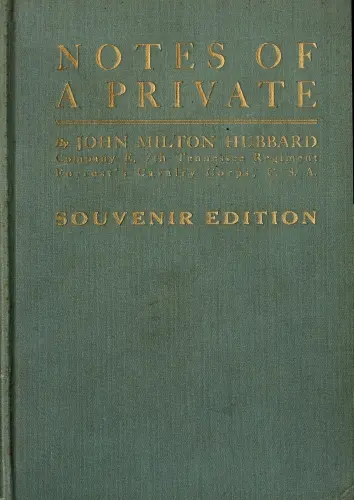
"Notes of a Private" by John Milton Hubbard is a historical account written in the early 20th century. The narrative is rooted in the author's personal experiences as a soldier in the Confederate Army during the American Civil War, specifically while serving in Company E of the Seventh Tennessee Cavalry. The book provides insights into the life and sentiments of the soldiers, as well as various events and battles they participated in, highlighting the complexities of loyalty, valor, and survival amidst the backdrop of war. The opening of the memoir introduces the reader to Hubbard's intentions in documenting his experiences, emphasizing a desire for truthfulness and justice regarding the men and events he observed. He recalls the initial excitement and camaraderie among the young recruits embarking on their military journey and discusses the stark transition from civilian life to war. The reader gets a glimpse of the naïveté of soldiers as they prepare for combat, filled with a mix of humor and earnestness, as they navigate through logistical challenges of soldiering. The narrative sets the foundation for a detailed exploration of wartime experiences, soldier behavior, and evolving perspectives as the Confederate forces engage in various campaigns and encounters throughout the South.
Introduction adapted from the source catalogue; source summaries may be automatically generated.
Free to read · English · 44,859 words · No account needed
MAKE TIME FOR A GOOD BOOK
On by default. Untick to stop anonymous reading totals. Each page counts after 10 seconds in view. How this works.
Anonymous counting is on unless you have switched it off.
But we must give up Tennessee--a sad thought. After a clash with some Federal Cavalry at Lockridge’s Mill, in Weakley county in which there was more of stampede than of fighting on their part, we retired toward the state line. We moved out leisurely, as no force was crowding us. We heard the noise of battle at Memphis on the 6th of June, 1862, and camped that night at Germantown. We soon heard of the defeat of the Confederate fleet in front of the city and of the Federal occupation. Next day found us in camp on Coldwater river, a few miles from Holly Springs. Then began a series of marches and countermarches in North Mississippi and trips to the borders of Tennessee. In one of these, a detachment of our command came near capturing General Grant at the house of Josiah Deloach. This gave rise to the story, after the war, that for his timely warning on the occasion Grant made Deloach postmaster of Memphis.
If I were to attempt to record more than a tithe of the events incident to our service in Mississippi during our first summer there, or do more than to touch the high places, as I skim along, these reminiscences would be too tedious for perusal.
William J. Tate, who had been elected lieutenant at the late regimental reorganization, was now promoted to the captaincy of Company E. Suffice it to say here that he had no superior as an officer in the regiment, and I shall have something more to say of him, when I come to speak of his death.
But the Armstrong raid. This was an expedition into West Tennessee under the command of General Frank Armstrong. Advancing by way of Grand Junction, we encountered a Federal force near Middleburg the 29th of August. There was some fighting between the Second Missouri Cavalry under Colonel McCulloch and the Second Illinois under Colonel Hogg, who was killed. In a combat at close quarters between McCulloch and Hogg, the latter was killed by Tom Turner, a young Missourian, to save the life of McCulloch. Captain Champion of the Second Missouri was killed here. As his body was borne from the field by two of his troopers, I saw, for the first time, a dead Confederate, who had been slain in battle. As the purpose of the raid seemed to be the cutting off of the army at Bolivar by tearing up the railroad, which led to its base of supplies, we crossed Hatchie river and struck the railroad at Medon. The Federal garrison here was small, but without artillery we found it impossible to dislodge them, so well were they protected in and about the depot with cotton bales and other material. Nothing was accomplished by the attack and several Confederates were either killed or wounded. It did so happen that Company E, in the charge on foot at the old brick church, passed over the same ground where it had been so royally entertained by the people of that vicinity the day it was mustered into service. Here Captain Bassett of Company C, Memphis, and Major Duckworth, afterwards Colonel of the regiment, were severely wounded, Bassett being permanently disabled. The command drew off to the east and went into camp at the Casey Savage farm. The Federals having received re-enforcements presented a bold front next morning when we passed to the west of the railroad. Here was a fine chance for a fight of which we did not avail ourselves, though the enemy were in an open field. With our force, we could have driven them to shelter or effected their capture. This was the first day of September, 1862, and we were to fight the battle of Briton’s Lane that day. We were to encounter a force, consisting of two infantry regiments, a section of artillery and a small detachment of cavalry. Our army could have enveloped them, and should have done so. The regiments were fought in detail, some of them scarcely getting into the engagement at all. The Seventh Tennessee was ordered to charge on foot through a corn field, from which the fodder had been stripped, against a heavy line of infantry lying behind a stout worm fence and in the woods. A galling fire was poured into Company E, but some of its men reached the fence. Dr. Joe Allen of Whiteville mounted the fence and fell dead on the enemy’s side of it. John Bradford of Toone, and Willie Wendel, a school boy of Bolivar, were killed near the fence. D. E. Durrett of Bolivar received a wound which put him on crutches to the day of his death, which occurred a few years ago, and Tom Joyner and John Fortune were severely wounded. How so many men got out of that field alive is one of those unaccountable things that sometimes occur in war. The whole command was discouraged by the operations of this raid, and thought that, if we had gained anything at all, we had paid dearly for it. The weather was hot and dry. When we returned to Mississippi the men were thoroughly dispirited and their horses in bad condition. True soldiers quickly recover from a disaster, when well treated in camp, and even horses seem to follow the example of the men. How sweet was the rest just then! But this respite was not for long. Even then Van Dorn and Price were arranging the details to attack Rosecrans at Corinth.
Your reading position is saved on this browser. Take it to another device with a library code. Reading pages adapt to text, rather than matching a printed edition.
BEHIND THE BOOK
This eBook is for the use of anyone anywhere in the United States and most other parts of the world at no cost and with almost no restrictions whatsoever. You may copy it, give it away or re-use it under the terms of the Project Gutenberg License included with this eBook or online at www.gutenberg.org. If you are not located in the United States, you will have to check the laws of the country where you are located before using this eBook. Read the source licence.
The original source file, including credits and licence, is retained by this library. Request an original-format copy at no charge. Please include the book title and Project Gutenberg identifier #49466.
KEEP YOUR CURIOSITY GOING
Cécile Tormay

Moritz Busch
John L. Ransom
Frances Wright
Cécile Tormay

Mabel Potter Daggett