THE CLASSIC COLLECTION✦Journal of a tour in Marocco and the Great AtlasCLASSIC FREE BOOKS
Journal of a tour in Marocco and the Great Atlas
Joseph Dalton Hooker & John Ball
THE CLASSIC COLLECTION · 1887
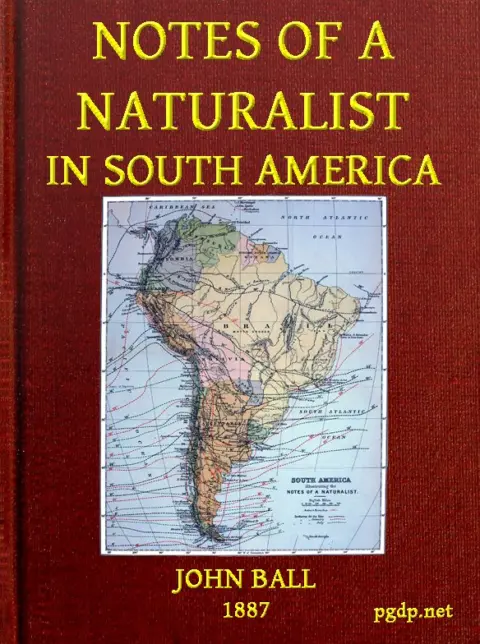
"Notes of a Naturalist in South America" by John Ball is a scientific travelogue written in the late 19th century. In this engaging narrative, the author recounts his voyage across South America, documenting not only the diverse flora and fauna he encounters but also reflecting on the social and political landscape of the places he visits. His observations provide valuable insights into the natural history and climate variations of the continent. The opening of the work sets the stage for Ball's journey, detailing the excitement and anticipation of embarking on an adventure across the Atlantic. He vividly describes his experiences aboard the ship, from the arrival at tropical islands like Barbados to the encounters with oceanic phenomena such as flying fish. As he approaches the lush jungles and unique ecosystems of South America, his reflections on the geography and meteorology prepare the reader for the exploration of a rich and diverse natural world that Ball aims to capture throughout his travels. The detailed observations in these early chapters foreshadow the fascinating discoveries and the thought-provoking discussions on the interplay between nature and humanity that will follow.
Introduction adapted from the source catalogue; source summaries may be automatically generated.
Free to read · English · 120,486 words · No account needed
MAKE TIME FOR A GOOD BOOK
On by default. Untick to stop anonymous reading totals. Each page counts after 10 seconds in view. How this works.
Anonymous counting is on unless you have switched it off.
[43] The species common here is allied to T. stricta, but is not, I
think, identical.
[44] The best general account of the geology of Brazil that I have seen is contained in a short paper by Orville A. Derby, entitled, “Physical Geography and Geology of Brazil.” It was published in the Rio News, in December, 1884, and, through the kindness of Mr. Geikie, i have seen a reprint in the library of the School of Mines.
[45] Proceedings of the Royal Geographical Society for 1879, p. 564.
[46] See his valuable work, “Climats, Géologie, Faune et Géographie
Botanique du Bresil.”
[47] “Klimatologie,” p. 382.
[48] Darwin’s estimate of the height was one thousand feet, while Professor Moseley gives double that amount. I incline to think that the lower figure is nearer to the truth.
[49] I borrow this statement from the excellent “Lehrbuch der Klimatologie,” by Dr. Julius Hann. Stuttgart, 1883.
[50] See Reports of the British Association for the Advancement of Science for 1882, pp. 451-453.
[51] It is remarkable that there is no reference to the investigations of M. de St. Robert, and the formula deduced from them, in the article on the “Barometrical Measurement of Heights,” in the new edition of the Encyclopædia Britannica.
[52] Published by the War Department, United States Army, Professional Papers of the Signal Service, No. xv.
[53] Air nearly saturated with vapour is lighter than air relatively dry; and hence it may happen that, when a current of moist air meets one relatively dry, it will flow over the latter if they are nearly at the same temperature, but if the drier current be much warmer, it may flow beneath it.
[54] On this subject see Handbuch der Klimatologie, by Julius Hann, pp. 141, et seq. See also Tables I. and II. in a report on thermometric observations in the Alps, by J. Ball, in Reports of the British Association for the Advancement of Science for 1862, pp. 366-368.
[55] See “Die Barometrischen Höhenmessungen und ihre Bedeutung für die Physik der Atmosphäre,” Leipzig, 1870, by R. Rühlmann.
[56] I use the term “eccentricity” in the popular sense, to express the distance of the focus from the centre of the ellipse.
[57] Viewed in the light of Mr. Langley’s recent researches on solar radiation, all these numerical determinations are probably far from the truth; but the errors do not much affect the present argument.
[58] The observations at Stanley Harbour, which are those adopted by Dr. Hann (Klimatologie, p. 697), show temperatures notably lower than those recorded for a place in the islands lying farther south, which are given in the Zeitschrift der Œsterreichischen Gesellschaft für Meteorologie, vol. v. p. 369. The mean of the two is probably nearly correct.
Your reading position is saved on this browser. Take it to another device with a library code. Reading pages adapt to text, rather than matching a printed edition.
BEHIND THE BOOK
This eBook is for the use of anyone anywhere in the United States and most other parts of the world at no cost and with almost no restrictions whatsoever. You may copy it, give it away or re-use it under the terms of the Project Gutenberg License included with this eBook or online at www.gutenberg.org. If you are not located in the United States, you will have to check the laws of the country where you are located before using this eBook. Read the source licence.
The original source file, including credits and licence, is retained by this library. Request an original-format copy at no charge. Please include the book title and Project Gutenberg identifier #52513.
KEEP YOUR CURIOSITY GOING
Wilfrid Scawen Blunt
Wilfrid Scawen Blunt

E. W. (Edgar Watson) Howe
Francis Greenleaf Allinson & Anne C. E. (Anne Crosby Emery) Allinson
Cyrenus Cole

John Martineau