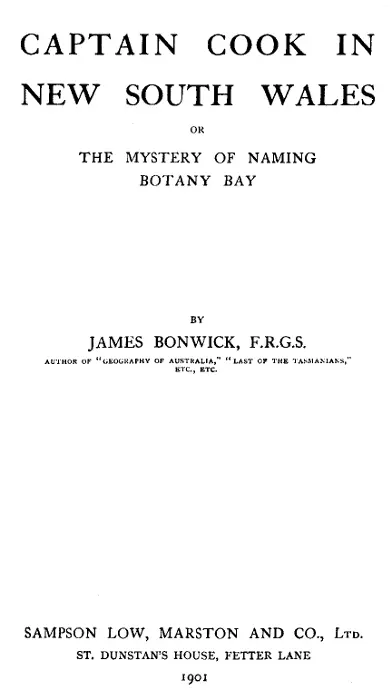
Captain Cook in New South Wales; Or, The Mystery of Naming Botany Bay
James Bonwick
THE CLASSIC COLLECTION · 1852
"Notes of a Gold Digger, and Gold Diggers' Guide" by James Bonwick is a practical guidebook written in the early 1850s, reflecting the excitement of the Australian gold rush era. This book provides essential information and firsthand insights for those eager to explore the Australian goldfields, with a particular focus on the challenges and experiences faced by miners during that time. The narrative conveys the hopes and dreams of prospectors who are drawn by the allure of finding gold, while also imparting practical advice to help them navigate the arduous journey and labor of gold digging. In this guide, Bonwick shares vivid descriptions of the landscape, the process of gold searching, and the communal life of diggers. He touches on essential topics such as the best clothing to wear, tools to carry, and the importance of mapping one’s journey through the often treacherous and unfamiliar terrains. The author recounts his personal experiences amidst the bustling activity of the goldfields, detailing the hard work of digging and washing dirt for gold, the camaraderie among miners, and the sporadic success that accompanied their efforts. The book not only encapsulates the lively atmosphere of the mining community but also serves as an important historical document, capturing the spirit of an era defined by hope, hardship, and the quest for fortune.
Introduction adapted from the source catalogue; source summaries may be automatically generated.
Free to read · English · 13,428 words · No account needed
MAKE TIME FOR A GOOD BOOK
On by default. Untick to stop anonymous reading totals. Each page counts after 10 seconds in view. How this works.
Anonymous counting is on unless you have switched it off.
The tunnelling work now follows. The head stuff is removed to make way for you to get under, to work at the latent treasure of specs, nuggets and washing stuff. The constraint of body in work, the damp, the closeness of the atmosphere, the gloom, the fear of impending rocks, with occasional raps of knuckles and skull against the sides and roof, altogether make this wombatting not the most amusing operation in life; though, like other uncomfortable things, it now and then leads to some important and profitable result. It is often annoying to find your hopes of veins in a bank so thoroughly blasted. A week’s labor brings you to your boundary in a certain direction without a single glimpse of gold. Then perhaps, you may be placed in a peculiarly puzzling condition. You trace a pleasing vein to the verge of your claim; honesty says, “stop,” and self interest cries “go on.” To some lofty minds this position makes no manner of difficulty; they see the gold, and they simply follow it, reserving to a more convenient season the consideration of the precise whereabouts of their neighbour’s ground. Cases have been known of a poor fellow delving for weeks in a hole, and when quite sure of dropping on the gold, he all at once disappears in a cavern, which his friend of the next claim has constructed with much ingenuity to lighten his labors and load.
But the business of washing has to be thought of. That heap of dirt has to be passed through the cradle. If in the dry season, this must be done at a distance of from three to nine miles from the hole, paying, perhaps, one shilling a bucket for cartage. There is the loss of time going so far, and the inconvenience of having the company split into digging and washing parties, each having a separate establishment. Unless, therefore, you immediately require cash, you prefer carting the stuff home to your tent beside the dried up creek, waiting for the time of rains. When that joyous harvest of diggers does come, all is bustle and merriment. If a sensible man, and not putting off till to-morrow, you have secured your washing station beforehand. You now cut a place in the bank for your tubs and cradle, drive in two posts by the edge of the water, and roll down against them a log of six or eight feet long, against which dirt is put, to serve as a firm footing and embankment. The cradle is made to swing easily and unshiftingly, by the rockers resting in the grooves of two blocks of wood firmly fixed in the soil. By giving the cradle a slight slant to the lower end, the water will run off the quicker; but if it dips too much a little gold may wash off with the sand. All being ready, you take your iron bucket and carry the stuff to the tubs. The Aquarius with his long handed dipper, supplies the liquid for puddling. The stuff is kept well stirred about with a spade, so as to set the metal free from the adhesive soil and pipe clay. The dirtied water is gently poured off every now and then, and, with a fresh supply from the stream, you puddle away. Be not afraid of too much working, remembering that good puddling makes easy and profitable cradling. When this is done, you fill the hopper of your cradle with the stuff, keep on pouring water with the dipper, and rock carefully and evenly, using with the right hand a short stick to break any clods that may be in your hopper, but which your tub ought not to have sent there. The tubs being emptied, one of the party can be filling and preparing another, while you take out the residuum at the bottom of your cradle. The gold ought to rest on the wooden shelf under the hopper, but much will run down with the sand into one of the compartments at the bottom. But this has to be washed by the hand in the tin dishes. Now this process I cannot describe. It is one of the deepest mysteries of the gentle craft of gold digging. The uninitiated cannot possibly divine how the dish washer is able to separate the soil from the precious treasure. This art requires a watchful eye and skilful hand. Many men from careless washing lose much gold. Two men were in a great hurry to get through their heap, a party afterwards went over the washed material and extracted ten pounds weight of metal.
Your reading position is saved on this browser. Take it to another device with a library code. Reading pages adapt to text, rather than matching a printed edition.
BEHIND THE BOOK
This eBook is for the use of anyone anywhere in the United States and most other parts of the world at no cost and with almost no restrictions whatsoever. You may copy it, give it away or re-use it under the terms of the Project Gutenberg License included with this eBook or online at www.gutenberg.org. If you are not located in the United States, you will have to check the laws of the country where you are located before using this eBook. Read the source licence.
The original source file, including credits and licence, is retained by this library. Request an original-format copy at no charge. Please include the book title and Project Gutenberg identifier #57161.
KEEP YOUR CURIOSITY GOING
Wilfrid Scawen Blunt
Wilfrid Scawen Blunt

E. W. (Edgar Watson) Howe
Cécile Tormay

Moritz Busch
John L. Ransom