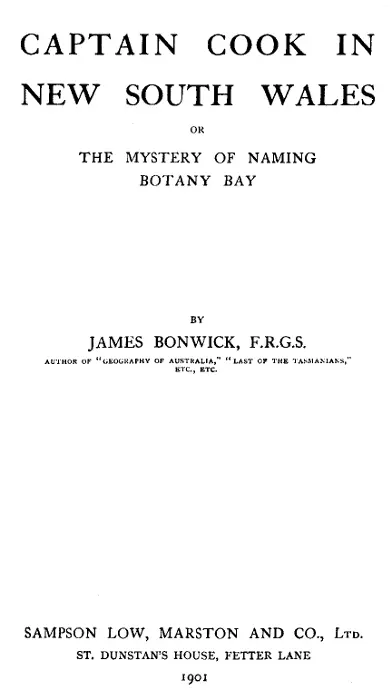
Captain Cook in New South Wales; Or, The Mystery of Naming Botany Bay
James Bonwick
THE CLASSIC COLLECTION · 1852
"Notes of a Gold Digger, and Gold Diggers' Guide" by James Bonwick is a practical guidebook written in the early 1850s, reflecting the excitement of the Australian gold rush era. This book provides essential information and firsthand insights for those eager to explore the Australian goldfields, with a particular focus on the challenges and experiences faced by miners during that time. The narrative conveys the hopes and dreams of prospectors who are drawn by the allure of finding gold, while also imparting practical advice to help them navigate the arduous journey and labor of gold digging. In this guide, Bonwick shares vivid descriptions of the landscape, the process of gold searching, and the communal life of diggers. He touches on essential topics such as the best clothing to wear, tools to carry, and the importance of mapping one’s journey through the often treacherous and unfamiliar terrains. The author recounts his personal experiences amidst the bustling activity of the goldfields, detailing the hard work of digging and washing dirt for gold, the camaraderie among miners, and the sporadic success that accompanied their efforts. The book not only encapsulates the lively atmosphere of the mining community but also serves as an important historical document, capturing the spirit of an era defined by hope, hardship, and the quest for fortune.
Introduction adapted from the source catalogue; source summaries may be automatically generated.
Free to read · English · 13,428 words · No account needed
MAKE TIME FOR A GOOD BOOK
On by default. Untick to stop anonymous reading totals. Each page counts after 10 seconds in view. How this works.
Anonymous counting is on unless you have switched it off.
1. The prevalent rocks are observed to be of a crystalline, or what is called igneous, character; as, granites of all varieties, quartz, mica, slate, felspar, sienite &c. Some felspar is seen decomposed into a soft white finger-staining mineral, or into fine porcelain clay. At the “Gap” of the river Macquarie the sienite is flanked by precipitous silicious slates. The Mount Alexander range is of a granitic character, and the beds of the streams running from it, on the Bendigo road, are filled with huge boulders of granite on a granite floor, containing parallel veins of crystallized felspar, having usually a north and south direction. No detritus of other rocks is found on the granite by the “Porcupine.” Some of the rocks bear fantastic resemblance to Beehives, Logan stones, and Scandinavian Tumuli. Granite is the bed of the Macquarie at Bathurst, and the base of the Mullion range, near which were the first diggings of New South Wales. The quartz is of all kinds; black, white, yellow, pink, green, red, spotted, streaked, mosaic, porous, fibrous, clinker like, and crystallized. Carbon makes it black; copper or chlorine, green; oxide of iron, red or brown; manganese, rose colour. The crystals are hexaedron pyramids, single or double, of different sizes and degrees of transparency. Some rise from the surface like wedges, having a singular appearance. The prisms are triangular, quadrilateral or pentagonal; some crystals have others attached to their sides. Veins of black quartz are observed with the centre very vesicular. Carious quartz, or swimming stone, is not common. The granulated quartz or grindstone schist has often minute transparent crystals in cavities. From a hole in Golden Gully, Bendigo, I obtained a specimen of soft sandstone, with most exquisitely beautiful veins of crystallized quartz running in all directions.
2. The Crystalline rocks are observed gradually changing into what is called the Sedimentary rocks, as slates. Such a transition from the crystalline to the laminated form is by insensible degrees. The experience of the miner is often opposed to the theories of geologists. He cannot help noticing the different kinds of slates, as presenting proof of their being transmutations of, or some among the many kinds of developement in, crystalline rocks. There are slates as amorphous looking as any Huttonian can desire. Others are so silicious, as to be denominated by the New South Wales geologists, Quartzites. On the Bell’s creek the clay slate changes into jasper. The chlorite slate of Ophir is so full of quartz veins, and dykes and bosses of quartz, as to be called by Sir T. L. Mitchell, Quartz iferons schist. Instances are numerous of slate with embedded quartz, and quartz entangling slate. At the cathedral rock, near Specimen Hill, Bendigo, numerous veins of chlorite slate are seen running unharmed and unchanged amidst that huge block of so called, igneous rock. The same specimen of quartz has exhibited in different parts not only different colours, but the clinker, the calcined, and the transparent conditions. The Rev. W. B. Clarke, of Sydney, hints at the probability of quartz, greenstone, basalt, and slates, by the influence of segregation, chemical affinity, galvanic or other forces, being “derived from the same original source, and indefinitely varied in the order of their arrangements and relations to each other at different intervals.” Mr. Clarke’s observations on the Diggings’ ground, would seem rather to have confounded his geological creed. The absence of ordinary stratification, even in the holes, is a remarkable feature. The character of stuff through which we have to go on the tops of hills resembles that in the gullies. Though much of the soil bears evidence of diluvial action, yet a considerable portion clearly results from the decomposition of the rocks near. The great irregularity of mineral beds in the holes, no two holes being alike, would not present the idea of gentle depositions, nor are we warranted to assume volcanic dislocation. Such fantastic changes in the order and depths of these mineral beds, were compared by a diggings’ friend to the alternations of the eight notes of music in different bars.
Your reading position is saved on this browser. Take it to another device with a library code. Reading pages adapt to text, rather than matching a printed edition.
BEHIND THE BOOK
This eBook is for the use of anyone anywhere in the United States and most other parts of the world at no cost and with almost no restrictions whatsoever. You may copy it, give it away or re-use it under the terms of the Project Gutenberg License included with this eBook or online at www.gutenberg.org. If you are not located in the United States, you will have to check the laws of the country where you are located before using this eBook. Read the source licence.
The original source file, including credits and licence, is retained by this library. Request an original-format copy at no charge. Please include the book title and Project Gutenberg identifier #57161.
KEEP YOUR CURIOSITY GOING
Wilfrid Scawen Blunt
Wilfrid Scawen Blunt

E. W. (Edgar Watson) Howe
Cécile Tormay

Moritz Busch
John L. Ransom