THE CLASSIC COLLECTION✦An outlaw’s diary: the CommuneCLASSIC FREE BOOKS
An outlaw’s diary: the Commune
Cécile Tormay
THE CLASSIC COLLECTION · 1856
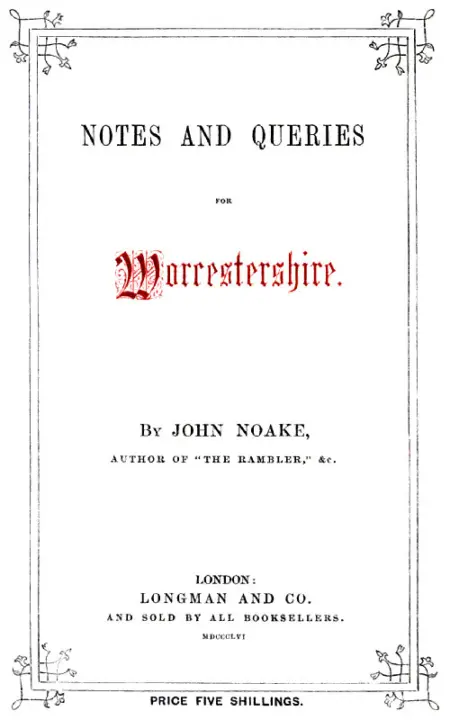
"Notes and Queries for Worcestershire" by John Noake is a historical account written in the mid-19th century. The work serves as a compilation of various details about Worcestershire, shedding light on its history, customs, and social life. The author aims to create a more nuanced narrative of the county's past, moving beyond dry statistics to a richer understanding of the people and their experiences. At the start of the publication, the author expresses his anticipation that this installment will contribute to the understudied history of Worcestershire. He reflects on the limitations of prior historical approaches, emphasizing the need for detailed research into local customs, traditions, and social life. Noake insists that a collaborative effort is essential for a comprehensive account, suggesting that while his work is a modest beginning, it invites further inquiry into the county's rich heritage, aiming to illuminate the lives of its inhabitants across the centuries.
Introduction adapted from the source catalogue; source summaries may be automatically generated.
Free to read · English · 101,259 words · No account needed
MAKE TIME FOR A GOOD BOOK
On by default. Untick to stop anonymous reading totals. Each page counts after 10 seconds in view. How this works.
Anonymous counting is on unless you have switched it off.
On occasion of episcopal visitations, the clergy visited were, except in special cases, bound to provide food, &c., for the Bishop and his attendants, but sometimes the suite was so numerous as to lead to great inconvenience. In 1290, Godfrey, Bishop of Worcester, in spite of canonical prohibition, being at variance with the Prior and Convent of Worcester, came to visit them with 140 horses and a multitude of attendants, and continued with them three days; but this was not done without an appeal on the part of the Prior. The Bishop turned the Prior out of the chamber; and it seems like an aggressive act that need not have been committed, if then, as since, the Bishop had a palace hard by the Cathedral. For remedy of such encroachments the Lateran Council, under Pope Alexander III, had specially defined the limits of bishops' and archdeacons' trains. Bishop Godfrey Giffard frequently preached at visitations, and some of the texts of his discourses addressed to religious houses are extant in his register; an instance of which is as follows: "Procurationes Episcopi. Item, die Jovis in crastino beati Michaelis, dominus Episcopus visitavit apud Sanctum Augustinum Bristolliæ, et prædicavit ibi, præsentibus priore et monachis Sancti Jacobi de Bristollia, et magistro ac suis fratribus Sancti Martii de ordin', cujus thema fuit: 'Videam voluptatem Domini et visitem templum ejus.' (Psalm xxvi, 4.) Et procuratus fuit eodem die sumptibus domus."
In the course of a visitation tour, Bishop Swinfield came to Tenbury, in the archdeaconry of Salop and deanery of Burford. The Norman abbey of Lyra held the great tithes; the vicarial amounted to just one half of them, £6. 13s. 4d. The associate of the dominus proctor, who helped to manage the revenues of the convent, was ready with his procuration for the party. After visiting Burford, they came to Lindridge, and visited the church, which had been both a rectory and vicarage; these, however, upon the recent death of the late vicar, Walter, in 1288, had been united under the present rector, John de Buterlee (Bitterley), and were valued jointly at £13. 6s. 8d. per annum. The reason for this proceeding, illustrative of the state of affairs in the church, is expressly set forth in the instrument framed for that purpose; that whereas it had been canonically provided that ecclesiastical benefices should not be divided; and that such as for certain causes had been divided, upon cessation of such causes should on the first opportunity be restored to their integrity, so that it should be one church, one rector; and that no rector of a parish church should employ a vicar, but be bound to serve it himself, as the cure thereof requires; unless a dignity or prebend be annexed to the said church, when the institution or creation of a vicar might be allowed. And whereas he (John de Bitterley) professed himself ready to reside personally on his church of Lindridge as the law required, there being no reasonable cause why there should be a vicar in the said church, the vicarage and rectory were perpetually united with all rights and appurtenances, emolument, burden, and cure. It may however be added, that this integrity came again, within a few years, to be more permanently violated by the appropriation of the great tithes to the Prior and Convent of Worcester, by special grant of the King, with consent of the Bishop of Hereford. Edward wrote a letter to his chancellor in French, directing that it might be translated into Latin, and sent by a clerk of the chancery to the chapter of Hereford; another instance of the employment of the French language in this reign. The rector of Lindridge discharged his duty of procuration; and on the following day (April 15) they moved forward in the direction of Bewdley to Aka (Rock). The parishes to which the visitor was directing his attention in this quarter lay within a small compass. Master William Brun was rector in 1276, and no subsequent incumbent has been detected up to this year of visitation. The value of the benefice was the same as that of Lindridge. Out of many of these benefices payments were made in other quarters; as in this instance: the Prior of Ware was paid £2. 13s. 4d. and the Prior of Conches £2. Out of Lindridge the Prior of Worcester received £6. 13s. 4d. Procuration was duly furnished here; and this is the fifth day since any expense on the part of the Bishop was incurred. On arriving at Kinlet, the visiting party were obliged to have recourse to Kidderminster for supplies. Robert the carter was the purveyor; he had a guide to attend him, probably through the intervening forest of Wyre, and paid for passing the Severn on his way to and from the town.
Your reading position is saved on this browser. Take it to another device with a library code. Reading pages adapt to text, rather than matching a printed edition.
BEHIND THE BOOK
This eBook is for the use of anyone anywhere in the United States and most other parts of the world at no cost and with almost no restrictions whatsoever. You may copy it, give it away or re-use it under the terms of the Project Gutenberg License included with this eBook or online at www.gutenberg.org. If you are not located in the United States, you will have to check the laws of the country where you are located before using this eBook. Read the source licence.
The original source file, including credits and licence, is retained by this library. Request an original-format copy at no charge. Please include the book title and Project Gutenberg identifier #47105.
KEEP YOUR CURIOSITY GOING
Cécile Tormay

Moritz Busch
John L. Ransom
Frances Wright
Cécile Tormay

Mabel Potter Daggett