THE CLASSIC COLLECTION✦An outlaw’s diary: the CommuneCLASSIC FREE BOOKS
An outlaw’s diary: the Commune
Cécile Tormay
THE CLASSIC COLLECTION · 1856
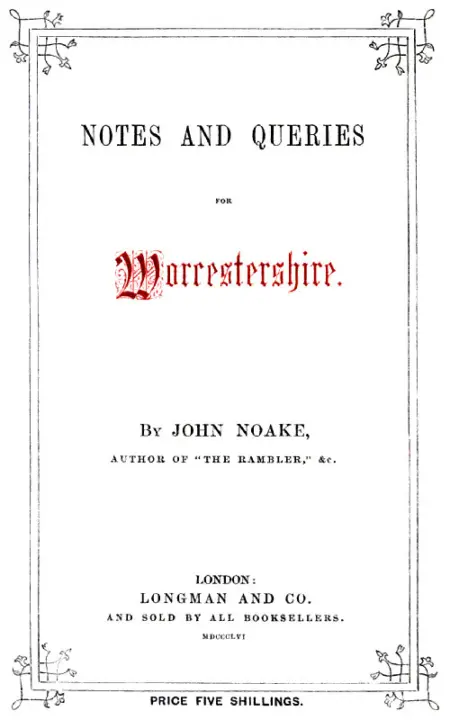
"Notes and Queries for Worcestershire" by John Noake is a historical account written in the mid-19th century. The work serves as a compilation of various details about Worcestershire, shedding light on its history, customs, and social life. The author aims to create a more nuanced narrative of the county's past, moving beyond dry statistics to a richer understanding of the people and their experiences. At the start of the publication, the author expresses his anticipation that this installment will contribute to the understudied history of Worcestershire. He reflects on the limitations of prior historical approaches, emphasizing the need for detailed research into local customs, traditions, and social life. Noake insists that a collaborative effort is essential for a comprehensive account, suggesting that while his work is a modest beginning, it invites further inquiry into the county's rich heritage, aiming to illuminate the lives of its inhabitants across the centuries.
Introduction adapted from the source catalogue; source summaries may be automatically generated.
Free to read · English · 101,259 words · No account needed
MAKE TIME FOR A GOOD BOOK
On by default. Untick to stop anonymous reading totals. Each page counts after 10 seconds in view. How this works.
Anonymous counting is on unless you have switched it off.
Mistress Joyce Jeffries was the half-sister of Humphrey Coningsby, Esq., of Neen Sollers, a gentleman remarkable for his chivalrous enterprise as a traveller in the reign of James I. This autograph account book embraces a period of nine years, and embodies many curious particulars bearing upon the events, persons, and manners of the age, also setting forth the writer as the representative of a class now only to be seen in family pictures of the time. She lived unmarried, had an income of more than £500 per annum, in the expenditure of which she was very generous. Her dress was costly; she employed false curls and curling irons, wore many rings, used spectacles, and carried a whistle suspended at her girdle by a yard of loop black lace--probably for a little dog. A Cypress cat was given her by the Lady Dansey of Brinsop, and she kept a throstle in a twiggen cage. She had many god-children, to one of whom (Mistress Eliza Acton) she gave £800 as a marriage portion. Madam Jeffries kept several servants, and went abroad in a coach drawn by two mares. She was very observant of the festivals and ceremonies of the church, and contributed to the wassell of the hinds when they lighted their twelve fires, and made the fields resound with their revelry; and on Valentine's Day gave Tom Aston, Dick Gravell, or any other male, a present in money for coming to be her Valentine. She sent the mayor a present of ten shillings on his law-day, and on one occasion dined with him, when the waits were in attendance, to whom she gave money; and she was generous to travelling minstrels and showmen, as "to a boy that did sing like a blackbird," "to Cherlickcombe and his jackanapes," and "to a man that had the dancing horse at the Hereford Midsummer fair." As to what befell her in the troubled time of the Civil War, the book passes from the year 1638 to the end of 1647, during which England toiled and suffered under intestine strife. No county was more loyal to the royal cause than that of Hereford. In 1638, Mrs. Jeffries pays ship-money and another impost called "the king's provision," and finds a soldier for her property in Hereford and elsewhere. In 1641 she purchases pamphlets and news-books and takes an interest in passing political events. In September, 1642, when the Earl of Essex entered Worcester, and sent the Earl of Stamford to occupy Hereford, she quitted her town house and went to Garnons, the residence of Mr. Geers, a few miles distant, thinking she would be there in security; but in the plundering which took place by the Earl of Stamford's soldiers, immediately upon their arrival, the house of Mr. Geers was visited and pilfered by Captain Hammond, who carried off much goods, including her two bay coach mares. At the same time she had other property secreted and saved in other places. The Parliamentarians having left the city in December, it was reoccupied by the Royalists, and her friend and cousin, Fitzwilliam Coningsby, was made Governor; when, besides her regular assessment, she sent him a present of £50 to pay his soldiers, and a bullock worth £6. In the spring of 1643 he marched with the rest of the commissioners of the county and the Herefordshire levies to join the little army of Lord Herbert of Raglan, at Highnam near Gloucester, where they were all captured by Sir William Waller. Hereford continued unmolested till the month of April, and Mistress Jeffries returned for a few days to her house, but the report of the Parliamentarians coming once more to assail the city under the command of that general drove her once more to her retreat. Her house at Widemarsh Gate suffered during his attack on the city, but she remained in quiet at Garnons until April, 1644. As the county was now seriously disturbed by the contending parties she suddenly took flight again, visiting Hereford for the last time, and carrying off her trunks and chests and servants to Ham Castle, the seat of her cousin Jeffries, on the banks of the Teme, on the edge of the county of Worcester. Soldiers were still quartered in her house at Hereford, and she pays for work done in making bulwarks to defend the city. At length, in 1645, when the whole of the suburbs were laid bare up to the walls by order of the governor, Colonel Barnabas Scudamore, her new house and several others her property without Widemarsh Gate were pulled down. She takes this as a matter of course, without comment upon the hardship of the proceeding, and upon all occasions shows a cheerful and contented mind. In many other respects she felt the effects of the war, and symptoms of them frequently appear in her accounts. She contributed to the lecturers introduced into the churches; her cousin's child was "baptised after the new directory;" and the committee men laid their hands on her property and straitened her means, though she still persevered in the unwearied exercise of humanity and in bestowing her charity on others. As she advances in years her accounts exhibit a trait or two of her approaching infirmities: she loses various small articles of value--spectacles and rings, which her servants find and bring to her, and are rewarded accordingly; and the recurrence of this excites some suspicion of their knavery. The death of her cousin Herbert Jeffries, at Ham Castle, in consequence of his breaking his leg, disturbed her tranquillity, and is described with melancholy minuteness. Age seems to have neither abated her generous feeling nor the ardour of her domestic affections. She was always interested in those events which usually bring joy to families and occasional entries in our parochial registers. The union of Miss Acton, her goddaughter, with Mr. Francis Geers, and a christening that took place at Ham Castle a very short time before her death (the child receiving her own Christian name), was to her a source of infinite pleasure. She went on, "giving" to some and "forgiving" others, to the close of her beneficent career. She died in April, 1648, and was buried in the chancel of the parish church of Clifton-on-Teme, where her memory is still revered by those to whom her existence and character are known.
Your reading position is saved on this browser. Take it to another device with a library code. Reading pages adapt to text, rather than matching a printed edition.
BEHIND THE BOOK
This eBook is for the use of anyone anywhere in the United States and most other parts of the world at no cost and with almost no restrictions whatsoever. You may copy it, give it away or re-use it under the terms of the Project Gutenberg License included with this eBook or online at www.gutenberg.org. If you are not located in the United States, you will have to check the laws of the country where you are located before using this eBook. Read the source licence.
The original source file, including credits and licence, is retained by this library. Request an original-format copy at no charge. Please include the book title and Project Gutenberg identifier #47105.
KEEP YOUR CURIOSITY GOING
Cécile Tormay

Moritz Busch
John L. Ransom
Frances Wright
Cécile Tormay

Mabel Potter Daggett