THE CLASSIC COLLECTION✦An outlaw’s diary: the CommuneCLASSIC FREE BOOKS
An outlaw’s diary: the Commune
Cécile Tormay
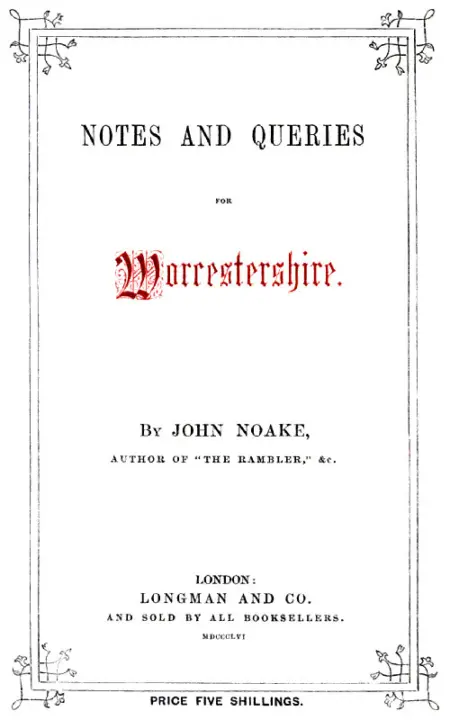
THE CLASSIC COLLECTION · 1856
"Notes and Queries for Worcestershire" by John Noake is a historical account written in the mid-19th century. The work serves as a compilation of various details about Worcestershire, shedding light on its history, customs, and social life. The author aims to create a more nuanced narrative of the county's past, moving beyond dry statistics to a richer understanding of the people and their experiences. At the start of the publication, the author expresses his anticipation that this installment will contribute to the understudied history of Worcestershire. He reflects on the limitations of prior historical approaches, emphasizing the need for detailed research into local customs, traditions, and social life. Noake insists that a collaborative effort is essential for a comprehensive account, suggesting that while his work is a modest beginning, it invites further inquiry into the county's rich heritage, aiming to illuminate the lives of its inhabitants across the centuries.
Introduction adapted from the source catalogue; source summaries may be automatically generated.
Free to read · English · 101,259 words · No account needed
MAKE TIME FOR A GOOD BOOK
On by default. Untick to stop anonymous reading totals. Each page counts after 10 seconds in view. How this works.
Anonymous counting is on unless you have switched it off.
The Toleration Act of William III gave immunity to all Protestant Dissenters, except those who denied the Trinity, from the penal laws to which they had been subjected. In the Sessions' order book, date 1696, is a "Mem. That the persons under-named in open Court of Sessions did take the oaths mentioned and appointed to be taken in and by an Act made Anno primo Willi et Marie, entitled 'An Act for abrogating of the oaths of allegiance and supremacy, and appointing other oaths;' and also made and subscribed the declaration appointed to be made and subscribed in and by an Act made Anno 25 Caroli Secundi, entitled 'An Act for preventing dangers which may happen from Popish recusants,' according to an Act made Annis 7 et Willi tertii Regis, entitled 'An Act requiring the practicers of the law to take the oaths and subscribe the declarations therein mentioned.'" The following are the names of the subscribers in this county:
John Soley, Esq.
Charles Cocks, Esq.
Richard Nanfan, }
Henry Toye, }
Thomas Parker, }
Joshua Bradley, }
Richard Cowcher, }
John Yarranton, }
Richard Teynton, }
John Ffownes, }
Edwyn Eyre, }
Robert Bird, }
Thomas Partington, } Gent.
Samuel Grove, }
Thomas Hayward, }
Thomas Hart, }
William Cardale, }
Epaphroditus Bagnall, }
William Hart, }
Richard Norbury, }
Henry Hodges, }
Richard Herbert, }
Thomas Oliver, }
Edmund Rose, }
22 Maii, 1696.
Samuel Hunt, }
Edward Walker, Advocate, }
John Price, }
William Bowkey, }
Henry Philpott, }
Edward Hallen, }
Thomas Millward, }
Edward Dyson, } Gent.
Godman Atwood, }
Anthony Ashfield, }
James Gilbert, }
John Morris, }
Robert Parr, }
Henry Prescott, }
Edward Walker, jun., }
James Nash, }
Die eadem--the same time the persons under-named subscribed the
association:
Richard Norbury, }
Anthony Ashfield, }
James Gilbert, }
John Morris, }
Robert Parr, }
Henry Prescott, }
Edward Walker, jun. }
Godman Atwood, } Gent.
Thomas Milward, }
Edward Hallen, }
Henry Philpott, }
John Price, }
Edward Walker, Advocate, }
William Bowkey, }
Samuel Hunt, }
An explanation is necessary with regard to "signing the association," as stated above. In Harris's Life of William III, p. 143, under the date of 1688, it is stated that after the arrival of the gentlemen of Somerset and Dorsetshire, at Exeter, "Sir Edward Seymour asked Dr. Burnet 'Why they had not got an association, without which they were only a rope of sand, and none would think themselves bound to stick to them.' The Doctor told him 'It was for want of a man of his authority and credit to support such an advice.'" He then proposed it to the Prince, who, with the Earl of Shrewsbury and all present, approved the motion. Accordingly the Doctor did urge an association, containing "a solemn engagement firmly to adhere together in pursuance of the ends of the Prince's declaration, and in defence thereof, and never to depart from it till the religion, laws, and liberties of the people should be secured by a free Parliament; and if any attempt should be made on the person of the Prince, that it should be revenged on all by whom any such attempt should be made." This association was speedily signed there and in other places, particularly by many in the University of Oxford. Lord Herbert of Cherbury, and the principal gentlemen of Worcestershire and Herefordshire, met at Worcester, and declared for the Prince of Orange, when Sir Walter Blount and the Sheriff of Worcestershire were sent prisoners to Ludlow Castle. The declaration, I presume, continued to be signed for several subsequent years.
Your reading position is saved on this browser. Take it to another device with a library code. Reading pages adapt to text, rather than matching a printed edition.
BEHIND THE BOOK
This eBook is for the use of anyone anywhere in the United States and most other parts of the world at no cost and with almost no restrictions whatsoever. You may copy it, give it away or re-use it under the terms of the Project Gutenberg License included with this eBook or online at www.gutenberg.org. If you are not located in the United States, you will have to check the laws of the country where you are located before using this eBook. Read the source licence.
The original source file, including credits and licence, is retained by this library. Request an original-format copy at no charge. Please include the book title and Project Gutenberg identifier #47105.
KEEP YOUR CURIOSITY GOING
Cécile Tormay

Moritz Busch
John L. Ransom
Frances Wright
Cécile Tormay

Mabel Potter Daggett