THE CLASSIC COLLECTION✦An outlaw’s diary: the CommuneCLASSIC FREE BOOKS
An outlaw’s diary: the Commune
Cécile Tormay
THE CLASSIC COLLECTION · 1856
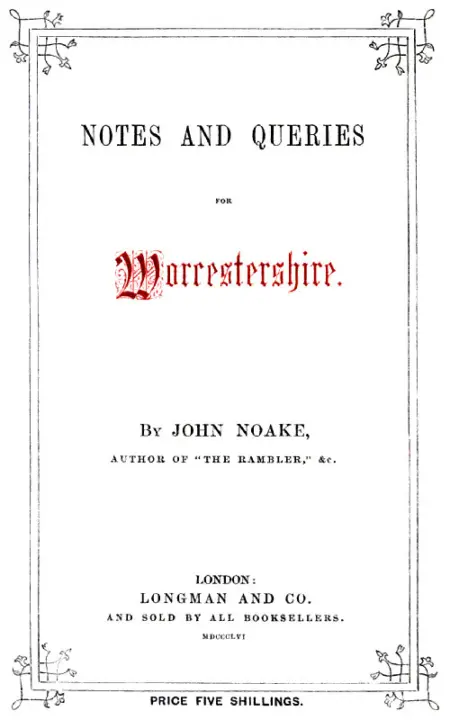
"Notes and Queries for Worcestershire" by John Noake is a historical account written in the mid-19th century. The work serves as a compilation of various details about Worcestershire, shedding light on its history, customs, and social life. The author aims to create a more nuanced narrative of the county's past, moving beyond dry statistics to a richer understanding of the people and their experiences. At the start of the publication, the author expresses his anticipation that this installment will contribute to the understudied history of Worcestershire. He reflects on the limitations of prior historical approaches, emphasizing the need for detailed research into local customs, traditions, and social life. Noake insists that a collaborative effort is essential for a comprehensive account, suggesting that while his work is a modest beginning, it invites further inquiry into the county's rich heritage, aiming to illuminate the lives of its inhabitants across the centuries.
Introduction adapted from the source catalogue; source summaries may be automatically generated.
Free to read · English · 101,259 words · No account needed
MAKE TIME FOR A GOOD BOOK
On by default. Untick to stop anonymous reading totals. Each page counts after 10 seconds in view. How this works.
Anonymous counting is on unless you have switched it off.
A system under which a gaoler rents his prison, and makes his profit by selling drink to the inmates at an enormous rate, reads curiously enough in these days when the science of prison discipline has so greatly advanced as to induce us to make the most costly sacrifices. It will be observed that the county prison was on the site of the ancient castle, once standing near the Cathedral precincts, but which had long been destroyed. An order was made in 1723, "that Mr. Hall, the treasurer, doe take due care that the partition be made in the women's ward, in order to keep the debtors from the felons." In 1767 the Clerk of the Peace was directed to apply to the Treasury for the grant of "a certain piece of garden ground, about five acres, lying contiguous to the public gaol of the county, and particularly serviceable to the occupiers thereof for the time being, and also the site and remains of the old castle or citadel of Worcester, which now is and hath long been used as a public gaol or prison and bridewell for the said county," and praying that the grant of the premises be made to the Earl of Plymouth, Lord Coventry, Lord Sandys, Lord Ward, and other magistrates, including the names of Lygon, Rushout, Winnington, and Dowdeswell, "in trust, for the keeping of prisoners and otherwise for the use and benefit of this county." A petition was, however, transmitted to the Lords of the Treasury, by the mayor and aldermen of the city, against the grant of the site of these fortifications to the county magistrates, and the city authorities were successful in the application. This seems to have been the first effort made towards gaol improvement, but the period was near at hand when the outraged laws of health were to vindicate themselves. The Worcester county prison, with several others in the midland counties, in the year 1783, was visited with the fatal gaol distemper, which swept the cells of their inhabitants and proved fatal to that eminent physician, Dr. Johnstone. At that period I find an order on the book "to apply to the sheriff for his concurrence to fix a temporary gaol, and endeavour by advertisement and otherwise to find one or more proper places for the confinement of felons." Extensive improvements were set on foot, in which the humane system suggested by the philanthropist Howard was introduced, and when the works were finally completed (in 1795) a sum of between £4000 and £5000--a large amount for that period--had been expended. In 1785, William Lygon, Esq., was thanked "for his great trouble in procuring the removal of a number of transports from the county gaol on board the lighters on Thames, whereby the county was saved a considerable expense and the health of the gaol was preserved." About four years afterwards, and while the alterations were still going on, an order was made not to confine any one in the dungeon of the gaol nor to confine any two prisoners in one cell. The spirit of reform, however, was not yet satisfied, for scarcely had the century closed when it was found that the great outlay that had been incurred was useless, and that the establishment was altogether insecure; William Davis, the gaoler, complaining of the escape of certain prisoners; and a "watchman or guard" was decided on. After an unprecedented opposition on the score of expense, and a protracted scene of strife and contention among the magistracy, the Court of Quarter Sessions at length resolved, in the year 1808 (but not till Lord Chief Baron Macdonald had threatened the county with a heavy fine), to build a new gaol in Salt Lane, at a cost of £18,000. The details of these transactions will be found in "Worcestershire in the Nineteenth Century," recently published, the author of which informs us that on the Sunday during or immediately following the Assizes, which used to be known as Assize Sunday, and kept as a great fair, the keepers at the (old) county gaol were accustomed to show the prisoners through the bars to the curious crowd, and collect money in a boot for pointing out those who were sentenced to be hanged! In 1814 the prisoners were removed to the new gaol; and at the very next Sessions, Mr. Wells, attorney, was requested to apply to Mr. Sandys, the architect, relative to the escape of some prisoners therefrom!! From that time to the present this ill-fated building has seemed destined to an endless sinking of capital, for the trial of new experiments and for remedying the stupidity of bygone architects and committees. About £18,000 was spent on it a dozen years ago, and now (1856) nearly £20,000 has been voted for the same purpose.
Your reading position is saved on this browser. Take it to another device with a library code. Reading pages adapt to text, rather than matching a printed edition.
BEHIND THE BOOK
This eBook is for the use of anyone anywhere in the United States and most other parts of the world at no cost and with almost no restrictions whatsoever. You may copy it, give it away or re-use it under the terms of the Project Gutenberg License included with this eBook or online at www.gutenberg.org. If you are not located in the United States, you will have to check the laws of the country where you are located before using this eBook. Read the source licence.
The original source file, including credits and licence, is retained by this library. Request an original-format copy at no charge. Please include the book title and Project Gutenberg identifier #47105.
KEEP YOUR CURIOSITY GOING
Cécile Tormay

Moritz Busch
John L. Ransom
Frances Wright
Cécile Tormay

Mabel Potter Daggett