THE CLASSIC COLLECTION✦An outlaw’s diary: the CommuneCLASSIC FREE BOOKS
An outlaw’s diary: the Commune
Cécile Tormay
THE CLASSIC COLLECTION · 1856
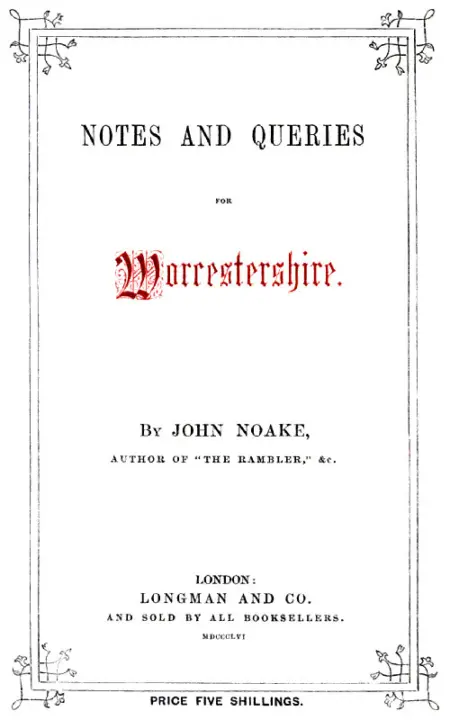
"Notes and Queries for Worcestershire" by John Noake is a historical account written in the mid-19th century. The work serves as a compilation of various details about Worcestershire, shedding light on its history, customs, and social life. The author aims to create a more nuanced narrative of the county's past, moving beyond dry statistics to a richer understanding of the people and their experiences. At the start of the publication, the author expresses his anticipation that this installment will contribute to the understudied history of Worcestershire. He reflects on the limitations of prior historical approaches, emphasizing the need for detailed research into local customs, traditions, and social life. Noake insists that a collaborative effort is essential for a comprehensive account, suggesting that while his work is a modest beginning, it invites further inquiry into the county's rich heritage, aiming to illuminate the lives of its inhabitants across the centuries.
Introduction adapted from the source catalogue; source summaries may be automatically generated.
Free to read · English · 101,259 words · No account needed
MAKE TIME FOR A GOOD BOOK
On by default. Untick to stop anonymous reading totals. Each page counts after 10 seconds in view. How this works.
Anonymous counting is on unless you have switched it off.
Such scenes of fighting, drunkenness, and debauchery, were probably never witnessed in the parish but at those times, and close beneath the shadow of its old church too. The clergy, aided by the indefatigable exertions of the present respectable clerk, Mr. Williams, at length rooted out the evil; and a little dancing which is still carried on at Fearnall Heath on the Monday is all that remains of Claines wake.
The overseers in 1678 were ordered to deduct the third part of the pay of such poor as should be found tippling in alehouses upon Sundays, for the space of a month after they should be found so tippling. Among the curious entries in these books are the following:
1669.--"Given to one whose dwelling was drowned by the sea
coming too late to church, 1s."
1713.--"Whereas several pack horses hath spoiled the road leading from Dean Green to Claines Church, not having any right to travel the said road, being no inhabitance of the said parish, we order that there be a barr with post and railes set upp to prevent it over against the house of Richard Onions."
An interesting document relative to the liability of Claines to pay to the relief of the poor of the Tything of Whistones will be found under the head of "County Sessions Records--The Poor."
The Rev. W. Crowther is the present perpetual curate of Claines;
churchwardens, Mr. Moon and Mr. Martin Curtler. Population in 1851,
1373.
"Thoughts shut up, want air,
And spoil, like bales unopen'd to the sun."
The Sessions rolls, now in the custody of the Clerk of the Peace, consisting of recognizances, presentments, informations, memorials, grand jury bills, &c., commence with 1600, but the order books do not go further than 1693. From the latter it appears that a great portion of the county business was transacted at inns and private gentlemen's houses. The Talbot, in Sidbury, for a great number of years enjoyed the magisterial patronage, adjournments being regularly made from the Guildhall (where the County Assizes and Sessions were then held) to that respectable old hostelry, where no doubt the magnates compensated themselves for the dry and tedious work in hand by generous and stimulating potations, as was the custom with the city authorities. Several Sessions were adjourned to Hooper's coffee-house at the Guildhall, which is first mentioned in 1767 as being kept by Lucy Hooper, and also to the Trinity Hall (an old building occupied by various trading "companies" or "guilds," on the site of which now stand Messrs. Freame's warehouses near St. Swithin's church). A committee of magistrates were ordered to inspect this hall in 1796, to consider the propriety of purchasing it and converting it into an office for the Clerk of the Peace; but this seems to have fallen to the ground. The Talbot, Claines (Tything), was preferred for some time, the Star being occasionally used; then the Crown inn was chosen in 1792 by a formal vote of the bench; and in the early part of the present century the Hop-pole came in for its share. During all this period, however, on many occasions, adjournments were made to other towns and villages. The Earl of Coventry was frequently visited in this way at Croome; the Hon. H. Herbert, at Ribbesford (1710); Rev. Dr. William Lloyd, at Ripple; William Hancock, Esq., at Bredon's Norton, and the Bishop's Palace at Hartlebury (1715); Lord Herbert, at Ribbesford (1721); and in 1723 a circuit seems to have been taken on many consecutive days to the Crown, Evesham; Crown, Blockley; George, Shipston; Angel, Pershore; Talbot, Feckenham; Crown, Bromsgrove; George, Bewdley; Lion, Kidderminster; Talbot, Stourbridge; Bush, Dudley; Hundred House, Witley; Crown, Tenbury; the house of Mrs. Collins, Shelsley; and the Sun, Upton. By the statute 9th George I, chap. 24, all persons who were Papists, and all persons who had not taken the oath for securing the throne to the House of Hanover, were to do so before the 25th of December, 1723, in one of the courts at Westminster or at the Quarter Sessions. This was no doubt the cause of the adjournments of the Quarter Sessions in that year. In modern times it often occurs that the Quarter Sessions are adjourned to different places in the county for the convenience of newly-appointed magistrates being sworn into office. In the year 1809, Sir Harry Lippincott, Bart., was appointed a magistrate for Gloucestershire, and he was sworn into office at an adjournment of the Gloucestershire Quarter Sessions--the Sessions being adjourned to the White Lion, the principal inn at Berkeley (now the Berkeley Arms), the late Earl of Berkeley taking the chair, and administering the oaths to the hon. bart. In 1697, Lancelott Jewkes, the Worcester county gaoler, was fined £20 "for not attending this court to do his duty, the court having had several occasions for him." It was ordered in 1716, "that the Sheriff for the future do not return any freeholders within the burrough of Bewdley to serve on jurys for the County Sessions, they having Sessions of their own." Another order was made in 1723, "that there be an advertisement in the Worcester newspaper, to give notice to people lyable to serve on jurys not to give money to the bayliffe to excuse them, and that the treasurer doe pay for the advertisement four weeks successively." The following is a table of fees ordered in 1753 for justices' clerks, in pursuance of an act of the previous session:
Your reading position is saved on this browser. Take it to another device with a library code. Reading pages adapt to text, rather than matching a printed edition.
BEHIND THE BOOK
This eBook is for the use of anyone anywhere in the United States and most other parts of the world at no cost and with almost no restrictions whatsoever. You may copy it, give it away or re-use it under the terms of the Project Gutenberg License included with this eBook or online at www.gutenberg.org. If you are not located in the United States, you will have to check the laws of the country where you are located before using this eBook. Read the source licence.
The original source file, including credits and licence, is retained by this library. Request an original-format copy at no charge. Please include the book title and Project Gutenberg identifier #47105.
KEEP YOUR CURIOSITY GOING
Cécile Tormay

Moritz Busch
John L. Ransom
Frances Wright
Cécile Tormay

Mabel Potter Daggett