THE CLASSIC COLLECTION✦An outlaw’s diary: the CommuneCLASSIC FREE BOOKS
An outlaw’s diary: the Commune
Cécile Tormay
THE CLASSIC COLLECTION · 1856
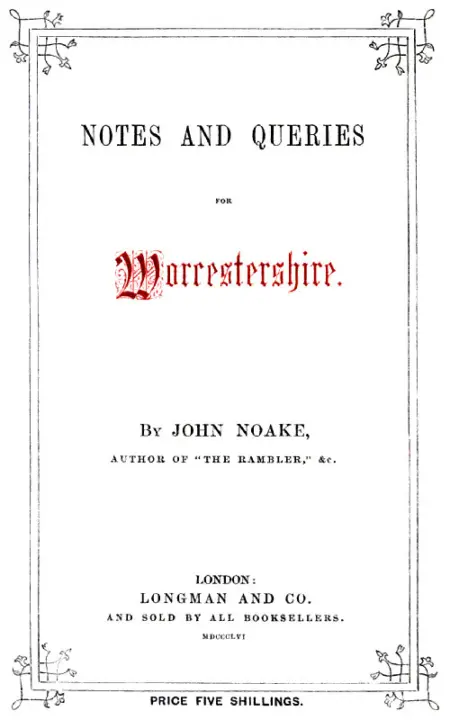
"Notes and Queries for Worcestershire" by John Noake is a historical account written in the mid-19th century. The work serves as a compilation of various details about Worcestershire, shedding light on its history, customs, and social life. The author aims to create a more nuanced narrative of the county's past, moving beyond dry statistics to a richer understanding of the people and their experiences. At the start of the publication, the author expresses his anticipation that this installment will contribute to the understudied history of Worcestershire. He reflects on the limitations of prior historical approaches, emphasizing the need for detailed research into local customs, traditions, and social life. Noake insists that a collaborative effort is essential for a comprehensive account, suggesting that while his work is a modest beginning, it invites further inquiry into the county's rich heritage, aiming to illuminate the lives of its inhabitants across the centuries.
Introduction adapted from the source catalogue; source summaries may be automatically generated.
Free to read · English · 101,259 words · No account needed
MAKE TIME FOR A GOOD BOOK
On by default. Untick to stop anonymous reading totals. Each page counts after 10 seconds in view. How this works.
Anonymous counting is on unless you have switched it off.
Tredington, 240, 312.
Trial by combat, 147.
Trumpeters at Assizes, 282.
Tything, 93.
Upton-on-Severn, 75, 85, 125, 130, 146, 270, 311, 313, 314.
Upton Snodsbury, 61, 245.
Upton Warren, 132, 253.
Vacarius' Roman law, 143.
Valentine's Day, 212.
Vernon family, 264, 295.
Versified will, 262.
Vineyards, 288.
Virtuous parish, 296.
Wages of Magistrates, 291.
Waits, 213.
Wake at Claines, 72.
Ward, Lord, 87.
Watchman, the last, 38.
Weather rhymes and sayings, 306.
Welland, 57, 126.
Whipping, 84.
Whitbourne, 128.
White Ladies, 212, 256.
Whitsun farthings, 14, 23, 56, 65, 69.
Whoop custom, 217.
Wichbold, 312, 313.
Wichenford, 295, 315.
Wick, 207.
Winnington family, 87, 123, 137.
Witchcraft, 78, 183, 142.
Witley, 75, 125, 160.
Wolverley, 142, 201, 259, 311, 325.
Yardley, 313, 314, 316.
St. Michael's.
The register of this parish commences with the year 1546, but as the entries for about half a century are apparently in the same handwriting, it is probable that in or soon after the year 1597, when an order was issued that all parochial registers should be transcribed on vellum, an older register of St. Michael's was copied on that now existing. It is on vellum and in excellent preservation--which probably will not be said some two or three centuries hence respecting the common and perishable paper registers now in use by Government authority. The first entry which attracted my attention in this register was--
"1648.--John Somers, gent., and Katherine, the daughter of John Seaverne, gent., and Mary his wife, were married Nov. 13."
And among the births are the following:
"1650.--John the sonne of John Somers, gent., and Katherine his wife, was born the fourth day of March."
"1653.--Mary, daughter of John Somers, gent., and Katherine his
wife, was born 15th Oct."
"1655.--Katherine, daughter of John Somers, gent., and
Katherine his wife, born 7th April."
Here, then, are the means of deciding a fact which has long been the subject of dispute. Mr. Cooksey, in his "Life of Lord Somers," asserts that he was born at the White Ladies; but Dr. Nash mentions the tradition that the famous Lord was born in the College Churchyard, in a house since pulled down, adjoining the south side of the old church of St. Michael; "but as during the Civil Wars (says that veracious and painstaking chronicler, Chambers) the registers were discontinued, or very irregularly kept, though the Doctor diligently searched, his birth could not be found, either in the parishes of Severn Stoke, St. Michael, St. Helen, St. Peter, or the Tything." The "diligence" of the Doctor's search must now be a matter of doubt, as the four entries copied above are not only easily observed, but are somewhat prominent. The "John Somers, gent.," whose marriage with Katherine Seaverne is recorded in 1648, was unquestionably the attorney who resided for some time at the White Ladies, and afterwards within the Cathedral precincts; and their first-born, who was introduced to the world on the 4th of March, 1650, was afterwards the celebrated nobleman who became the head of the Whigs and Lord High Chancellor of England--whose eloquence, knowledge of the law, inflexible integrity, and great capacity for public business, made him an ornament to his country--and whose defence of the seven bishops, in opposition to the tyranny of James II, entitles him to a place in the foremost rank of the defenders of our constitutional liberty. The death of his parents is not entered in St. Michael's register, as they both died and were buried at Severn Stoke. Lord Somers himself was buried in Hertfordshire.
Your reading position is saved on this browser. Take it to another device with a library code. Reading pages adapt to text, rather than matching a printed edition.
BEHIND THE BOOK
This eBook is for the use of anyone anywhere in the United States and most other parts of the world at no cost and with almost no restrictions whatsoever. You may copy it, give it away or re-use it under the terms of the Project Gutenberg License included with this eBook or online at www.gutenberg.org. If you are not located in the United States, you will have to check the laws of the country where you are located before using this eBook. Read the source licence.
The original source file, including credits and licence, is retained by this library. Request an original-format copy at no charge. Please include the book title and Project Gutenberg identifier #47105.
KEEP YOUR CURIOSITY GOING
Cécile Tormay

Moritz Busch
John L. Ransom
Frances Wright
Cécile Tormay

Mabel Potter Daggett