THE CLASSIC COLLECTION✦An outlaw’s diary: the CommuneCLASSIC FREE BOOKS
An outlaw’s diary: the Commune
Cécile Tormay
THE CLASSIC COLLECTION · 1856
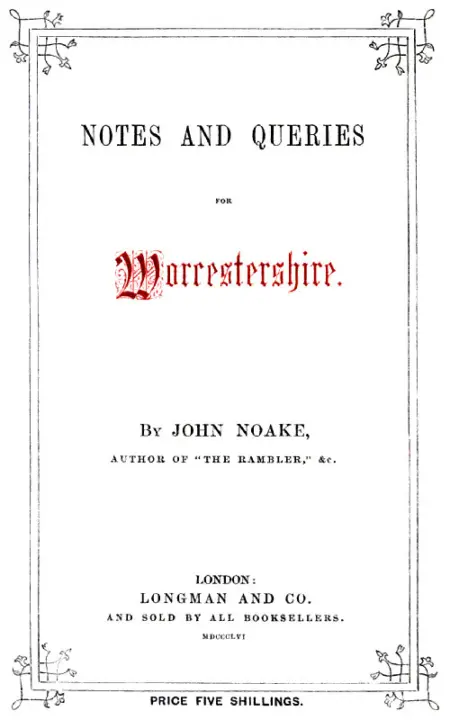
"Notes and Queries for Worcestershire" by John Noake is a historical account written in the mid-19th century. The work serves as a compilation of various details about Worcestershire, shedding light on its history, customs, and social life. The author aims to create a more nuanced narrative of the county's past, moving beyond dry statistics to a richer understanding of the people and their experiences. At the start of the publication, the author expresses his anticipation that this installment will contribute to the understudied history of Worcestershire. He reflects on the limitations of prior historical approaches, emphasizing the need for detailed research into local customs, traditions, and social life. Noake insists that a collaborative effort is essential for a comprehensive account, suggesting that while his work is a modest beginning, it invites further inquiry into the county's rich heritage, aiming to illuminate the lives of its inhabitants across the centuries.
Introduction adapted from the source catalogue; source summaries may be automatically generated.
Free to read · English · 101,259 words · No account needed
MAKE TIME FOR A GOOD BOOK
On by default. Untick to stop anonymous reading totals. Each page counts after 10 seconds in view. How this works.
Anonymous counting is on unless you have switched it off.
A regulation was laid down in 1595 that the bells should be "charged at every churching and wedding, by consent as aforesaid--4d. at every churching, and 6d. at every wedding; and if any not inhabiting within this parish shall require to have ringing hereafter at their wedding, they shall paye towards the reparation of the belles, xiid." Among the receipts yearly the sum of 2s. is regularly mentioned as having been received from the chamberlains for the council bell. This was probably the bell by which the corporation meetings were called together, St. Andrew's being the nearest church to the Guildhall. The receipts for the use of all the bells in the year 1602 amounted to 11s. 8d. A clock and chimes also existed here. Among the occasions for ringing at this church was the following, in 1625:
"Paid by Mr. Maior's appointment for ringinge when there was speeche betwixt our King Charles and the French ladye, 2s. 6d."
After the expedition of "his sacred Majesty" to Spain, to woo the Infanta, that match was broken off, and negotiations were begun in 1625 for his marriage with the Princess Henrietta Maria, youngest daughter of Henri IV of France--an union the most unfortunate for Charles and for his country, so adverse were her influences over him, and so unmanly his acquiescence to her. About the year 1590 the following inventory was made "of such stuffe as remayneth in the p'rishe church of St. Andrew at the accompt of John Hiller and Thomas Hemynge, at the daye of choseing wardens, when--A Bible, ii books of Omilies (one is lost), a book of Comon Prayer, a book of Iniuncons (Injunctions), (this is lost), the Paraphraces, Emusculus Comon Places, a Comunion cuppe and a cover, a surples, a cloath for ye Comunion table, ii church pawles with ii pillowes, a Comunion table with a frame and a carpet for the same, iii joyned fearms, ii long and on short, on longe forme with iv feet, a coffer with a locke and a keye, a great cheste with ii locks, the poor men's boxe with ii locks and keyes, ii long laddars of the p'rishes, ii other laddars, on for the clocke and the other for the steeple, a dext (desk), with a frame, sixe bells with a clock, chimes, and the whole furniture thereunto belonging, ii bears (biers), the rejester book (the parson hath it)." The Paraphrases, above alluded to, were those of Erasmus, which Cramner ordered to be set up in every church. "Emusculus's Comon Places" were contained in a work now in the Royal Library in the British Museum, which has the following title: "Common Places of Christian Religion, gathered by Wolfgangus Musculus, for the use of suche as desire the knowledge of Godly truthe, translated out of the Latin into Englishe. Hereunto are added two other Treatises, made by the same author, one on Othes, the other on Usurye. Londini, Anno Domini M.D.LXIII." The imprint at the end of the work (which consists of 1174 folio pages) is--"Imprinted at London by Reginalde Wolfe, Anno Domini 1563." In 1604, "a book of cannons for our parson" was purchased for 16d., and "payed for our Bible 36s." It would appear that the churchwardens sold Bibles in those days, and it is even probable that they let out the church Bible to those parishioners who could not afford to purchase one, for in 1610 occurs this item--"Imprimis, received for our church Bible, xs. vid." These officers were occasionally overhauled for neglect of duty, for in 1612 is this entry--"Payed for the fees of the Consistory Court when we weare called thither for not buying Mr. Jewell's works, and likewise about ye broken bell, xxiiid." Jewell's works were printed in 1609, and the Archbishop Bancroft, in his letter to the Bishops, dated 27th July, 1610 (printed in Dr. Cardwell's Annals of the Reformed Church, vol. 2, p. 154), desires the Bishops, Chancellors, and Archdeacons, with the rest of the preachers and ministers, "to induce the parishioners of every parish to buy one of the works of Bishop Jewel." In 1610 a "Communion table with a form" was bought for 6s. 4d., and in 1616 three trenchers were ordered for the Communion table at a cost of 6d. The cost of bread and wine for the year 1613 was 16s. 8d.; for 1624, £1. 4s. 6d.; and the pence collected at the communion for the year 1619, £1. 11s. 1d. Wine and sugar loaves were given to the strange clergymen who preached occasionally. The vestry resolved in 1598 that 5s. should be paid for every corpse above the age of ten years buried in the church, and under that age 3s. 4d., "and to pave the ground at their own charges." At a later period the act for burying in woollen was rigidly enforced, for the benefit of the woollen trade. In 1692, "paid for a warrant to seize widdow Yates' goods for not making affadavid yt she was buried in woollen, 1s." Pope alludes to this custom in the following lines:
Your reading position is saved on this browser. Take it to another device with a library code. Reading pages adapt to text, rather than matching a printed edition.
BEHIND THE BOOK
This eBook is for the use of anyone anywhere in the United States and most other parts of the world at no cost and with almost no restrictions whatsoever. You may copy it, give it away or re-use it under the terms of the Project Gutenberg License included with this eBook or online at www.gutenberg.org. If you are not located in the United States, you will have to check the laws of the country where you are located before using this eBook. Read the source licence.
The original source file, including credits and licence, is retained by this library. Request an original-format copy at no charge. Please include the book title and Project Gutenberg identifier #47105.
KEEP YOUR CURIOSITY GOING
Cécile Tormay

Moritz Busch
John L. Ransom
Frances Wright
Cécile Tormay

Mabel Potter Daggett