THE CLASSIC COLLECTION✦An outlaw’s diary: the CommuneCLASSIC FREE BOOKS
An outlaw’s diary: the Commune
Cécile Tormay
THE CLASSIC COLLECTION · 1856
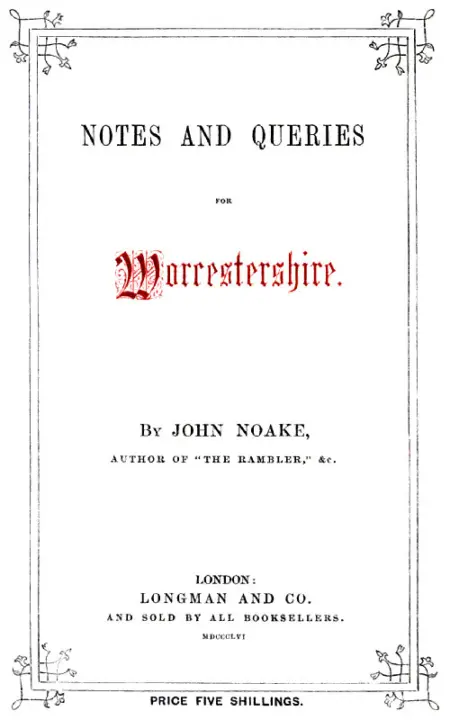
"Notes and Queries for Worcestershire" by John Noake is a historical account written in the mid-19th century. The work serves as a compilation of various details about Worcestershire, shedding light on its history, customs, and social life. The author aims to create a more nuanced narrative of the county's past, moving beyond dry statistics to a richer understanding of the people and their experiences. At the start of the publication, the author expresses his anticipation that this installment will contribute to the understudied history of Worcestershire. He reflects on the limitations of prior historical approaches, emphasizing the need for detailed research into local customs, traditions, and social life. Noake insists that a collaborative effort is essential for a comprehensive account, suggesting that while his work is a modest beginning, it invites further inquiry into the county's rich heritage, aiming to illuminate the lives of its inhabitants across the centuries.
Introduction adapted from the source catalogue; source summaries may be automatically generated.
Free to read · English · 101,259 words · No account needed
MAKE TIME FOR A GOOD BOOK
On by default. Untick to stop anonymous reading totals. Each page counts after 10 seconds in view. How this works.
Anonymous counting is on unless you have switched it off.
After his flight from Worcester and concealment at White Ladies, the King appeared as "Will Jones," attired in a leather doublet, with pewter buttons, a pair of old green breeches, a green "jump coat," a pair of stockings with the tops cut off, a pair of stirrup stockings, a pair of shoes cut and slashed to give ease to his feet, an old grey greasy hat without a lining, a "noggen shirt" of the coarsest linen, his hands and face made of a "reechy complexion" with the aid of walnut leaves. He attempted to reach Wales, but got no further than Madeley, being obliged to return, as there were no means of crossing the Severn, without danger. He returned to his shelter in Staffordshire, and quitted his suit for a new grey one, as the holiday attire of a farmer's son, and thus as "Will Jackson" he rode before Mrs. Jane Lane, and ultimately effected his escape.
In Martley church is still, I believe, an inscription to Lettice Lane, sister to the above Mrs. Jane Lane, who rode with Charles II, disguised as her servant, on his retreat to the south-west coast. On the floor of the old church of Knightwick (recently closed) was also a plain stone to Grace Lane, another of the same family. It is said that his Majesty halted at Knightwick, and was glad to turn shoeblack at the Talbot inn, to avoid the suspicion of pursuers. Colonel Lane, of Bentley, Staffordshire, had property at Knightwick, and the young lady, with her royal master, probably rested here on that account. The gold pouncet box given by the King to Mrs. Jane Lane during their journey from Bentley to Bristol, after the battle of Worcester, and a beautiful portrait (a miniature) of Colonel Lane, were exhibited by Miss Yonge, at the Archæological Institute Meeting at Shrewsbury, October, 1855. On the former are engraved, on a lozenge, the arms of the Lane family, with the canton of England granted as an honourable augmentation. These interesting relics were in the possession of Dr. Arden, who married a lady of the Lane family, and they were presented by Miss Arden to their present possessor. In "Colston's Life and Times" is the following interesting allusion to the progress of the royal fugitive:--"At the close of the year, the vessel which conveyed the body of the Lord-Deputy Ireton, who had died of the plague, at Limerick, came into King Road, 'notice of which having been forwarded to the Mayor of Bristol, he sent a boat, covered with black, in which the corpse was brought to the city. When the body was landed, a velvet pall was placed over the coffin, and the Mayor, Aldermen, and Common Council, in their formalities, and the Governor and his officers, with a multitude of citizens, attended the body. On this occasion the great guns were fired from the castle and fort.' Nearly coincident with the above, a horseman, with apparently his mistress seated behind him, on a pillion, entered Bristol at Lawford's Gate. He was unknown, unnoticed; but between him, and the ashes that with gloomy solemnity were paraded, there was a connecting link--connecting yet repulsive. They were the ashes of a fallen foe, the mortal remains of an enemy--of one who had sentenced to a traitor's doom the august sire of the menial who now journeyed through a city, whose allegiance to him and his cause had been severed, where there awaited a thousand arms to deliver him to captivity, perhaps to death. The place is evidently familiar to the rider. He made no inquiries, but conducted his horse unheeded through the streets. He arrives in view of the lofty bulwarks of the castle, its towers and gigantic keep. Their sight may have called forth latent memories, for here the horse was stayed, turned aside, as though the travellers would take a passing survey of the stately pile; but this was all; they halted not to rest at inn or hostelry, nor dismounted to refresh the steed, but quietly and leisurely continued their course, through a narrow gloomy street, over the bridge, and thus in safety passed from out the ancient town, unsuspected, unchallenged, and unknown. How strange are life's vicissitudes, its contrasts! A king, disguised--passing obscurely through a half hostile city! The mortal remains of the son-in-law of the usurper of his kingdom received with military honours and Royal etiquette. In one quarter, pomp and state following the ashes, as would befit a monarch's obsequies; in another, a deserted crownless sovereign, in lowly garb, eludes the pursuit of his enemy, and passes in safety to a less doubtful shelter from the city, of which he was the lawful lord. In after years, all this quaint and gorgeous pomp will be displayed to welcome this fugitive, and he will be escorted triumphantly through its lately hostile bosom."
Your reading position is saved on this browser. Take it to another device with a library code. Reading pages adapt to text, rather than matching a printed edition.
BEHIND THE BOOK
This eBook is for the use of anyone anywhere in the United States and most other parts of the world at no cost and with almost no restrictions whatsoever. You may copy it, give it away or re-use it under the terms of the Project Gutenberg License included with this eBook or online at www.gutenberg.org. If you are not located in the United States, you will have to check the laws of the country where you are located before using this eBook. Read the source licence.
The original source file, including credits and licence, is retained by this library. Request an original-format copy at no charge. Please include the book title and Project Gutenberg identifier #47105.
KEEP YOUR CURIOSITY GOING
Cécile Tormay

Moritz Busch
John L. Ransom
Frances Wright
Cécile Tormay

Mabel Potter Daggett