THE CLASSIC COLLECTION✦An outlaw’s diary: the CommuneCLASSIC FREE BOOKS
An outlaw’s diary: the Commune
Cécile Tormay
THE CLASSIC COLLECTION · 1856
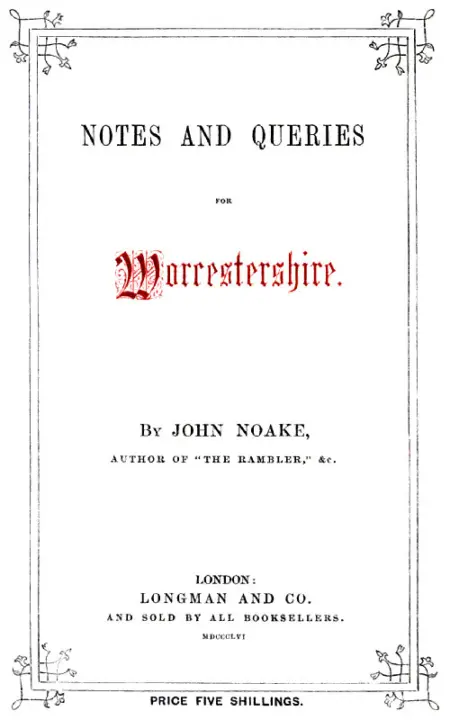
"Notes and Queries for Worcestershire" by John Noake is a historical account written in the mid-19th century. The work serves as a compilation of various details about Worcestershire, shedding light on its history, customs, and social life. The author aims to create a more nuanced narrative of the county's past, moving beyond dry statistics to a richer understanding of the people and their experiences. At the start of the publication, the author expresses his anticipation that this installment will contribute to the understudied history of Worcestershire. He reflects on the limitations of prior historical approaches, emphasizing the need for detailed research into local customs, traditions, and social life. Noake insists that a collaborative effort is essential for a comprehensive account, suggesting that while his work is a modest beginning, it invites further inquiry into the county's rich heritage, aiming to illuminate the lives of its inhabitants across the centuries.
Introduction adapted from the source catalogue; source summaries may be automatically generated.
Free to read · English · 101,259 words · No account needed
MAKE TIME FOR A GOOD BOOK
On by default. Untick to stop anonymous reading totals. Each page counts after 10 seconds in view. How this works.
Anonymous counting is on unless you have switched it off.
The majority of the Worcestershire bells were cast by Rudhall, of Gloucester, and his successor, Mears; Chapman and Mears, of London, towards the close of the last century, and T. Mears, of London, in the present, also have their names in some places, as at King's Norton; but a correspondent says he has one of Mears' lists, and finds only nine of his peals in Worcestershire, viz., Dudley, peal of ten, weight of tenor, 21 cwt.; Stourbridge, eight, tenor, 19 cwt.; King's Norton, eight, tenor, 17 cwt.; St. John's, Worcester, six, tenor, 16 cwt.; Fladbury, six, tenor, 13 cwt.; Longdon, six, tenor, 12 cwt.; Cookley, six, tenor, 12 cwt.; Abberley, six, tenor, 9 cwt.; and Stone, six, tenor, 6 cwt. On the Tredington bells the names of G. Purdye and Mr. Bagly appear (seventeenth century). The Clent bells are by Bagly, whose services were much called into requisition in Warwickshire, and it is said by enthusiastic ringers that the bells cast by the Baglys are not to be surpassed in the country: they are all light peals, with fine musical tones, and run down as true as a musical instrument can do. At Tanworth, Warwickshire, the tenor bell has this inscription: "Richard Saunders of Bromsgrove made we all, 1710." How long the trade of bell-founding existed at Bromsgrove does not appear, but the bells of St. Helen's (1706), St. John's (1710), and St. Nicholas (1715), were founded there by Mr. Saunders. The Worcester foundry, which had existed in Silver Street in the seventeenth century,[9] had probably closed at the above period when Bromsgrove was resorted to. On the third bell of Himbleton church is the inscription:
[9] There is a place in that street still called Bellfounders' Yard.
"John Martin, of Worcester, he made wee,
Be it known to all that do wee see. 1675."
The Worcester foundry is also traceable on the bells of St. Michael's, Worcester, Bishampton, Himbleton, and Grafton Flyford, from 1660 to 1676; John Martin, of St. Martin's, being the founder.
The Bretforton peal is by Westcote, of Bristol, 1823; Lester and Peck, of London, founded some of the Halesowen bells a century ago. Joseph Smith, of Edgbaston, and R. Wells, of Aldbourne, others of them, at the beginning and end of the same century. The old peal of bells, prior to these, at Halesowen, it appears from the churchwardens' accounts, were completed in 1518, and the bell-founder came from Nottingham. Joseph Smith, of Edgbaston, also founded the Alvechurch and Northfield bells--the first in 1711, the latter in 1730. On the third bell at Alvechurch is the following euphonious couplet:
"If you would know when we was run,
It was March the twenty-second, 1711."
Your reading position is saved on this browser. Take it to another device with a library code. Reading pages adapt to text, rather than matching a printed edition.
BEHIND THE BOOK
This eBook is for the use of anyone anywhere in the United States and most other parts of the world at no cost and with almost no restrictions whatsoever. You may copy it, give it away or re-use it under the terms of the Project Gutenberg License included with this eBook or online at www.gutenberg.org. If you are not located in the United States, you will have to check the laws of the country where you are located before using this eBook. Read the source licence.
The original source file, including credits and licence, is retained by this library. Request an original-format copy at no charge. Please include the book title and Project Gutenberg identifier #47105.
KEEP YOUR CURIOSITY GOING
Cécile Tormay

Moritz Busch
John L. Ransom
Frances Wright
Cécile Tormay

Mabel Potter Daggett