THE CLASSIC COLLECTION✦A Few More VersesCLASSIC FREE BOOKS
A Few More Verses
Susan Coolidge
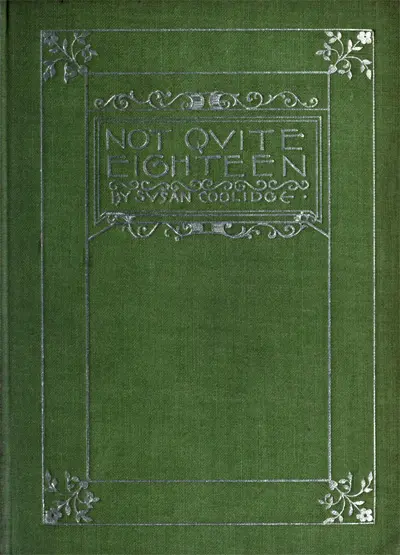
THE CLASSIC COLLECTION · 1894
"Not Quite Eighteen" by Susan Coolidge is a children's novel written in the late 19th century. The story follows the lives of two main characters, Hester and Roger Gale, who face challenges related to their family’s financial struggles and the search for lost dreams, particularly through the lens of childhood adventures and imagination. The narrative captures the essence of innocence, family bonds, and the quest for better opportunities, blending fantasy elements with a realistic portrayal of rural life. The opening of the novel introduces us to Midsummer's Day, described as a magical time brimming with beauty and possibility. We meet Hiram Swift, who drives summer boarders past the Gale family's run-down farmhouse, linking it to a local legend about a lost silver mine, which piques the interest of a curious girl in the wagon. Meanwhile, we are introduced to little Hester Gale, who cherishes her wooden doll, Bunny, as her beloved companion. Hester's quest to find Bunny after losing her leads to a series of events that intertwine family dynamics, personal aspirations, and unexpected discoveries. The stage is set for a story that explores the tension between desire and reality, showcasing the innocence of childhood against the backdrop of adult challenges.
Introduction adapted from the source catalogue; source summaries may be automatically generated.
Free to read · English · 44,003 words · No account needed
MAKE TIME FOR A GOOD BOOK
On by default. Untick to stop anonymous reading totals. Each page counts after 10 seconds in view. How this works.
Anonymous counting is on unless you have switched it off.
Dolly was youngest of the family,--a thin, wiry child, tall for her years, with a brown bang lying like a thatch over a pair of bright inquisitive eyes, and a thick pig-tail braided down her back. Phyllis, the next in age, was short and fat; then came Harry, then Erma, just sixteen (named after a German great-grandmother), and, last of all, Jack, tallest and jolliest of the group, who had just "passed his preliminaries," and would enter college next year. Mrs. Ware might be excused for the little air of motherly pride with which she gazed at her five. They were fine children, all of them,--frank, affectionate, generous, with bright minds and healthy bodies.
"Presence of mind sometimes means absence of body," remarked Jack, in answer to Dolly's question.
"I was speaking to Mamma," said Dolly, with dignity. "I wasn't asking
you."
"I am aware of the fact, but I overlooked the formality, for once. What makes you want to know, midget?"
"There was a story in the paper about a girl who hid the kerosene can when the new cook came, and it said she showed true presence of mind," replied Dolly.
"Oh, that was only fun! It didn't mean anything."
"Isn't there any such thing, then?"
"Why, of course there is. Picking up a shell just before it bursts in a hospital tent, and throwing it out of the door, is presence of mind."
"Yes, and tying a string round the right place on your leg when you've cut an artery," added Harry, eagerly.
"Swallowing a quart of whiskey when a rattlesnake bites you," suggested
Jack.
"Saving the silver, instead of the waste-paper basket, when the house is
on fire," put in Erma.
Dolly looked from one to the other.
"What funny things!" she cried. "I don't believe you know anything about it. Mamma, tell me what it really means."
"I think," said Mrs. Ware, in those gentle tones to which her children always listened, "that presence of mind means keeping cool, and having your wits about you, at critical moments. Our minds--our reasoning faculties, that is--are apt to be stunned or shocked when we are suddenly frightened or excited; they leave us, and go away, as it were, and it is only afterward that we pick ourselves up, and realize what we ought to have done. To act coolly and sensibly in the face of danger is a fine thing, and one to be proud of."
"Should you be proud of me if I showed presence of mind?" asked Dolly, leaning her arms on her mother's lap.
"Very proud," replied Mrs. Ware, smiling as she stroked the brown
head,--"very proud, indeed."
Your reading position is saved on this browser. Take it to another device with a library code. Reading pages adapt to text, rather than matching a printed edition.
Susan Coolidge
Susan Coolidge
Susan Coolidge
Susan Coolidge
BEHIND THE BOOK
This eBook is for the use of anyone anywhere in the United States and most other parts of the world at no cost and with almost no restrictions whatsoever. You may copy it, give it away or re-use it under the terms of the Project Gutenberg License included with this eBook or online at www.gutenberg.org. If you are not located in the United States, you will have to check the laws of the country where you are located before using this eBook. Read the source licence.
The original source file, including credits and licence, is retained by this library. Request an original-format copy at no charge. Please include the book title and Project Gutenberg identifier #33927.
KEEP YOUR CURIOSITY GOING
Coulson Kernahan

Maurice Baring
Frances Wright
Cécile Tormay

Frederic Jesup Stimson

W. H. P. (William Henry Pope) Jarvis