THE CLASSIC COLLECTION✦A Few More VersesCLASSIC FREE BOOKS
A Few More Verses
Susan Coolidge
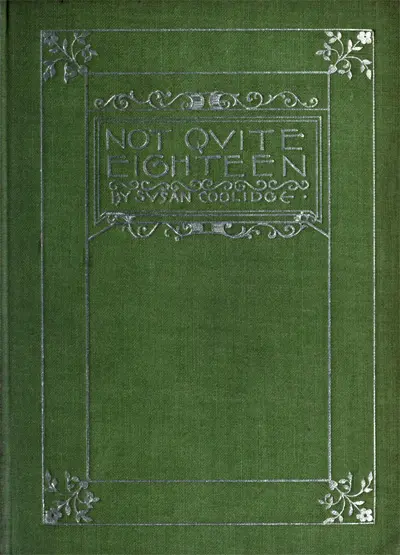
THE CLASSIC COLLECTION · 1894
"Not Quite Eighteen" by Susan Coolidge is a children's novel written in the late 19th century. The story follows the lives of two main characters, Hester and Roger Gale, who face challenges related to their family’s financial struggles and the search for lost dreams, particularly through the lens of childhood adventures and imagination. The narrative captures the essence of innocence, family bonds, and the quest for better opportunities, blending fantasy elements with a realistic portrayal of rural life. The opening of the novel introduces us to Midsummer's Day, described as a magical time brimming with beauty and possibility. We meet Hiram Swift, who drives summer boarders past the Gale family's run-down farmhouse, linking it to a local legend about a lost silver mine, which piques the interest of a curious girl in the wagon. Meanwhile, we are introduced to little Hester Gale, who cherishes her wooden doll, Bunny, as her beloved companion. Hester's quest to find Bunny after losing her leads to a series of events that intertwine family dynamics, personal aspirations, and unexpected discoveries. The stage is set for a story that explores the tension between desire and reality, showcasing the innocence of childhood against the backdrop of adult challenges.
Introduction adapted from the source catalogue; source summaries may be automatically generated.
Free to read · English · 44,003 words · No account needed
MAKE TIME FOR A GOOD BOOK
On by default. Untick to stop anonymous reading totals. Each page counts after 10 seconds in view. How this works.
Anonymous counting is on unless you have switched it off.
The subject of dispute was a parasol,--a dark blue one, trimmed with fringe, and with an ivory handle. The two little girls who were discussing it were Alice Hoare and her sister Madge. It was Madge's birthday, and the parasol was one of her presents.
The dispute continued.
"I wish you wouldn't always say that your things are better than any one else's," said Alice. "It's ex-exaspering to talk like that, and Mamma said when we exasperated it was almost as bad as telling lies."
"She didn't say "exasperate." That wasn't the word at all; and this is the sweetest, dearest, most perfectly beautiful parasol in the world, a great deal prettier than your green one."
"Yes, so it is," confessed candid Alice. "Mine is quite old now. This is younger, and, besides, the top of mine is broken off. But yours isn't really any prettier than Mary's."
"It is too! It's a great deal more beautiful and a great deal more
fascinating."
"What is that which is so fascinating?" asked their sister Mary, coming into the room. "The new parasol? My! that is strong language to use about a parasol. It should at least be an umbrella, I think. See, Madge, here is another birthday gift."
It was a gilt cage, with a pair of Java sparrows. "Oh, lovely! delicious!" cried Madge, jumping up and down. "I think this is the best birthday that ever was! Are they from you, Mary, darling? Thank you ever so much! They are the most perfectly beautiful things I ever saw."
"The parasol was the most beautiful just now," observed Alice.
"Oh, these are much beautifuller than that, because they are alive," replied Madge, giving her oldest sister a rapturous squeeze.
"I wish you'd make me a birthday present in return," said Mary. "I wish you'd drop that bad habit of exaggerating everything you like, and everything you don't like. All your 'bads' are 'dreadfuls,'--all your pinks are scarlets."
"I don't know what you mean," said Madge, puzzled and offended.
"It's only what Mamma has often spoken to you about, dear Madgie. It is saying more than is quite true, and more than you quite feel. I am sure you don't mean to be false, but people who are not used to you might think you so."
"It's because I like things so much."
"No, for when you don't like them, it's just as bad. I have heard you say fifty times, at least, 'It is the horridest thing I ever saw,' and you know there couldn't be fifty 'horridest' things."
"But you all know what I mean."
Your reading position is saved on this browser. Take it to another device with a library code. Reading pages adapt to text, rather than matching a printed edition.
Susan Coolidge
Susan Coolidge
Susan Coolidge
Susan Coolidge
BEHIND THE BOOK
This eBook is for the use of anyone anywhere in the United States and most other parts of the world at no cost and with almost no restrictions whatsoever. You may copy it, give it away or re-use it under the terms of the Project Gutenberg License included with this eBook or online at www.gutenberg.org. If you are not located in the United States, you will have to check the laws of the country where you are located before using this eBook. Read the source licence.
The original source file, including credits and licence, is retained by this library. Request an original-format copy at no charge. Please include the book title and Project Gutenberg identifier #33927.
KEEP YOUR CURIOSITY GOING
Coulson Kernahan

Maurice Baring
Frances Wright
Cécile Tormay

Frederic Jesup Stimson

W. H. P. (William Henry Pope) Jarvis