
Switch off
Oliver Optic
THE CLASSIC COLLECTION · 1872
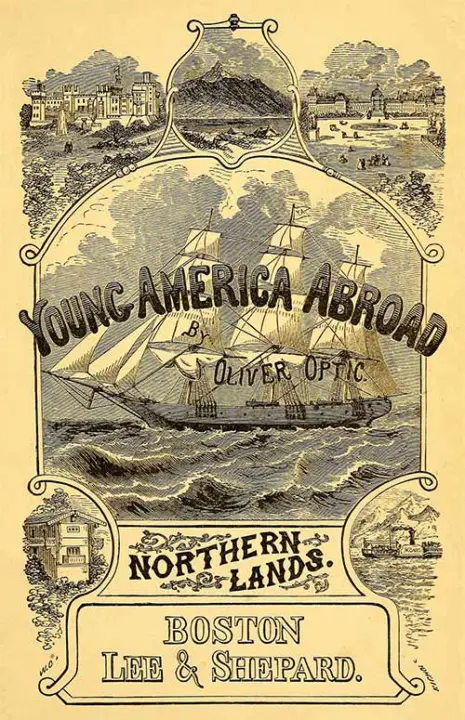
"Northern Lands; Or, Young America in Russia and Prussia" by Oliver Optic is a historical account and adventure story written in the late 19th century. The book focuses on the experiences of a group of young American tourists aboard the Academy Squadron as they travel through the Baltic region, exploring the cultural landscape of Russia and Prussia. Guided by their adventures, the narrative ultimately provides commentary on political ideals and social dynamics, especially as they relate to youth and growing up. The opening of the story introduces readers to a group of young cadets enjoying a picnic on an island in the Baltic, where heated discussions revolve around the leadership hierarchy aboard their ship and a proposed electoral reform to select officers. Characters like De Forrest and Beckwith express their concerns about their shipmate Cantwell's suitability for leadership, sparking a debate on merit, power, and fairness among their peers. The tensions among students over rank and suitability for command illustrate a larger commentary on political systems and personal responsibility, setting the stage for the ensuing adventures and insights that will unfold as their journey continues.
Introduction adapted from the source catalogue; source summaries may be automatically generated.
Free to read · English · 93,780 words · No account needed
MAKE TIME FOR A GOOD BOOK
On by default. Untick to stop anonymous reading totals. Each page counts after 10 seconds in view. How this works.
Anonymous counting is on unless you have switched it off.
"This powerful prince divided his empire among his twelve sons, who, as usual in such cases, went to war, and Sviatopolk I., after murdering three of his brothers, obtained the throne. In 1019, Yaroslaf, the brother who had received Novgorod as his portion, procuring the assistance of Henry II. of Germany and of the King of Poland, after a battle on the Alma which lasted three days, wrested the crown from Sviatopolk, who died while fleeing into Poland. Another brother compelled Yaroslaf to divide the empire with him; but at the death of the former it was united again, in 1036. He was a powerful prince, and greatly enlarged his territory. He built many churches, encouraged learning, and caused the first code of Russian laws to be compiled. At his death he gave the empire to his four sons, requiring the three younger to be subject to the eldest; but his will was disregarded, and Russia became a confederacy, instead of an empire, with four rulers. The division and anarchy in the country enabled the Poles, Lithuanians, Danes, and others to wrest large territories in the west from the Russians. The progress in civilization which had continued during the two preceding reigns was barred; famine and pestilence raged in the land, and Genghis Khan, with vast hordes of Asiatics, invaded and conquered the country. From the year 1054, when the civil wars commenced, to 1462, when the Tartar power and influence were finally broken, Russia was torn with dissensions, overrun by her powerful neighbors, often visited by famine and pestilence; yet within this period are recorded many great events. Moscow was founded in 1147; Alexander, Grand Prince of Novgorod, won a great victory over the Swedes and others on the Neva, which gives him the name of Alexander Nevski.
"With Ivan III., or Ivan the Great, in 1462, begins a more glorious period of Russian history. He was the Grand Prince of Moscow, and conquered Novgorod, Kazan, Perm, Tver, and other principalities. He married Sophia, niece of the Greek emperor Constantine XIII., on which occasion he adopted the double-headed black eagle as his standard, and was the first prince who claimed the title of 'Autocrat of all the Russias.' He was succeeded by his son Basil IV., in whose reign the empire was still further united, and the Tartars completely subjugated at Kazan. Basil was followed, in 1533, by his son Ivan IV., only three years old at his accession. During his minority the empire was torn by anarchy and civil war; but when Ivan was only fourteen years old, he seized the reins of power, and commenced the career of cruelty and tyranny, which gave him the name of the 'Terrible.' But he did more for Russia than any of his predecessors. He conquered Kazan again, which had asserted its independence during his minority, added Astrakhan, the Crimea, Siberia, and the country of the Don, to his empire. He encouraged commerce, and established a printing office in Moscow. He was a cruel tyrant, and caused the massacre of sixty thousand people in Novgorod, and thousands in Moscow and Tver. Finally he murdered his eldest son, and the only one who had the capacity to succeed him, with his own hand. His son Fedor, who came to the throne at his death, was weak in body and mind. His brother-in-law, Boris Godunoff, was an ambitious man, and sought to obtain the crown. He put out of the way several rivals and members of the imperial family, and finally accomplished his purpose in 1605; but his cruelty caused great dissatisfaction, and the people were ripe for revolt. At this time appeared in Poland a very remarkable impostor, claiming to be the Czarovitz of Russia, who was more successful than the pretenders that sought the crown of England. In carrying out his ambitious project, Boris Godunoff had procured the assassination of Dimitri, the youngest son of Ivan the Terrible, a lad only ten years old. A Polish prince, irritated by the negligence of a young man who had been in his employ but a short time, gave him a blow on the side of the head, which was accompanied by a very opprobrious epithet.
Your reading position is saved on this browser. Take it to another device with a library code. Reading pages adapt to text, rather than matching a printed edition.
BEHIND THE BOOK
This eBook is for the use of anyone anywhere in the United States and most other parts of the world at no cost and with almost no restrictions whatsoever. You may copy it, give it away or re-use it under the terms of the Project Gutenberg License included with this eBook or online at www.gutenberg.org. If you are not located in the United States, you will have to check the laws of the country where you are located before using this eBook. Read the source licence.
The original source file, including credits and licence, is retained by this library. Request an original-format copy at no charge. Please include the book title and Project Gutenberg identifier #54059.
KEEP YOUR CURIOSITY GOING
Wilfrid Scawen Blunt
Wilfrid Scawen Blunt

E. W. (Edgar Watson) Howe
Cécile Tormay

Moritz Busch
Coulson Kernahan
