
Switch off
Oliver Optic
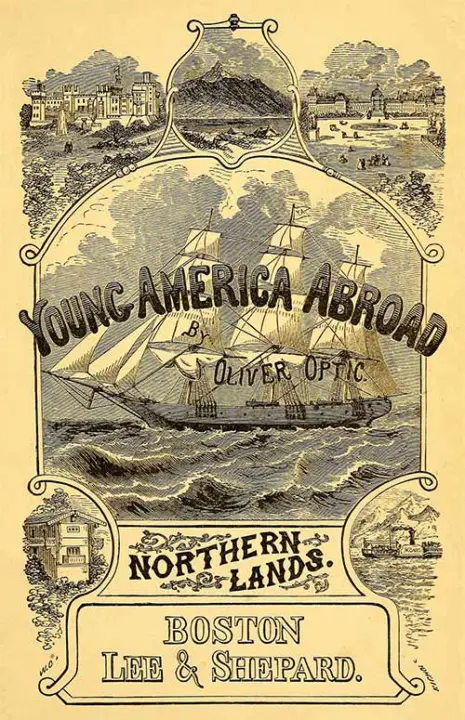
THE CLASSIC COLLECTION · 1872
"Northern Lands; Or, Young America in Russia and Prussia" by Oliver Optic is a historical account and adventure story written in the late 19th century. The book focuses on the experiences of a group of young American tourists aboard the Academy Squadron as they travel through the Baltic region, exploring the cultural landscape of Russia and Prussia. Guided by their adventures, the narrative ultimately provides commentary on political ideals and social dynamics, especially as they relate to youth and growing up. The opening of the story introduces readers to a group of young cadets enjoying a picnic on an island in the Baltic, where heated discussions revolve around the leadership hierarchy aboard their ship and a proposed electoral reform to select officers. Characters like De Forrest and Beckwith express their concerns about their shipmate Cantwell's suitability for leadership, sparking a debate on merit, power, and fairness among their peers. The tensions among students over rank and suitability for command illustrate a larger commentary on political systems and personal responsibility, setting the stage for the ensuing adventures and insights that will unfold as their journey continues.
Introduction adapted from the source catalogue; source summaries may be automatically generated.
Free to read · English · 93,780 words · No account needed
MAKE TIME FOR A GOOD BOOK
On by default. Untick to stop anonymous reading totals. Each page counts after 10 seconds in view. How this works.
Anonymous counting is on unless you have switched it off.
"Cantwell is not a member of it, sir," replied Wainwright. "It was got up simply to defeat the plan of the officers to control the election. At the meeting on the island to-day, not a word was said about the elections in any way. If the nominations are fairly made next time, I don't believe the society will meddle with them."
"I hope not," added Mr. Lowington.
"If the officers nominate in the cabin, without consulting the seamen, very likely the society will do something."
"In that case, I should not object; for a secret society in the steerage is no worse than one in the cabin."
"But what is the society for?" asked De Forrest, dissatisfied with the
situation.
"Simply for fun, for amusement--nothing else." replied Wainwright.
"Where do you meet?" asked the principal, curiously.
"We met in that old fish-house on the island. We have no place in the ship. I was going to ask you, sir, if we might fit up a place in the hold," added Wainwright.
"The hold is not a fit place for any meeting. I can do better, if assured that your society is a proper one."
"I think it is, sir. There is nothing in it contrary to the rules of the ship. In all the colleges there are secret societies, such as the Φ. Β. Κ."
"You may have the main cabin one evening in a week."
"Thank you, sir. We shall be very grateful to you," replied Wainwright, utterly confounded by the generosity of the principal.
De Forrest was disgusted, and went away with "a flea in his ear." Of course the action of the principal was immediately known among all the officers. Cumberland only laughed, while others looked grave, and proposed that they should get up a society among the officers. The proposition was hailed with a shout of satisfaction, and a committee appointed to prepare a plan. Wainwright hastened to Scott with the pleasant news he had to tell, and the main cabin was obtained for that evening. As the instructors spent most of their unoccupied time on deck, this was no hardship to them. The lodge opened again, with those present who had taken the second degree. In older to make the thing more ludicrous than before, the officers enveloped themselves in blankets, sheets, and such other fantastic apparel as they could lay hands upon, and each one placed his small tin wash-bowl on his head, the handle of which stuck out like a queue behind. The curtain over the skylight was drawn so that no one on deck could see into the cabin. The pantry was built out from the bulkhead, which separated it from the main cabin, into the steerage, forming a space, or gangway, four feet wide, between the pantry and the mess-rooms, from winch one of the doors opened into the cabin. A blanket was extended across from the front of the pantry, before the starboard door, making an apartment four feet square, in which the O. L. M. was stationed. The candidate was admitted to this place, and when the bag was drawn over his head, he was conducted into the lodge. The ceremonies were performed with even more spirit than in the old fish-house, and the roars of laughter that went up from the main cabin assured those within hearing that the members were having a good time. All the rest in the ship who had taken their first degree were "elevated" to the second on this occasion. At the close of the initiation, a vote of thanks to the principal was unanimously passed, for his kindness in granting the society the use of the cabin; and after some debate, he was also elected an honorary member of the order, with the privilege of attending any and all its meetings--a privilege of which, however, he magnanimously declined to avail himself.
Your reading position is saved on this browser. Take it to another device with a library code. Reading pages adapt to text, rather than matching a printed edition.
BEHIND THE BOOK
This eBook is for the use of anyone anywhere in the United States and most other parts of the world at no cost and with almost no restrictions whatsoever. You may copy it, give it away or re-use it under the terms of the Project Gutenberg License included with this eBook or online at www.gutenberg.org. If you are not located in the United States, you will have to check the laws of the country where you are located before using this eBook. Read the source licence.
The original source file, including credits and licence, is retained by this library. Request an original-format copy at no charge. Please include the book title and Project Gutenberg identifier #54059.
KEEP YOUR CURIOSITY GOING
Wilfrid Scawen Blunt
Wilfrid Scawen Blunt

E. W. (Edgar Watson) Howe
Cécile Tormay

Moritz Busch
Coulson Kernahan
