
Switch off
Oliver Optic
THE CLASSIC COLLECTION · 1872
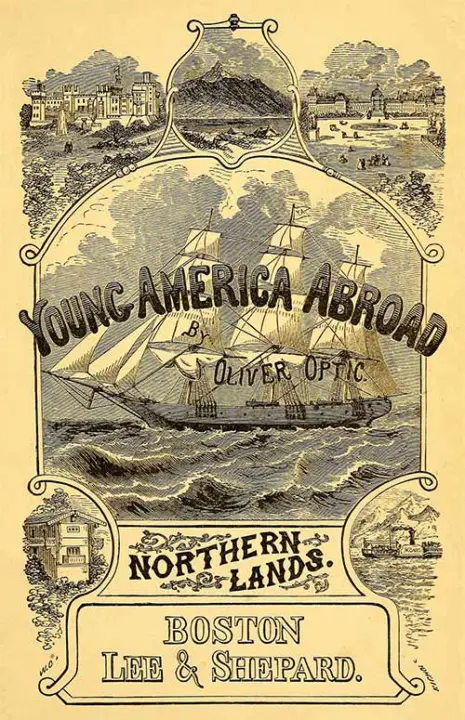
"Northern Lands; Or, Young America in Russia and Prussia" by Oliver Optic is a historical account and adventure story written in the late 19th century. The book focuses on the experiences of a group of young American tourists aboard the Academy Squadron as they travel through the Baltic region, exploring the cultural landscape of Russia and Prussia. Guided by their adventures, the narrative ultimately provides commentary on political ideals and social dynamics, especially as they relate to youth and growing up. The opening of the story introduces readers to a group of young cadets enjoying a picnic on an island in the Baltic, where heated discussions revolve around the leadership hierarchy aboard their ship and a proposed electoral reform to select officers. Characters like De Forrest and Beckwith express their concerns about their shipmate Cantwell's suitability for leadership, sparking a debate on merit, power, and fairness among their peers. The tensions among students over rank and suitability for command illustrate a larger commentary on political systems and personal responsibility, setting the stage for the ensuing adventures and insights that will unfold as their journey continues.
Introduction adapted from the source catalogue; source summaries may be automatically generated.
Free to read · English · 93,780 words · No account needed
MAKE TIME FOR A GOOD BOOK
On by default. Untick to stop anonymous reading totals. Each page counts after 10 seconds in view. How this works.
Anonymous counting is on unless you have switched it off.
"Ay, ay, sir! We captured him outside, and in spite of his frantic
struggles, have brought him before you to be examined," replied the R.
P. F.
"What is he?" demanded Scott, in gruff notes.
"A vile Indian."
"Hah!"
"A 'ticklarly vile Indian."
"When was he caught?"
"At six."
"Has he been searched?"
"Not yet."
"Does he confess?"
"Not yet."
"Clyde Blacklock, answer me truly," said Scott, solemnly. "Did you
steal it?"
"Answer him," said the candidate's conductor, in a low voice.
"Steal what?" asked Clyde.
"The bag out of which a faithless Brother of the Most Respectable Order of Bangwhangers let the cat," added the C. B., tragically.
"No, I didn't."
"Let him be searched!" continued Scott, in a sepulchral tone.
Whereupon the officers, who had silently gathered around the candidate, began to punch him in the ribs, and under the ears, not to hurt, but only to tickle him. As Clyde was sensitive in this direction, as almost anybody would be when taken by surprise, the effect was very decided, and the candidate wriggled, and squirmed, and roared.
"He has it I We have found it upon him!" said the R. P. F., suddenly.
"Hah!" cried Scott. "The vile Indian is guilty."
"Guilty!" responded all the other officers.
"Does he see it?" demanded the C. B.
"He don't see it."
"Let him see it!"
Then the R. P. F. and the L. P. F. seized the white cap by the corners, and jerked it violently from Clyde's head, and laid it on the floor before him, with the letters right side up to him. All the officers pointed at the cap, with the most extravagant expressions of surprise and indignation upon their faces.
"Behold the bag!" exclaimed the group, in concert.
"And it has our mark upon it," replied Scott, with indignation in his looks and tones. Then suddenly changing his voice and manner, he continued, very gently, "Brother Blacklock, this degree is founded upon the story of a vile Indian in the wilds of America. Some emigrants were travelling over the prairies of the great west, intending to settle in Nevada. One of them had a favorite Maltese cat, of which the whole party were very fond. They were very much afraid of losing the creature, and for greater security they carried her in a bag,--precisely like that just found upon you,--bearing upon it the initials of the owner's name, which was, in full, Andrew Thomas Vincent Iverson. For a guide they had a vile Indian, who, like all vile Indians, was very fond of whiskey. One night this vile Indian was particularly 'dry.' and wanted to 'wet his whistle' with fire-water. After the emigrants had gone to sleep, he searched the camp for some of his favorite beverage. He came across the bag containing the Maltese cat. As the contents thereof seemed to be lively, he thought it contained a bottle of whiskey. He opened the bag, and the cat leaped out, not whiskey; in other words, he let the cat out of the bag--at all times a very grave and terrible offence. When he saw what he had done, he was alarmed, and concealed the bag within his clothes, intending to make the emigrants believe that the cat had run away, carrying the bag with her. But, vile Indian that he was, his employers suspected him, and punching him in the ribs, they discovered the bag. Then they knew that he had let the cat out of the bag, and as the penalty of his crime, they compelled him to eat Bologna sausage until he couldn't help barking. Brother Blacklock, this solemn ceremony is intended to convince you that, should you ever let the cat out of the bag, you will be subjected to the same penalty as the vile Indian, who was A 'Ticklarly Vile Indian. This bag bears our mark,--AT-VI.,--which relates to the hour you were caught--at six. It also means A 'Ticklarly Vile Indian, and alludes, besides, to the rallying number of our order--AT., eighty; VI., six. Brother Blacklock, it is your next move. Take a seat where you find one."
Your reading position is saved on this browser. Take it to another device with a library code. Reading pages adapt to text, rather than matching a printed edition.
BEHIND THE BOOK
This eBook is for the use of anyone anywhere in the United States and most other parts of the world at no cost and with almost no restrictions whatsoever. You may copy it, give it away or re-use it under the terms of the Project Gutenberg License included with this eBook or online at www.gutenberg.org. If you are not located in the United States, you will have to check the laws of the country where you are located before using this eBook. Read the source licence.
The original source file, including credits and licence, is retained by this library. Request an original-format copy at no charge. Please include the book title and Project Gutenberg identifier #54059.
KEEP YOUR CURIOSITY GOING
Wilfrid Scawen Blunt
Wilfrid Scawen Blunt

E. W. (Edgar Watson) Howe
Cécile Tormay

Moritz Busch
Coulson Kernahan
