
Switch off
Oliver Optic
THE CLASSIC COLLECTION · 1872
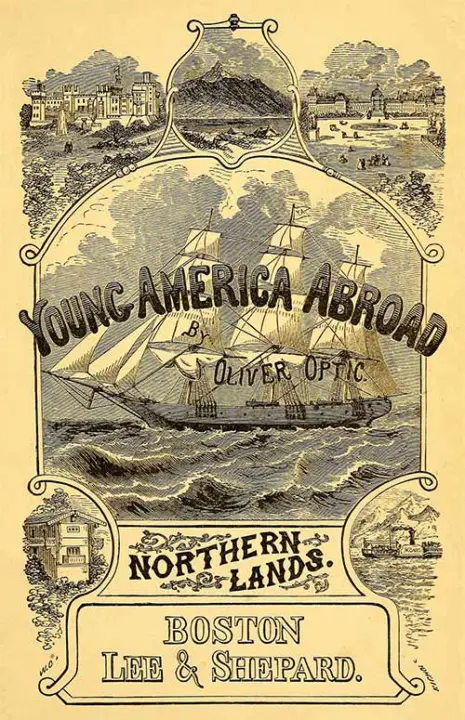
"Northern Lands; Or, Young America in Russia and Prussia" by Oliver Optic is a historical account and adventure story written in the late 19th century. The book focuses on the experiences of a group of young American tourists aboard the Academy Squadron as they travel through the Baltic region, exploring the cultural landscape of Russia and Prussia. Guided by their adventures, the narrative ultimately provides commentary on political ideals and social dynamics, especially as they relate to youth and growing up. The opening of the story introduces readers to a group of young cadets enjoying a picnic on an island in the Baltic, where heated discussions revolve around the leadership hierarchy aboard their ship and a proposed electoral reform to select officers. Characters like De Forrest and Beckwith express their concerns about their shipmate Cantwell's suitability for leadership, sparking a debate on merit, power, and fairness among their peers. The tensions among students over rank and suitability for command illustrate a larger commentary on political systems and personal responsibility, setting the stage for the ensuing adventures and insights that will unfold as their journey continues.
Introduction adapted from the source catalogue; source summaries may be automatically generated.
Free to read · English · 93,780 words · No account needed
MAKE TIME FOR A GOOD BOOK
On by default. Untick to stop anonymous reading totals. Each page counts after 10 seconds in view. How this works.
Anonymous counting is on unless you have switched it off.
"Very well; I consent to the change of time; and the consorts shall be notified at once," replied the principal, who went to the cabin, wrote two notes, and sent them to the vice-principals by the adult forward officers.
"Now, let us understand the method of proceeding thoroughly," continued Mr. Lowington, as he returned to his position on the hatch. "Only a captain is eligible to the office of commodore, or the present incumbent may be reëlected. Only the present cabin officers can be candidates for the five highest offices in the ship; and agreeably to the proviso relating to the ship, no officer who falls below the rank of No. 16 is eligible to any office, but must return to the steerage. Are these rules fully understood?"
"Yes, sir," responded the crowd.
"Further, if any student who is now the commodore, the captain, or a lieutenant, should not be elected to one of these positions, what would his rank be for next month?"
"Just the same as it would have been, if the new plan had not been
adopted," replied De Forrest.
"I am glad you understand it," added the principal, with a significant look at the third lieutenant. "I will now read the merit-roll, in order that you may know who are, and who are not, eligible to the elective offices. Lincoln is number 1; Cumberland, 2; Norwood, 3; Judson, 4; Murray, 5; Cantwell, 6; Sheridan, 7; Ryder, 8; Vroome, 9; Beckwith, 10; De Forrest, 11; Wainwright, 12; Jones, 13; Orlof, 14; Messenger, 15; Brown, 16. All but three of these may be candidates for the first six offices; and those not elected to higher positions will take their rank by the merit-roll."
Three of the cabin officers had dropped into the steerage, and three in the steerage had risen to the cabin; and when the names of the latter were read, they were greeted with earnest applause. The rest of the names on the roll were read, and the ship's company dismissed. The Novelty printing presses were again in demand. Scott obtained one, and De Forrest the other; and so rapidly was the printing of the ballots accomplished, that by ten o'clock the required number were printed. Promptly at six bells, or eleven o'clock, the ship's company were piped to muster again. The principal made careful arrangements for a fair vote. The box was placed on a water cask, and on each side of it one of the instructors, to see that no one put in more than one ballot. The students were then formed in a single line, on the starboard side, and required to march around the box, deposit their votes, and then to come round upon the port side, the forward officers standing amidships to prevent any from passing over and voting a second time. The principal was aware that the most intense excitement pervaded the crew, and he deemed it proper, even for the appearances' sake, to guard against "repeaters" and "ballot stuffers." One officer and two seamen were appointed to count the votes, and when all had deposited their ballots, the committee, attended by the two instructors, retired to the main cabin to perform their duty. While they were thus engaged, a boat from the Josephine, and another from the Tritonia, brought the result of the voting in these vessels to the ship. The returns were in sealed envelopes, and were sent down to the committee. In a short time the votes were counted, the returns from the consorts added, and the whole verified by the instructors present. Murray, the officer on the committee who had been named first was to make the report.
Your reading position is saved on this browser. Take it to another device with a library code. Reading pages adapt to text, rather than matching a printed edition.
BEHIND THE BOOK
This eBook is for the use of anyone anywhere in the United States and most other parts of the world at no cost and with almost no restrictions whatsoever. You may copy it, give it away or re-use it under the terms of the Project Gutenberg License included with this eBook or online at www.gutenberg.org. If you are not located in the United States, you will have to check the laws of the country where you are located before using this eBook. Read the source licence.
The original source file, including credits and licence, is retained by this library. Request an original-format copy at no charge. Please include the book title and Project Gutenberg identifier #54059.
KEEP YOUR CURIOSITY GOING
Wilfrid Scawen Blunt
Wilfrid Scawen Blunt

E. W. (Edgar Watson) Howe
Cécile Tormay

Moritz Busch
Coulson Kernahan
