
Switch off
Oliver Optic
THE CLASSIC COLLECTION · 1872
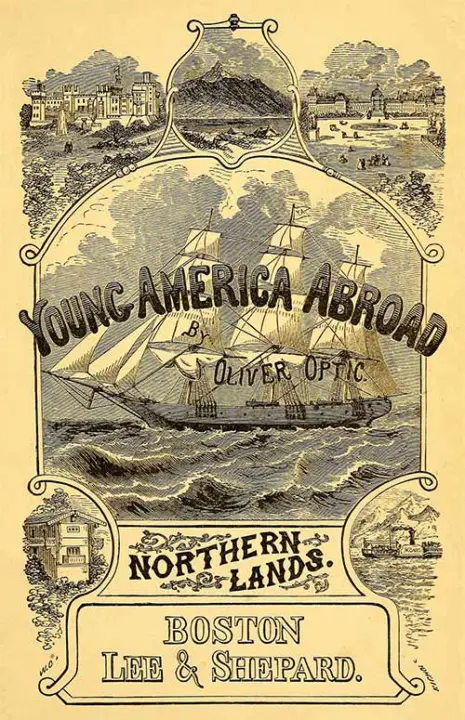
"Northern Lands; Or, Young America in Russia and Prussia" by Oliver Optic is a historical account and adventure story written in the late 19th century. The book focuses on the experiences of a group of young American tourists aboard the Academy Squadron as they travel through the Baltic region, exploring the cultural landscape of Russia and Prussia. Guided by their adventures, the narrative ultimately provides commentary on political ideals and social dynamics, especially as they relate to youth and growing up. The opening of the story introduces readers to a group of young cadets enjoying a picnic on an island in the Baltic, where heated discussions revolve around the leadership hierarchy aboard their ship and a proposed electoral reform to select officers. Characters like De Forrest and Beckwith express their concerns about their shipmate Cantwell's suitability for leadership, sparking a debate on merit, power, and fairness among their peers. The tensions among students over rank and suitability for command illustrate a larger commentary on political systems and personal responsibility, setting the stage for the ensuing adventures and insights that will unfold as their journey continues.
Introduction adapted from the source catalogue; source summaries may be automatically generated.
Free to read · English · 93,780 words · No account needed
MAKE TIME FOR A GOOD BOOK
On by default. Untick to stop anonymous reading totals. Each page counts after 10 seconds in view. How this works.
Anonymous counting is on unless you have switched it off.
"I say, Longwood, I want you to go for the independent ticket," said De Forrest, addressing one of the students who had declined to join the Bangwhangers.
"The opposition have just formed a secret society, and all its members are pledged to vote for Cantwell," replied Longwood.
"Cantwell! nonsense! He can't be elected to any office."
"No use; the fellows know him too well. We had a meeting in the cabin, and there will be two tickets. This will be the winning one;" and the third lieutenant handed Longwood one of the printed ballots.
"What's the other ticket?"
"The present officers; but I have just found out that they are taking my name off the ticket, and putting on Murray's. What do you think of that? Is it fair play?"
"Well, I don't know; but if you are working against the regular ticket, you can't expect its friends to go for you," replied Longwood.
"But they want to shove me down, and I hope my friends won't let them do it. I got up this plan, you know, but the fellows don't seem to give me any credit for it. Vote this ticket--won't you?"
"I'll see," answered the voter, as the candidate passed on to another.
The first lieutenant, Judson, knowing the influence of Scott among the crew, went to him the moment he came on board, to present the claims of the regular ticket.
"I'm a Cantwell man," replied Scott.
"It's no use to go for him; he can't be elected," said Judson.
"Who knows?" added Scott.
"We have had a meeting in the cabin, and have regularly nominated a
ticket."
"Probably it didn't occur to you that the crew had any right to meddle
with the matter."
"Yes; we considered the subject; but we hadn't time to call a meeting of the whole ship's company."
"Time is short," laughed Scott.
"If the fellows in the steerage wish it, perhaps we can put Cantwell on the regular ticket as fourth lieutenant, instead of Murray."
"I am not authorized to speak for our fellows; and I don't know that they would vote your ticket even if you put Cantwell's name on it."
"Cantwell's name wouldn't strengthen our ticket at all."
"Perhaps not."
Scott took one of the ballots, but would not even promise to consider
it.
"The officers have had a caucus in the cabin, Scott," said Cantwell.
"So Mr. Judson informs me; and they haven't put your name on the
ticket?"
"No; of course I didn't expect them to do it. I told them the crew ought to be consulted, and Captain Lincoln tried to make a motion to that effect, but they wouldn't do it."
Your reading position is saved on this browser. Take it to another device with a library code. Reading pages adapt to text, rather than matching a printed edition.
BEHIND THE BOOK
This eBook is for the use of anyone anywhere in the United States and most other parts of the world at no cost and with almost no restrictions whatsoever. You may copy it, give it away or re-use it under the terms of the Project Gutenberg License included with this eBook or online at www.gutenberg.org. If you are not located in the United States, you will have to check the laws of the country where you are located before using this eBook. Read the source licence.
The original source file, including credits and licence, is retained by this library. Request an original-format copy at no charge. Please include the book title and Project Gutenberg identifier #54059.
KEEP YOUR CURIOSITY GOING
Wilfrid Scawen Blunt
Wilfrid Scawen Blunt

E. W. (Edgar Watson) Howe
Cécile Tormay

Moritz Busch
Coulson Kernahan
