
Switch off
Oliver Optic
THE CLASSIC COLLECTION · 1872
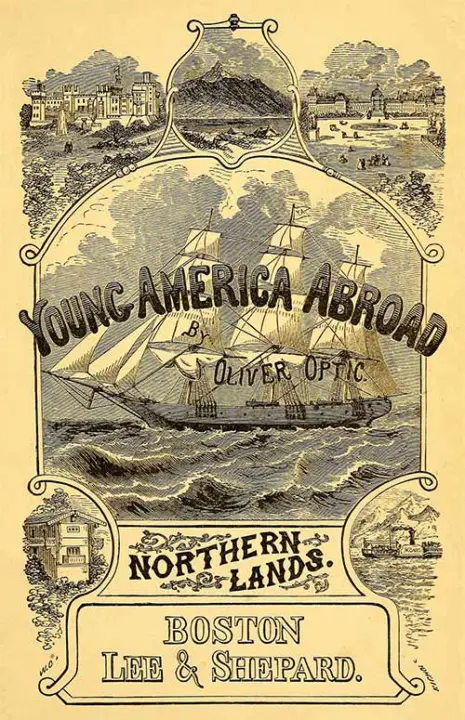
"Northern Lands; Or, Young America in Russia and Prussia" by Oliver Optic is a historical account and adventure story written in the late 19th century. The book focuses on the experiences of a group of young American tourists aboard the Academy Squadron as they travel through the Baltic region, exploring the cultural landscape of Russia and Prussia. Guided by their adventures, the narrative ultimately provides commentary on political ideals and social dynamics, especially as they relate to youth and growing up. The opening of the story introduces readers to a group of young cadets enjoying a picnic on an island in the Baltic, where heated discussions revolve around the leadership hierarchy aboard their ship and a proposed electoral reform to select officers. Characters like De Forrest and Beckwith express their concerns about their shipmate Cantwell's suitability for leadership, sparking a debate on merit, power, and fairness among their peers. The tensions among students over rank and suitability for command illustrate a larger commentary on political systems and personal responsibility, setting the stage for the ensuing adventures and insights that will unfold as their journey continues.
Introduction adapted from the source catalogue; source summaries may be automatically generated.
Free to read · English · 93,780 words · No account needed
MAKE TIME FOR A GOOD BOOK
On by default. Untick to stop anonymous reading totals. Each page counts after 10 seconds in view. How this works.
Anonymous counting is on unless you have switched it off.
"Eye, nose," answered Jones, drawing his finger over his right eye, and then placing it on the end of his nose, as he mentioned the name of each organ.
"Who knows?"
"Eighty noes."
"Right, Brother Bangwhanger; come to my arms," added Scott. "But the number is to be modified so as always to show the exact strength of this honorable and most respectable order."
The joker and his companion went through the dialogue several times, till every member was familiar with it, and then they practised it among themselves, amid peals of laughter.
"Now, Brother Bangwhangers, we are to elect officers. The first and highest is the C. B.," continued Scott.
"What does it mean?" asked half a dozen or more.
"I can't tell you till you take the second degree," replied the joker.
"Please to nominate."
"Scott!" shouted the members.
"Brother R. P. F., spare my modesty, and put the question," said the
joker.
Jones put the question, and of course Scott was unanimously elected.
"The next office, is the D. C. B. Please to nominate."
"Wainwright."
He was elected.
"Now for the Q. D."
"Hobbs." And he was chosen.
"The Y. D. K."
"Edson." And no one objected.
"The I. L. M."
"Merrill." And the vote was unanimous.
"The O. L. M."
"Hall." And he went in.
"The R. P. F."
"Jones." And the nomination was confirmed.
"The L. P. F."
"Brown." And he was the choice of the members.
"Eight officers, and they are all chosen. They will constitute the original second degree men, and, after they have been instructed, we shall be ready to admit you all to that enviable distinction. Now, the Q. D. and the Y. D. K. will count the members."
The number reported was eighty-two, which was nearly a majority of the
students in the squadron.
"Who knows?" called the C. B.
"Eighty-two knows," replied several.
"That's enough to put a veto on the De Forresters. Now, remember the solemn pledge you have taken, to vote for Cantwell, to say nothing to nobody, and never to eat soup with a darning-needle."
"To all these three
I do agree,"
responded the members, laughing.
"Although the last is the most important, the first is not to be neglected; and any member who knows, and don't do, shall be headed up in a mackerel kit and thrown overboard by the R. P. F., before he takes the second degree, in which the sublime mysteries of the order will be fully elucidated. Who knows?"
Scott coined jokes and puns for a few moments, to the intense enjoyment of the members; and by this time four of the outsiders desired to become members. They were immediately admitted.
Your reading position is saved on this browser. Take it to another device with a library code. Reading pages adapt to text, rather than matching a printed edition.
BEHIND THE BOOK
This eBook is for the use of anyone anywhere in the United States and most other parts of the world at no cost and with almost no restrictions whatsoever. You may copy it, give it away or re-use it under the terms of the Project Gutenberg License included with this eBook or online at www.gutenberg.org. If you are not located in the United States, you will have to check the laws of the country where you are located before using this eBook. Read the source licence.
The original source file, including credits and licence, is retained by this library. Request an original-format copy at no charge. Please include the book title and Project Gutenberg identifier #54059.
KEEP YOUR CURIOSITY GOING
Wilfrid Scawen Blunt
Wilfrid Scawen Blunt

E. W. (Edgar Watson) Howe
Cécile Tormay

Moritz Busch
Coulson Kernahan
