
Switch off
Oliver Optic
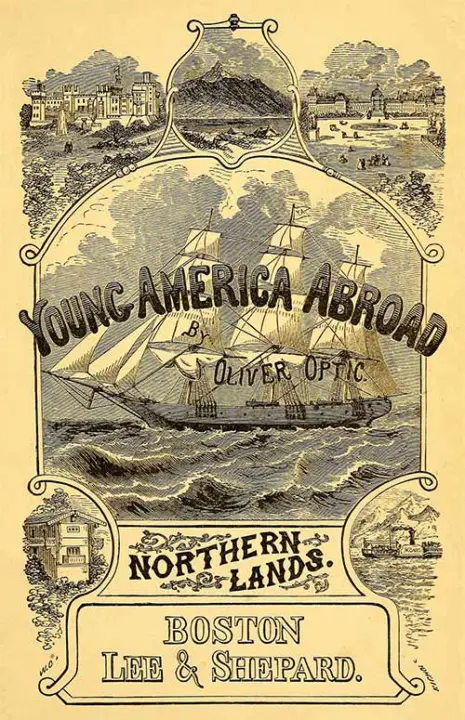
THE CLASSIC COLLECTION · 1872
"Northern Lands; Or, Young America in Russia and Prussia" by Oliver Optic is a historical account and adventure story written in the late 19th century. The book focuses on the experiences of a group of young American tourists aboard the Academy Squadron as they travel through the Baltic region, exploring the cultural landscape of Russia and Prussia. Guided by their adventures, the narrative ultimately provides commentary on political ideals and social dynamics, especially as they relate to youth and growing up. The opening of the story introduces readers to a group of young cadets enjoying a picnic on an island in the Baltic, where heated discussions revolve around the leadership hierarchy aboard their ship and a proposed electoral reform to select officers. Characters like De Forrest and Beckwith express their concerns about their shipmate Cantwell's suitability for leadership, sparking a debate on merit, power, and fairness among their peers. The tensions among students over rank and suitability for command illustrate a larger commentary on political systems and personal responsibility, setting the stage for the ensuing adventures and insights that will unfold as their journey continues.
Introduction adapted from the source catalogue; source summaries may be automatically generated.
Free to read · English · 93,780 words · No account needed
MAKE TIME FOR A GOOD BOOK
On by default. Untick to stop anonymous reading totals. Each page counts after 10 seconds in view. How this works.
Anonymous counting is on unless you have switched it off.
"The vote is doubted," said the chairman. "Those in favor of the motion will muster on the right of the chair; those opposed, on the left."
Cantwell then appointed four tellers, two from each side. Two of them, one for, and one against, the measure, were then directed to count the number on each side.
"Form a line, and march between the tellers to be counted," added the
chairman.
The business was done fairly, for each party was watching the other. The tellers on each side, after comparing their results, and finding that they agreed, were ready to report.
"How many in the affirmative?" asked the chairman.
"Eighty-eight," replied one of the tellers.
"In the negative?"
"Eighty-one," replied one of the tellers for that side.
"Eighty-eight having voted in the affirmative, and eighty-one in the negative, the motion is carried," said the chairman. "The next business in order is the appointment of the committee. How shall they be chosen?"
"By the chair," shouted Scott.
"Second the motion," added a student.
"It is moved and seconded that the committee be nominated by the chair."
"Mr. Chairman, it does not seem to me to be exactly right that the committee should be nominated by the chairman, who is opposed to the plan," suggested Beckwith.
"The chairman has not yet indicated whether he is in favor or opposed to the plan," said Cantwell, with a contemptuous curl of his lips and nose. "He intends to be entirely impartial in the discharge of his duty."
A shout of applause from the opposition followed this remark.
"The student who spoke against the plan mentioned the chairman in the same category with himself."
"The chairman did not authorize him to do so," answered Cantwell.
"Question!" shouted the jokers.
"The question is called for, which is, that the chairman nominate the
committee."
The vote was taken and doubted. The count, by tellers, as before, resulted in a tie; for several who had voted for the plan, moved by the apparent impartiality of the chairman, broke loose from party discipline, and voted with the other side.
"The chair votes in the affirmative, and the motion is carried," said Cantwell, as soon as the tellers had reported. "The chair nominates Lieutenants Judson and Norwood, and Mr. Scott. The question is upon the confirming of the nomination of the chair."
"Mr. Chairman, Scott is opposed to the plan which this meeting has voted to recommend," interposed De Forrest.
"The chair is aware of the fact, and for that reason nominated him," replied Cantwell. "The committee stand two in favor to one opposed to the plan."
Your reading position is saved on this browser. Take it to another device with a library code. Reading pages adapt to text, rather than matching a printed edition.
BEHIND THE BOOK
This eBook is for the use of anyone anywhere in the United States and most other parts of the world at no cost and with almost no restrictions whatsoever. You may copy it, give it away or re-use it under the terms of the Project Gutenberg License included with this eBook or online at www.gutenberg.org. If you are not located in the United States, you will have to check the laws of the country where you are located before using this eBook. Read the source licence.
The original source file, including credits and licence, is retained by this library. Request an original-format copy at no charge. Please include the book title and Project Gutenberg identifier #54059.
KEEP YOUR CURIOSITY GOING
Wilfrid Scawen Blunt
Wilfrid Scawen Blunt

E. W. (Edgar Watson) Howe
Cécile Tormay

Moritz Busch
Coulson Kernahan
